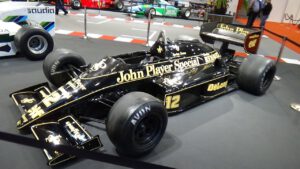
1986 – Lotus Renault T98 Ayrton Senna – Exterior and Interior – Essen Motor Show 2015
The 1986 Formula One season produced one of the most extreme racing machines ever driven, and one of the most iconic performances of Ayrton Senna. The Lotus Renault 98T combined immense turbocharged power with fragile reliability, creating a car that was both feared and admired. It became the platform for some of Senna’s most memorable qualifying laps and his legendary wet-weather mastery.
Technical Details
The Lotus Renault 98T was powered by the Renault EF15B 1.5-liter V6 turbocharged engine, a unit emblematic of the peak turbo era in Formula One. In race trim, the engine produced approximately 800–900 horsepower, but in qualifying configuration—thanks to extreme boost pressures—it could exceed 1,200 horsepower, making it one of the most powerful F1 engines ever used. Power delivery was notoriously abrupt, with significant turbo lag followed by explosive acceleration.
The car featured a carbon fiber monocoque chassis, a technology that had become standard in top-level racing by the mid-1980s. Suspension consisted of double wishbones with pushrod-actuated springs and dampers, optimized for aerodynamic efficiency and mechanical grip. The Lotus Renault T98 also incorporated advanced electronics for its time, including adjustable turbo boost settings controlled from the cockpit—an innovation that allowed drivers to manage power output during a lap.
Aerodynamics were highly developed, with large front and rear wings generating significant downforce, while the car’s low, sleek profile helped manage airflow. Braking was handled by carbon disc brakes, delivering strong stopping power under extreme conditions. However, fuel consumption limits imposed by regulations meant that drivers had to balance performance with efficiency, adding another layer of complexity to race strategy.
- Manufacturer: Lotus Cars / Team Lotus
- Model name: Lotus Renault 98T
- Year of manufacturing: 1986
Design
The Lotus Renault 98T is instantly recognizable for its striking black and gold livery, associated with the John Player Special sponsorship that defined an era of Formula One aesthetics. The car’s shape reflects the aerodynamic priorities of the mid-1980s: low, wide, and sculpted to channel airflow efficiently around the chassis and wings.
The front wing is broad and flat, designed to maximize downforce, while the rear wing rises prominently above the engine cover. The sidepods are relatively compact but carefully shaped to accommodate cooling for the turbocharged engine, which generated immense heat. Air intakes and ducting are integrated into the bodywork with functional precision rather than stylistic flourish.
The cockpit is tight and minimalist, emphasizing driver focus. Controls were limited but crucial, including the now-famous boost control knob that allowed Senna to adjust engine power on the fly. The overall design conveys a sense of raw purpose—every surface and component shaped by performance demands rather than comfort or ornamentation.
Historical Significance
The Lotus Renault 98T represents the final chapter of the turbocharged excess that defined Formula One in the 1980s. Built by Lotus Cars under the leadership of engineer Gérard Ducarouge, the car pushed the limits of what was technically possible within the regulations of the time.
During the 1986 season, Ayrton Senna secured eight pole positions with the 98T, showcasing his extraordinary qualifying ability. The combination of extreme engine power and Senna’s precision allowed the car to dominate single-lap performance. He also achieved two race victories, including a famous win at the 1986 Spanish Grand Prix, where he held off Nigel Mansell by just 0.014 seconds—one of the closest finishes in Formula One history.
The Lotus Renault T98 also highlighted the challenges of the turbo era. Strict fuel limits and reliability concerns meant that outright speed did not always translate into consistent race results. Nevertheless, the car remains a symbol of a period when engineering ambition often pushed beyond practical limits.
Quirks and Pop Culture
One of the most remarkable aspects of the Lotus Renault T98 was its adjustable turbo boost system, which gave drivers unprecedented control over engine performance. Senna famously used this feature to extract maximum power during qualifying laps, contributing to his reputation as one of the greatest qualifiers in Formula One history.
The car is also closely associated with Senna’s legendary wet-weather drive at the 1986 Monaco Grand Prix, where he demonstrated exceptional car control in treacherous conditions before the race was controversially stopped early.
Visually, the black and gold livery has become one of the most iconic color schemes in motorsport, frequently referenced in modern racing design and celebrated in historic Formula One events. The Lotus Renault T98 is often featured in documentaries and retrospectives about the turbo era, symbolizing both its brilliance and its excess.
Display and preservation
This car was shown at the Essen Motor Show 2015, held from November 28 to December 6, where 359,900 visitors experienced Europe’s leading showcase for performance and automotive passion. The event blended high-performance production cars, motorsport, tuning culture, and classic vehicles into a dynamic exhibition. Highlights ranged from extreme widebody builds to refined customizations, alongside historic Formula 1 cars celebrating 65 years of racing heritage. The vibrant DMAX Motorsport Arena added live-action excitement. Amid this energetic setting, we also filmed a selection of classic cars, capturing their presence within this diverse and electrifying automotive spectacle.
Conclusion
The 1986 Lotus Renault 98T stands as a defining machine of Formula One’s turbocharged era. Its extraordinary engine power, advanced technology, and demanding driving characteristics made it both a challenge and an opportunity for drivers. In the hands of Ayrton Senna, it delivered unforgettable performances that cemented his legacy. Today, the Lotus Renault T98 is remembered not just as a racing car, but as a symbol of a time when Formula One pushed engineering and human skill to their limits.