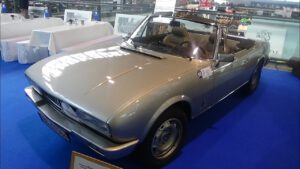
1980 Peugeot 504 CC Cabriolet – Exterior and Interior – Retro Classics Stuttgart 2019
By 1980, the Peugeot 504 Cabriolet had already been in production for over a decade, a rarity in a period marked by increasingly rapid model cycles. Its continued presence in the market reflected a consistent demand for a car that combined proven engineering with understated elegance. In its later “CC” form, the model represented the final evolution of a concept that had remained largely unchanged in appearance but steadily refined in detail.
Technical Details
The 1980 Peugeot 504 CC Cabriolet was typically powered by a front-mounted inline four-cylinder engine with a displacement of 1,971 cc. In its fuel-injected configuration, using a Kugelfischer mechanical injection system, output reached approximately 104 horsepower. This system improved efficiency and drivability compared to earlier carbureted versions, while maintaining mechanical simplicity.
Power was delivered to the rear wheels through a four- or five-speed manual gearbox, with an automatic transmission available depending on market specification. The drivetrain retained the classic front-engine, rear-wheel-drive layout, contributing to stable and predictable handling characteristics.
The suspension system was designed with an emphasis on comfort. Independent front suspension was paired with a rear axle setup engineered to provide a balance between ride quality and road holding. Disc brakes at the front and drum brakes at the rear remained standard, supported by servo assistance in later models. The technical concept remained consistent with Peugeot’s philosophy: durability, ease of maintenance, and suitability for long-distance driving.
- Manufacturer: Peugeot
- Model name: Peugeot 504 CC Cabriolet
- Year of manufacturing: 1980
Design
The Peugeot 504 Cabriolet was designed and built by Pininfarina, and by 1980 its design had become a familiar and recognizable presence. Unlike many cars that underwent frequent stylistic revisions, the Peugeot 504 Cabriolet retained its original proportions and character throughout its production life.
The body featured clean, linear surfaces with a strong emphasis on balance. The front end was defined by a simple grille and rectangular headlamps, integrated into a cohesive and restrained composition. The long hood and relatively low stance gave the car a composed appearance, while the gently sloping rear completed a well-proportioned silhouette.
With the roof lowered, the Cabriolet presented a particularly clean profile, free from unnecessary visual elements. Chrome accents were used sparingly, reinforcing the car’s understated character. The interior reflected a similar approach, offering improved materials and comfort features compared to earlier versions, while maintaining a clear and functional layout.
Historical Significance
The Peugeot 504 was introduced in 1968 and became one of the brand’s most important models, achieving global success across a wide range of markets. Within this broader context, the Cabriolet occupied a more specialized position, aimed at customers seeking a combination of reliability and refined design.
By 1980, the Cabriolet had outlived many of its contemporaries, a testament to both its enduring appeal and Peugeot’s strategy of continuous technical refinement rather than frequent redesign. The “CC” designation is often used to distinguish later Cabriolet versions, which incorporated incremental improvements in equipment and drivability.
The collaboration with Pininfarina remained a key element of the model’s identity. Production of the Cabriolet in Italy underscored the importance of design partnerships in expanding Peugeot’s reach into more exclusive segments. The extended production run also highlights the model’s ability to adapt to changing expectations without losing its core characteristics.
Quirks and Pop Culture
The Peugeot 504 Cabriolet is often noted for the contrast between its elegant appearance and the robust engineering it shares with the standard Peugeot 504 saloon. While the sedan became widely recognized for its durability—particularly in demanding environments such as Africa—the Cabriolet offered a more leisure-oriented interpretation of the same mechanical base.
Its association with Pininfarina contributes to its cultural perception, linking it to a broader tradition of Italian-designed cars, even though its engineering remained distinctly French. The model’s long production life means that it spans multiple automotive eras, from the late 1960s into the early 1980s, making it somewhat unusual among open-top cars.
Although it did not achieve widespread fame in film or popular media, the Peugeot 504 Cabriolet has maintained a steady presence in classic car circles, where it is appreciated for its combination of durability and restrained design.
Display and preservation
The vehicle was exhibited at Retro Classics Stuttgart in 2019. Spread across nine exhibition halls as well as the outdoor and entrance areas, the 19th edition welcomed more than 90,000 visitors and presented around 4,000 vehicles. Unlike earlier years, the organizers did not focus on a central special exhibition, placing even greater emphasis on the market itself. Around 1,700 of the cars on display were offered for private or trade sale, underlining the event’s strong reputation as a meeting point not only for enthusiasts, but also for collectors and buyers.
Conclusion
The 1980 Peugeot 504 CC Cabriolet represents the final phase of a model defined by continuity and careful refinement. Its fuel-injected engine, conventional yet dependable engineering, and Pininfarina-designed bodywork created a car that balanced usability with understated elegance. Historically, it illustrates Peugeot’s ability to sustain a successful concept over an extended period through incremental improvements. Today, it stands as a distinctive example of a long-lived European cabriolet, valued for both its technical integrity and its consistent design.