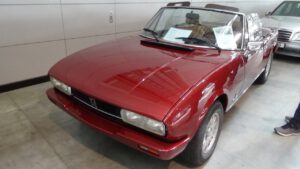
1980 Alfa Romeo 2000 Spider – Exterior and Interior – Motorworld Classics Bodensee 2022
The Alfa Romeo 2000 Spider is one of those cars where the headline isn’t a single year, but the fact that it kept going—evolving carefully—until early summer 1993. Under its familiar shape sat a 1962-cc update introduced in 1971, and the real ownership stories often start with small, specific details: a drain that clogs, water that collects, and the way a properly sealed trunk can matter as much as horsepower. If you want a classic that rewards attention, the Alfa Romeo 2000 Spider is full of it.
Technical Details:
The Alfa Romeo 2000 Spider arrived with the 2000-series update unveiled in June 1971, and the model designation pointed straight to the engine: the bore grew from 80 mm (1750) to 84 mm while stroke remained 88.5 mm, bringing displacement to 1962 cc. The crankshaft was nitrided for improved wear resistance, enlarged intake valves increased gas flow, and a more effective oil filter was introduced. Alfa also revised the camshaft approach: the intake and exhaust cams were made “flatter,” and valve timing changes reduced overlap. Output was quoted at 132 PS at 5,500 rpm, paired with improved torque and a curb weight around 1060 kg (similar to the 1750), giving the Alfa Romeo 2000 Spider noticeably stronger temperament without becoming a heavier car.
Market specification mattered. As before, US models used Spica fuel injection and carried the series designation 115, while European cars used two horizontal twin-choke Weber carburetors. Export drivetrains could include a limited-slip differential, a real advantage when accelerating out of bends. Brakes were sized up versus the 1750 and fitted with maintenance-free wheel brake cylinders; servo-assisted disc brakes on all four wheels were standard. Efficiency was part of the package too: with a 53-liter tank of Super gasoline, ranges of around 600 km were possible with a measured right foot.
Durability was generally strong—the nitrided crankshaft was described as capable of outlasting the car—but owners of early engines (1971/72) reported recurring cylinder head gasket problems. The root cause was thermal stress between the aluminum block and the steel cylinder liners, which could lead to imperfect sealing surfaces; a telltale sign could be oil mixing into the coolant on cold starts. Alfa offered goodwill solutions for affected engines, yet anyone evaluating an Alfa Romeo 2000 Spider is advised to check for gasket issues. Additional practical watchpoints include ensuring the oil filter stays firmly seated (it can work loose) and using the correct oil in the limited-slip differential to avoid audible complaints. Rust is another technical reality, and on the Spider it overlaps directly with body design and water management.
- Manufacturer: Alfa Romeo
- Model Name: Alfa Romeo 2000 Spider
- Year of Manufacturing: 1971-1986
Design:
For the 2000 series, Alfa Romeo retained the 1750 body shape across Berlina, Sprint, and Spider. In the Alfa Romeo 2000 Spider’s case, that meant the roadster did not receive a new face like the coupe; externally, a chromed script signaled the larger engine under the hood. The broader Spider story, however, is inseparable from its rear-end design and its relationship with water. The “Series 2” Spider (1970–1982) gained the nickname “Coda Tronca” (“chopped tail”) for its Kamm-style fastback rear—controversial at launch, later praised for stability. The fastback shape also created a very specific ownership requirement: the trunk lid must seal tightly, because exhaust gases can swirl upward behind the car and enter through small gaps or unsealed holes (even around license-plate hardware).
The open-body format brings its own architecture. Fastback Spiders have four openings in the sill area intended to drain rainwater from the soft-top edge via tubes. These openings can be blocked unintentionally—especially if underbody protection is applied carelessly—leading to water accumulation that can spill forward under braking, soaking shoes and socks before the driver realizes what’s happening. The cabin itself evolved over time without abandoning the original mid-1960s visual concept: by 1986 the Spider received a new interior, including a redesigned dashboard that improved the overall vehicle “architecture.” Later cars also became more pleasant on longer drives in terms of noise, though the Spider remained audibly mechanical—rear axle and drivetrain sounds are less muffled when there’s no rear seat. Exterior changes mentioned in your content include the adoption of distinctive black bumpers first on US exports, then in Europe from 1983, plus a black rear spoiler at the top edge of the trunk lid and improved headlights (eventually without plexiglass covers). Pininfarina’s rear redesign also improved luggage space, and the 1990 update removed the spoiler and introduced a new Pininfarina-styled rear that many purists welcomed; body-colored bumpers helped the proportions look more balanced.
Historical Significance:
The Alfa Romeo 2000 Spider matters historically because it proved how long a classic sports-car template could remain relevant when updated in small, targeted steps. Introduced in 1971 alongside the other 2000 models, it outlived its immediate two-liter siblings and remained in production until early summer 1993 as the lone open 105-spec Alfa after the Alfetta arrived in 1974—there was no Alfetta cabriolet. Over the years, the Spider saw incremental but meaningful changes tied to emissions and drivability requirements. In Germany, Alfa offered injection from 1988 using Bosch K-Jetronic in conjunction with catalytic converter compatibility; in the US, catalytic variants arrived earlier (from 1976 in California, then later across the remaining states). The injection update required a different intake manifold, and later systems progressed to ML-Motronic (from 1990) with electronically controlled ignition to improve fuel efficiency.
Alfa also introduced a notable mechanical update in 1980: the Vari-Cam system, which used oil pressure to alter intake cam behavior during idle and transition to higher rpm, improving emissions performance. Chassis tuning evolved in smaller steps as well; later cars were described as stiffer, with less tendency to lean outward in fast cornering. The Spider range broadened too: from 1974 to 1993 a 1.6-liter version returned (with the 1.3 ending in 1973), sold in some markets as Junior and later Spider 1.6. Production scale helps explain the Spider’s market position: about 125,000 Spiders were built from 1966 to 1993, making it widely available rather than rare—good news for enthusiasts seeking access to a classic Italian two-seater. The production end was announced in June 1993; rumors of a six-cylinder successor did not materialize.
Quirks and Pop Culture:
Ownership quirks are part of the Alfa Romeo 2000 Spider’s identity, and they’re unusually concrete. Water management is the recurring theme: check the spare-wheel well for collected water, keep drains clear, and be wary of sound-deadening mats that can act like sponges and hold moisture against the floor. Carpets in later Spiders can also trap water; removing them periodically to ventilate and dry is recommended in wet climates. If you’re applying underbody protection, leaving the drainage openings free is not optional—blocking them can turn the cabin into a water reservoir that reveals itself during hard braking.
Rust remains a classic Spider concern, especially on early 1970s cars, though later manufacturing protection improved body life. Mechanical quirks include the early head gasket issue described above, the need to ensure the oil filter doesn’t loosen, and the importance of using correct limited-slip differential oil to avoid telltale noises. There’s also a niche but real crankshaft-related note: an aluminum plug sealing an oil drilling can work loose, usually signaled by dropping oil pressure; the fix involves properly resealing (Loctite is recommended in your content) and then rebalancing the crankshaft.
In pop culture, the Spider carries a permanent association with The Graduate—your content notes that the film featured an earlier Spider, but by 1980 Alfa still benefited from that cinematic halo. The car also appears across late-1970s and early-1980s American TV and film as a shorthand for European style and “intellectual cool,” often assigned to professors, architects, or romantic leads. Enthusiast lore adds a familiar refrain: it’s often framed as a “slow car fast” experience, praised for steering feel and engine sound, and criticized for electrical gremlins and rust-prone bodywork. One more trivia line belongs in any Alfa Romeo 2000 Spider SEO post: the Spider is one of the longest-running production designs, evolving from 1966 into the 1990s.
Display and preservation:
The vehicle was exhibited at Motorworld Classics Bodensee in 2022. This event, held in Friedrichshafen, is a popular gathering for classic car enthusiasts in southern Germany, Austria, and Switzerland. The 2022 edition featured over 800 exhibitors spread across multiple halls and open-air spaces, offering a vibrant mix of vintage automobiles, motorcycles, boats, and aircraft. Visitors could explore restoration workshops, parts markets, and club presentations. A key highlight was the live vehicle auctions and dynamic driving demonstrations on the event grounds. The show reaffirmed its reputation as a hands-on celebration of classic mobility culture.
Conclusion:
The Alfa Romeo 2000 Spider combines a clear 1971 technical step—1962 cc, 132 PS, nitrided crankshaft, revised breathing and timing—with a long, carefully updated production life that stretched to early summer 1993. Its design story is less about flashy revisions and more about how an open roadster body behaves in the real world: drains, seals, exhaust swirl, noise, and rust prevention are as defining as the powertrain. Add in injection and catalyst-era adaptations, the 1980 Vari-Cam emissions-focused innovation, and a lasting cultural image shaped by The Graduate’s halo, and the Alfa Romeo 2000 Spider reads like a practical classic—one that rewards owners who notice details and drive it as intended.