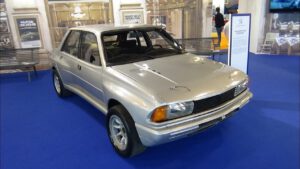
1980 – 1981 Peugeot 305 V6 Sport – Auto d’Epoca Padova 2017
At first glance, the Peugeot 305 appears to be a conventional compact family car of the late 1970s. Yet the V6 Sport prototype tells a very different story—one of experimentation, performance ambition, and a direction Peugeot ultimately chose not to pursue. Built in extremely limited numbers, it stands as a rare glimpse into what a sportier Peugeot sedan could have become.
Technical Details
The Peugeot 305 V6 Sport was not a standard production model but a prototype developed around 1980–1981. Unlike the regular Peugeot 305, which used modest four-cylinder engines, this version was equipped with a V6 power unit from the PRV (Peugeot-Renault-Volvo) collaboration. This engine, typically displacing around 2.7 liters, produced approximately 130 to 150 horsepower depending on specification, a substantial increase over the standard model’s output.
The engine was mounted at the front and drove the front wheels, retaining the Peugeot 305’s fundamental layout. Integrating a V6 into a chassis originally designed for smaller engines required significant modifications, including reinforcement of the structure and adjustments to suspension and cooling systems. The front suspension, based on MacPherson struts, and the rear trailing-arm setup were adapted to handle the increased power and weight.
Performance figures were notably higher than those of the standard Peugeot 305, with improved acceleration and a higher top speed, placing the car closer to contemporary sports sedans. However, the added weight over the front axle also affected handling balance, a known challenge for front-wheel-drive cars with larger engines at the time.
- Manufacturer: Peugeot
- Model name: Peugeot 305 V6 Sport
- Year of manufacturing: 1980–1981
Design
Externally, the Peugeot 305 V6 Sport remained close to the standard Peugeot 305 sedan, maintaining the clean and understated design language typical of Peugeot in this period. The original Peugeot 305 had been styled in collaboration with Pininfarina, resulting in a balanced and conservative appearance with straight lines and minimal ornamentation.
The V6 Sport version introduced subtle modifications to reflect its enhanced performance. These could include wider wheels, sportier tires, and minor adjustments to the stance, giving the car a more purposeful look without fundamentally altering its identity. The restrained approach meant that, visually, the car did not immediately reveal its performance potential.
Inside, the cabin followed the same functional layout as the standard model but could be equipped with sport-oriented details such as improved seating and instrumentation. The overall design remained focused on practicality rather than luxury or overt sportiness.
Historical Significance
The Peugeot 305 V6 Sport emerged during a period when manufacturers were exploring ways to combine everyday usability with higher performance. For Peugeot, this prototype represented an exploration of the upper limits of the Peugeot 305 platform.
However, the project did not proceed to series production. Several factors likely influenced this decision, including cost, market positioning, and the technical challenges associated with fitting a relatively large V6 engine into a front-wheel-drive compact sedan. Instead, Peugeot would later pursue performance through other models, such as the 505 and eventually the highly regarded 205 GTI.
The V6 Sport remains significant as an internal experiment, illustrating Peugeot’s willingness to test unconventional ideas even if they did not reach the market. It also reflects the broader industry trend of the late 1970s and early 1980s, when manufacturers were experimenting with performance variants of otherwise conventional cars.
Quirks and Pop Culture
One of the most interesting aspects of the Peugeot 305 V6 Sport is its rarity. As a prototype or limited experimental model, it is largely unknown outside specialist circles and is seldom seen in public. This rarity has given it a near-mythical status among Peugeot enthusiasts.
The use of the PRV V6 engine—shared with a wide range of vehicles from different manufacturers—adds another layer of intrigue. Seeing this engine in a relatively compact and understated sedan creates a contrast between appearance and performance that defines the car’s character.
Unlike more famous performance models, the Peugeot 305 V6 Sport did not achieve a presence in motorsport or popular media. Its story is instead preserved through documentation, prototypes, and enthusiast knowledge, making it a subject of interest primarily for historians and collectors.
Display and preservation
This car was shown at the Auto e Moto d’Epoca Padova 2017. The event took place from October, 26th to the 29th. Hosted at PadovaFiere, the event attracted over 115,000 visitors and presented more than 5,000 vehicles. Alongside the impressive display blending heritage, modern automotive trends, and passionate collectors, the event hosted Bonhams sales highlighting a shifting market.
Conclusion
The Peugeot 305 V6 Sport is best understood as a technical and conceptual experiment rather than a finished product. By combining a practical sedan platform with a powerful V6 engine, Peugeot explored the boundaries of performance within its lineup. Although it never reached production, the project highlights a moment of creative exploration within the company and offers insight into alternative paths that Peugeot ultimately chose not to follow.