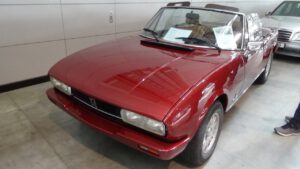
1976 Citroen Ami 8 Break – Oldtimer-Meeting Baden-Baden 2021
In France, the Citroën Ami 8 Break became a popular choice among families and young drivers during the late 1960s and 1970s. Its modest performance, combined with low running costs and exceptional practicality, made it a familiar sight on everyday roads.
Technical Details:
The Citroën Ami 8 Break is based on the proven technical foundations of the Ami range and ultimately on the Citroën 2CV. It is powered by an air-cooled, two-cylinder boxer engine with a displacement of 602 cc. This compact unit features an overhead-valve layout with gear-driven camshaft operation. Bore and stroke measure 74 x 70 mm, and output is rated at 32 PS at 5,750 rpm, corresponding to 35 SAE horsepower. Power is delivered to the front wheels via a four-speed gearbox with one reverse gear, operated through a dashboard-mounted gear lever. The transmission was partially synchronized, and the Citroën Ami 8 Break could optionally be equipped with an additional centrifugal clutch, reducing the need to use the clutch pedal except when shifting gears.
The engine construction reflects Citroën’s focus on simplicity and durability. The vertically split aluminum crankcase integrates the oil sump, while the cylinders are made of cast iron. Aluminum cylinder heads are mounted directly without gaskets and feature hemispherical combustion chambers with two opposed valves arranged in a V configuration. Valve actuation is handled by tappets, pushrods, and rocker arms. Ignition is distributorless, with both spark plugs firing simultaneously in a wasted-spark system. Lubrication is provided by an Eaton gear-type oil pump driven by the camshaft. The crankshaft is built-up and shrink-fitted, with undivided connecting rods.
Braking is managed by disc brakes at the front and drum brakes at the rear. With a curb weight of just 725 kilograms, the Ami 8 Break reaches a top speed of approximately 123 km/h. Its compact dimensions—3,990 mm in length, 1,520 mm in width, and 1,490 mm in height—combined with a wheelbase of 2,400 mm, made it agile and easy to maneuver. Narrow 135 SR 15 tires further emphasized efficiency and comfort rather than outright performance.
- Manufacturer: Citroën
- Model Name: Ami 8 Break
- Year of Manufacturing: 1969–1978
Design:
The stylistic evolution from the Citroën Ami 6 to the Citroën Ami 8 was presented at the 1969 Geneva Motor Show and was shaped by Citroën designer Robert Opron. While the overall concept remained unchanged, the bodywork was smoothed and simplified to modernize the appearance and improve all-round visibility. For the Citroën Ami 8 Break, the rear section remained largely unchanged from its predecessor, so much so that it served as a design reference for the new saloon version.
A particularly practical design improvement was achieved by relocating the rear lights into the rear fenders. This allowed the deletion of the closing panel and enabled the extended tailgate to reach down to the flat cargo floor, significantly improving loading convenience. The Ami 8 adopted a hatchback-style rear in place of the earlier notchback layout, with the tailgate hinged beneath the rear window. Inside, the dashboard was largely manufactured from thermoplastic, reflecting both cost efficiency and contemporary design trends. Initially, all doors were fitted with sliding windows, later replaced by crank windows at the front from July 1970 onward.
Historical Significance:
The Citroën Ami 8, internally designated Type AM3, succeeded the Ami 6 and continued its role as a practical, compact family car. Like its predecessor, it was technically derived from the Citroën 2CV, retaining the same basic philosophy of simplicity, economy, and comfort. Production ran from spring 1969 until 1979, with the Ami 8 Break introduced as a station wagon variant in August 1969.
Equipped exclusively with two-cylinder engines, the Citroën Ami 8 Break broadened the appeal of the Ami range by offering increased cargo capacity and versatility. Vehicles produced at Citroën’s plant in Vigo, Spain, were marketed under the name “Citroën Dynam” for trademark reasons, highlighting the model’s adaptability to different markets. The Ami 8 represented Citroën’s effort to refresh an established concept while maintaining its technical roots.
Quirks and Pop Culture:
In France, the Citroën Ami 8 Break became a popular choice among families and young drivers during the late 1960s and 1970s. Its modest performance, combined with low running costs and exceptional practicality, made it a familiar sight on everyday roads. The car’s unpretentious character and distinctive design ensured that it was remembered less as a status symbol and more as a faithful companion for daily life.
Display and preservation:
The vehicle was exhibited at the Oldtimer-Meeting Baden-Baden in 2021. This event, held annually in the spa town’s Kurpark and along the Kaiserallee, is one of Germany’s most picturesque classic car gatherings. In 2021, the 44th edition featured 300 vintage vehicles from 80 different brands, including rare models. The event embraced a 1970s theme, showcasing over 40 vehicles from that era. An innovative highlight was the “automobile fashion show,” where models presented current fashion trends while riding in open-top classic cars through the park. The event concluded with the traditional Concours d’élégance, awarding 120 prizes across 15 categories.
Conclusion:
The Citroën Ami 8 Break stands as a clear example of Citroën’s talent for combining practicality with unconventional engineering. Produced between 1969 and 1978, it offered a lightweight body, an ingeniously simple air-cooled boxer engine, and thoughtful design improvements that enhanced everyday usability. With its flat cargo floor, economical drivetrain, and unmistakable character, the Ami 8 Break fulfilled its role as a versatile family estate and remains a charming reminder of Citroën’s pragmatic yet inventive approach to automotive design.