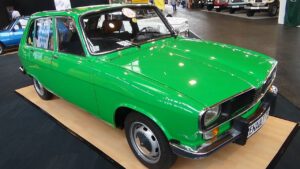
1975 Renault 16TL – Klassikwelt Bodensee 2017
By the mid-1970s, the Renault 16 had already proven that practicality could redefine what a family car should be. The 1975 Renault 16 TL represents a mature stage of that concept—refined rather than reinvented, but still distinct in a market that had largely caught up with its ideas. What began as an unconventional design a decade earlier had by then become a reference point.
Technical Details
The 1975 Renault 16 TL retained the model’s characteristic front-engine, front-wheel-drive layout. It was powered by an inline four-cylinder engine mounted longitudinally, positioned behind the gearbox—a distinctive Renault configuration. In TL specification, the engine typically had a displacement of around 1,470 cc, producing approximately 60 horsepower, depending on market and tuning.
Power was transmitted to the front wheels via a four-speed manual gearbox. The transmission layout, mounted ahead of the engine, influenced both weight distribution and service accessibility. The Renault 16 continued to use independent suspension on all four wheels, relying on torsion bars rather than coil springs. This system allowed for a relatively soft ride and effective load handling, particularly useful given the car’s versatility.
Braking was handled by front disc brakes and rear drum brakes, a balanced setup for a mid-size family car of the period. The overall engineering emphasis remained on comfort, stability, and adaptability rather than outright performance.
- Manufacturer: Renault
- Model name: Renault 16 TL
- Year of manufacturing: 1975
Design
The Renault 16 TL’s design remained largely consistent with the original concept introduced in the mid-1960s, but by 1975 it had been subtly refined. Its defining feature was the five-door hatchback body, combining the profile of a sedan with the practicality of a wagon. The long roofline flowed into a large rear hatch, creating a flexible interior space that could be adapted for passengers or cargo.
Externally, the TL version featured modest updates, including revised trim details and a simplified front end. The design avoided excessive ornamentation, relying instead on proportion and functionality. Large glass areas provided good visibility and contributed to a sense of openness.
Inside, the Renault 16 TL emphasized versatility. The rear seats could be adjusted or folded in multiple configurations, allowing for different combinations of seating and storage. The interior layout was practical and user-focused, with clear instrumentation and controls. Materials were durable rather than luxurious, but the overall impression was one of thoughtful design tailored to everyday use.
Historical Significance
By 1975, the Renault 16 was no longer a novelty but an established success. Introduced in 1965, it had won the European Car of the Year award in 1966 and helped define the modern hatchback concept. The TL variant represented one of the core versions in the lineup, offering a balance between affordability and equipment.
The car’s influence extended beyond Renault. Its combination of front-wheel drive, flexible interior, and hatchback body style anticipated trends that would become widespread in the following decades. Many later family cars adopted similar layouts, confirming the Renault 16’s role as a pioneer.
At the same time, the automotive landscape of the mid-1970s was changing. New competitors were entering the market with more modern designs and technologies. The Renault 16 TL, while still competitive, represented an earlier generation of thinking—one that had set the standard but was now being gradually overtaken.
Production of the Renault 16 continued until 1980, with nearly two million units built. The 1975 model sits within this later phase, where the car’s concept remained relevant even as newer models began to emerge.
Quirks and Pop Culture
One of the Renault 16’s most unusual technical features was its asymmetrical wheelbase, caused by the torsion bar suspension layout. The rear wheels were positioned slightly differently on each side, a detail rarely noticed in everyday use but often highlighted in technical discussions.
The Renault 16 TL was also known for its adaptability. Owners frequently used it for a wide range of purposes, from family transport to light commercial duties, thanks to its flexible interior. This versatility contributed to its reputation as a practical and forward-thinking vehicle.
In cultural terms, the Renault 16 became associated with a more modern, pragmatic lifestyle. It was not a status symbol in the traditional sense, but it represented a shift toward functionality and efficiency. Its widespread use across Europe reinforced its image as a dependable and innovative family car.
Display and preservation
This car was filmed at the Klassikwelt Bodensee 2017. The show demonstrated how dynamic classic vehicle preservation can be when brought to life beyond static displays. Attracting nearly 39,000 visitors from 17 countries, the event combined exhibitions across ten halls with live demonstrations on land, water, and in the air. Historic aircraft, racing cars, and motorcycles were not only displayed but actively showcased, reinforcing their mechanical vitality. Special exhibitions and club presentations added depth, while around 600 privately owned classics integrated visitors into the display itself. This immersive format highlighted preservation as an experience—where history is not only protected, but continuously lived and shared.
Conclusion
The 1975 Renault 16 TL illustrates how a well-conceived design can remain relevant over an extended period. Technically, it combined front-wheel drive with a comfortable and adaptable suspension system. Its hatchback design offered a level of practicality that was still ahead of many competitors.
Historically, it stands as part of a model line that reshaped expectations for family cars, influencing the direction of automotive design in the decades that followed. By the mid-1970s, the Renault 16 TL was no longer revolutionary, but it remained a clear example of how innovation can become the norm.