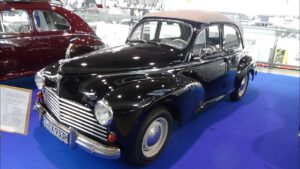
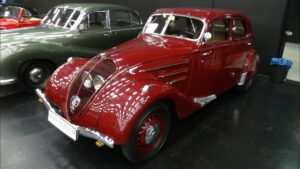
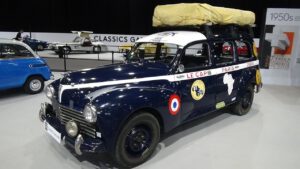
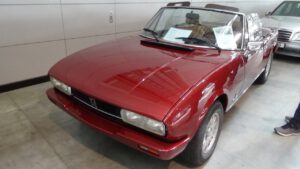
1972 Jaguar E-Type V12 Cabriolet – Exterior and Interior – Motorworld Classics Bodensee 2022
By 1972, the Jaguar E-Type had shed much of its early-1960s sharpness and taken on a broader, more mature identity. In V12 Cabriolet form, it was no longer simply a sports car—it was a twelve-cylinder grand tourer designed for open-air high-speed cruising. The transformation was deliberate, and it defined the final years of E-Type production.
Technical Details:
The 1972 Jaguar E-Type V12 Cabriolet, part of the Series 3 generation introduced in 1971, was powered by Jaguar’s 5,343 cc (5.3-litre) V12 engine. This all-aluminum unit featured a single overhead camshaft per bank and delivered approximately 272 bhp (SAE gross) in early European specification. In the United States and other export markets, output figures varied due to emissions regulations and carburetor calibration, typically using four Zenith-Stromberg carburetors.
Power was transmitted to the rear wheels via a four-speed manual gearbox as standard. A three-speed automatic transmission was widely available and frequently chosen, particularly in North America. The drivetrain remained front-engine, rear-wheel drive, but the chassis had been adapted to accommodate the larger and heavier V12 unit.
The Series 3 introduced ventilated front disc brakes to cope with increased performance and mass, while the independent rear suspension with inboard disc brakes—first developed for earlier Jaguar models—was retained. Power steering became standard equipment, significantly improving maneuverability at low speeds. Despite added weight compared to the earlier six-cylinder cars, the V12 Cabriolet maintained a top speed close to 150 mph (around 240 km/h), with acceleration characterized by smooth, continuous torque rather than high-revving urgency.
- Manufacturer: Jaguar Cars
- Model Name: Jaguar E-Type V12 Cabriolet
- Year of Manufacturing: 1972
Design:
The 1972 Jaguar E-Type V12 Cabriolet retained the long bonnet and compact rear deck that defined the model line but incorporated significant visual revisions compared to earlier Series 1 cars. The most obvious change was the enlarged front grille opening, necessary to provide additional cooling for the twelve-cylinder engine. Flared wheel arches and a wider track contributed to a more substantial stance.
Unlike earlier generations, the Series 3 roadster was built exclusively on the longer wheelbase platform. This improved cabin access and interior space while subtly altering the car’s proportions. Open headlamps—introduced in the previous generation—remained a defining feature, replacing the earlier glass-covered units.
The Cabriolet’s folding soft top emphasized its grand touring role. With the roof lowered, the car presented a clean, uninterrupted profile. Inside, the cockpit reflected early-1970s expectations of comfort. Revised seats offered improved support, the dashboard layout incorporated rocker switches rather than earlier toggle designs, and ventilation systems were upgraded. Chrome bumpers and exterior trim remained prominent, reinforcing the car’s luxury positioning.
Historical Significance:
The Jaguar E-Type had debuted as a lightweight, racing-influenced sports car. By 1972, however, international safety and emissions standards—particularly in the United States—had reshaped performance car design. Jaguar’s introduction of the V12 engine in 1971 ensured that the E-Type remained competitive in terms of power and smoothness at a time when many rivals were losing output.
The same V12 engine also powered the Jaguar XJ12, marking Jaguar’s broader commitment to twelve-cylinder refinement. In Cabriolet form, the E-Type V12 represented the culmination of the model’s evolution from raw sports car to refined high-speed tourer.
Production of the Series 3 continued until 1974, when the E-Type line was discontinued. The 1972 model year sits squarely within this final phase, reflecting the car’s most powerful and mechanically advanced configuration.
Quirks and Pop Culture:
The E-Type’s cultural status had been firmly established since its early years, with enduring praise from figures such as Enzo Ferrari, who famously described it as exceptionally beautiful. By the early 1970s, the V12 Cabriolet carried that legacy into a new era.
Among enthusiasts, the Series 3 V12 roadster often generates discussion. Some prefer the lighter, earlier six-cylinder cars for their sharper handling and closer link to the 1961 original. Others value the V12 Cabriolet for its turbine-like smoothness, relaxed cruising ability, and distinctive twelve-cylinder exhaust note. The open body style enhances the sensory experience, allowing the engine’s character to be heard and felt more directly.
Display and preservation:
The vehicle was exhibited at Motorworld Classics Bodensee in 2022. This event, held in Friedrichshafen, is a popular gathering for classic car enthusiasts in southern Germany, Austria, and Switzerland. The 2022 edition featured over 800 exhibitors spread across multiple halls and open-air spaces, offering a vibrant mix of vintage automobiles, motorcycles, boats, and aircraft. Visitors could explore restoration workshops, parts markets, and club presentations. A key highlight was the live vehicle auctions and dynamic driving demonstrations on the event grounds. The show reaffirmed its reputation as a hands-on celebration of classic mobility culture.
Conclusion:
The 1972 Jaguar E-Type V12 Cabriolet represents the final, fully developed expression of Jaguar’s iconic sports car. Equipped with a 5.3-litre V12 engine, ventilated disc brakes, standard power steering, and a longer wheelbase, it evolved into a refined grand tourer suited to changing market demands. While visually and dynamically different from the early Series 1 models, the V12 Cabriolet ensured that the E-Type concluded its production life with technical distinction and enduring presence.