1972 Citroen SM – Oldtimer-Meeting Baden-Baden 2021
In 1968 Citroën bought a majority stake in Maserati. With access to Italian engine expertise, Citroën aimed to create a new model that would appeal to wealthy customers seeking both sportiness and technological sophistication. The result was the Citroën SM, with the abbreviation originally standing for “Sport Maserati,” though later often interpreted as “Sa Majesté.”
Technical Details:
The Citroën SM is powered by a Maserati-developed V6 engine, underscoring the technical ambition behind the project. This 90-degree, water-cooled six-cylinder unit, designated Maserati C 114/1, features four overhead camshafts operated via three duplex timing chains and bucket tappets. With a displacement of 2,670 cc and bore and stroke dimensions of 87 x 75 mm, the engine produces 170 PS at 5,500 rpm, corresponding to approximately 180 SAE horsepower. Fuel delivery is handled by three twin-choke downdraft carburetors, and power is transmitted to the front wheels through a five-speed manual gearbox with center-mounted shifter and one reverse gear.
The Citroën SM’s drivetrain layout was highly unconventional for its segment, as it combined high output with front-wheel drive. Braking performance relied on disc brakes at both the front and rear, supported by Citroën’s high-pressure braking system. With a curb weight of 1,450 kilograms, the Citroën SM reached a top speed of 220 km/h, making it the fastest series-production front-wheel-drive car of its time. The long wheelbase of 2,950 mm and the wide front and rear tracks of 1,530 mm and 1,330 mm respectively contributed to high-speed stability, while Michelin 195/70 VR 15 XWX tires supported the car’s touring capabilities.
Despite its impressive technical specification and excellent ride comfort, the Citroën SM’s highly complex mechanical systems proved demanding for both owners and mechanics. The combination of hydropneumatic suspension, advanced steering systems, and a sophisticated Maserati engine resulted in a vehicle that pushed the boundaries of engineering complexity. In total, 12,920 SM coupés were produced between 1970 and 1972.
- Manufacturer: Citroën
- Model Name: SM
- Year of Manufacturing: 1970 – 1975
Design:
The Citroën SM was conceived as a true Gran Turismo, made possible by Citroën’s partnership with Maserati, formalized in 1967. This collaboration allowed Citroën to transfer its brand-defining technologies, including hydropneumatic suspension, into a completely new luxury and performance segment. The result was a four-seat coupé designed to combine long-distance comfort with high-speed capability.
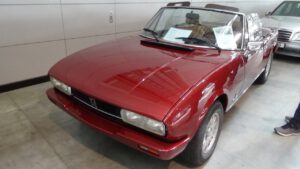
Citroën designer Robert Opron shaped the Citroën SM’s steel body into an exceptionally aerodynamic form. Its low-slung profile, long hood, and smooth surfaces conveyed speed even at rest, while the dramatically tapered rear emphasized its futuristic character. The front end was dominated by six headlights, a striking and unmistakable design feature that gave the Citroën SM a bold and extravagant appearance. Measuring 4,890 mm in length, 1,840 mm in width, and only 1,320 mm in height, the SM appeared wide, flat, and purposeful, reinforcing its identity as a high-speed grand tourer rather than a conventional luxury coupe.
Historical Significance:
Following the unprecedented success of the Citroën DS, the company decided to take a significant risk by entering the luxury performance segment. This strategic move was facilitated by Citroën’s acquisition of a majority stake in Maserati in 1968. With access to Italian engine expertise, Citroën aimed to create a new model that would appeal to wealthy customers seeking both sportiness and technological sophistication. The result was the Citroën SM, with the abbreviation originally standing for “Sport Maserati,” though later often interpreted as “Sa Majesté.”
The Citroën SM was officially presented on March 11, 1970, at the Geneva Motor Show, although customer deliveries did not begin until the 1971 model year. Production numbers illustrate initial optimism, with 868 coupés built in 1970 and 5,032 units produced in 1971. The car stood out for its exceptionally direct steering with speed-sensitive power assistance, its high level of ride comfort, and its impressive high-speed cruising ability enabled by the Maserati V6 engine.
However, compromises made to meet French tax regulations reduced the engine from an originally planned 3.2 liters and 200 PS to under 2.7 liters and 170 PS. While aerodynamics allowed the Citroën SM to achieve remarkable top speeds, its acceleration was less dramatic due to the relatively high weight and engine characteristics. In 1972, the Citroën SM received electronic fuel injection, increasing maximum speed to 228 km/h and further enhancing its technical credentials. Despite these advances, the Citroën SM remained a niche vehicle, admired more by enthusiasts than embraced by the broader luxury market.
Quirks and Pop Culture:
The Citroën SM developed a complex reputation shaped as much by its ambition as by its shortcomings. Issues related to engine reliability and a level of build quality considered inadequate for the high-end segment negatively affected customer confidence. Certain structural and mechanical details also puzzled drivers, reinforcing the perception that the Citroën SM demanded patience and technical understanding from its owners.
An attempt to elevate the model’s image through a presidential version built by specialist coachbuilder Chapron, intended for use by the French president, failed to reverse public perception. Despite its striking design and advanced technology, the Citroën SM struggled commercially and ultimately came to be regarded as a failure. This contrast between visionary engineering and market reality has since become one of the defining aspects of the Citroën SM’s legacy.
Display and preservation:
The vehicle was exhibited at the Oldtimer-Meeting Baden-Baden in 2021. This event, held annually in the spa town’s Kurpark and along the Kaiserallee, is one of Germany’s most picturesque classic car gatherings. In 2021, the 44th edition featured 300 vintage vehicles from 80 different brands, including rare models. The event embraced a 1970s theme, showcasing over 40 vehicles from that era. An innovative highlight was the “automobile fashion show,” where models presented current fashion trends while riding in open-top classic cars through the park. The event concluded with the traditional Concours d’élégance, awarding 120 prizes across 15 categories.
Conclusion:
The 1972 Citroën SM stands as one of the most daring and unconventional grand touring cars ever produced. Born from an ambitious collaboration with Maserati, it combined advanced aerodynamics, hydropneumatic comfort, and a high-revving V6 engine in a front-wheel-drive luxury coupé unlike anything else on the road. While its technical complexity and market challenges limited its commercial success, the Citroën SM remains a symbol of Citroën’s willingness to defy convention. Today, it is remembered not merely as a car, but as a bold engineering statement that pushed the boundaries of what a luxury performance vehicle could be.