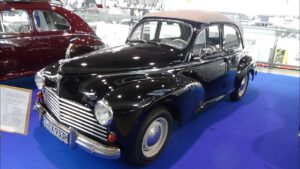
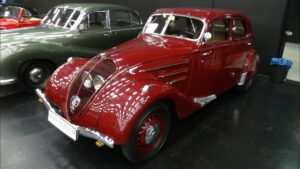
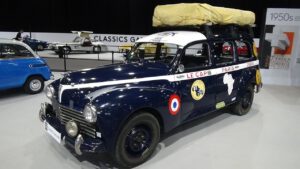
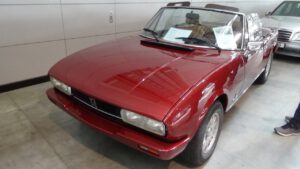
1971 Jaguar E-Type V12 – Exterior and Interior – Retro Classics Stuttgart 2022
Twelve cylinders changed the character of the Jaguar E-Type more profoundly than any styling revision ever could. When the V12 arrived in 1971, it did not simply replace the long-serving straight-six; it redefined the E-Type as a high-speed grand tourer for a new decade. The result was faster, heavier, more refined—and unmistakably different from its predecessors.
Technical Details:
The 1971 Jaguar E-Type V12, commonly identified as the Series 3, was powered by a newly developed 5,343 cc (5.3-litre) V12 engine. This all-aluminum unit produced approximately 272 bhp (SAE gross) in early European specification, though figures varied by market due to emissions regulations, particularly in the United States. The engine featured a single overhead camshaft per bank and was fed by four Zenith-Stromberg carburetors in most export versions.
Power was delivered to the rear wheels via a four-speed manual gearbox as standard, while a three-speed automatic transmission was widely available and frequently chosen, especially in North America. The drivetrain layout remained front-engine, rear-wheel drive, but the chassis received revisions to accommodate the larger engine and increased weight.
The wheelbase was extended compared with the earlier short-wheelbase cars, and ventilated disc brakes were introduced at the front to cope with higher performance and mass. The independent rear suspension with inboard disc brakes—first seen on earlier E-Types—was retained. Power steering became standard equipment on the V12 model, reflecting the car’s shift toward greater comfort and usability. Despite added weight, top speed remained in the region of 150 mph (approximately 240 km/h), while acceleration benefited from the V12’s smooth torque delivery.
- Manufacturer: Jaguar Cars
- Model Name: Jaguar E-Type V12
- Year of Manufacturing: 1971
Design:
Visually, the 1971 Jaguar E-Type V12 introduced significant changes that distinguish it from the earlier Series 1 and Series 2 cars. The front end featured a larger, more prominent grille opening to improve cooling for the twelve-cylinder engine. Subtle flared wheel arches and wider track dimensions gave the car a broader stance.
The Series 3 was offered exclusively as a roadster (Open Two Seater) and as a Fixed Head Coupé with a 2+2 seating configuration. Unlike earlier generations, the short-wheelbase two-seat coupé was discontinued. The extended wheelbase improved interior space, particularly for rear passengers in the 2+2 version.
Inside, the cabin reflected early-1970s expectations of luxury. The dashboard was redesigned with a more modern layout, improved ventilation, and upgraded materials. Standard power steering and, in many markets, automatic transmission reinforced the car’s repositioning as a refined grand tourer rather than a lightweight sports car. Chrome bumpers and open headlamps—introduced in the previous generation—remained part of the design language, but the overall appearance became more substantial and less delicate than the original 1961 concept.
Historical Significance:
The original Jaguar E-Type had set new standards for performance and value in the early 1960s. By 1971, however, changing safety and emissions regulations—particularly in the United States—had significantly altered the sports car market. Jaguar’s answer was not incremental refinement of the existing inline six, but the introduction of a completely new V12 engine.
This engine had been under development for racing applications in the 1960s and found its first production use in the Jaguar XJ12 shortly after the E-Type V12’s debut. Installing the V12 in the E-Type allowed Jaguar to maintain competitive performance figures in an era when power outputs of many rivals were declining due to emissions constraints.
The 1971 E-Type V12 thus marks the beginning of the final chapter of the E-Type story. Production of the Series 3 continued until 1974, after which the model line ended. The V12 version ensured that the E-Type concluded its career with technical distinction rather than gradual decline.
Quirks and Pop Culture:
The Jaguar E-Type had long enjoyed cultural visibility, and the V12 version carried this reputation into the 1970s. Earlier praise from figures such as Enzo Ferrari—who famously described the E-Type as “the most beautiful car ever made”—continued to shape public perception, even as the design evolved.
Among enthusiasts, the Series 3 V12 sometimes occupies a complex position. Purists often favor the earlier covered-headlamp Series 1 cars for their lighter weight and closer connection to the 1961 original. Others appreciate the V12 for its turbine-like smoothness, effortless high-speed cruising ability, and distinctive exhaust note. The car’s greater emphasis on comfort and torque over sharp agility reflects broader shifts in sports car philosophy during the early 1970s.
Display and preservation:
The vehicle was exhibited at the Retro Classics Stuttgart in 2022. This car show is one of the major events on the classic car calendar in Germany. In 2022, it took place across five exhibition halls. Visitors can enjoy special showcases, hunt for rare parts and books, and buy cars—both private sellers and dealers offer a wide range of classic and youngtimer vehicles. In 2022, there was a noticeable increase in low-mileage youngtimers and classic cars.
Conclusion:
The 1971 Jaguar E-Type V12 represents a decisive transformation of a landmark sports car. Its 5.3-litre twelve-cylinder engine, extended wheelbase, standard power steering, and improved braking system redefined the E-Type as a high-performance grand tourer suited to a changing regulatory and market environment. While visually and mechanically distinct from the early Series 1 models, the V12 version ensured that the E-Type remained technically relevant and competitively powerful until the end of its production in 1974.