1971 Jaguar E-Type V12 Coupé – Oldtimer-Meeting Baden-Baden 2022
The 1971 Jaguar E-Type V12 Coupé is quieter, deeper, and more effortless. With twelve cylinders under its long bonnet and a 2+2 body configuration, this version signals the E-Type’s transformation from pure sports car to refined high-speed grand tourer.
Technical Details:
The 1971 Jaguar E-Type V12 Coupé, part of the Series 3 generation, introduced Jaguar’s new 5,343 cc (5.3-litre) V12 engine to the fixed-head body style. This all-aluminum twelve-cylinder unit, featuring a single overhead camshaft per bank, produced approximately 272 bhp (SAE gross) in early European specification. In export markets—especially the United States—power outputs varied due to emissions regulations and the adoption of four Zenith-Stromberg carburetors.
The engine delivered strong, smooth torque across a wide rev range, fundamentally altering the E-Type’s driving character. A four-speed manual gearbox was standard, while a three-speed automatic transmission was widely available and frequently specified. Power was transmitted to the rear wheels in the traditional front-engine, rear-wheel-drive layout.
Chassis revisions accompanied the new engine. The wheelbase of the Coupé followed the longer 2+2 configuration, allowing space for small rear seats and improved cabin access. Ventilated front disc brakes were introduced to handle the additional weight and performance of the V12, while the independent rear suspension with inboard disc brakes was retained from earlier models. Power steering became standard, reflecting the car’s repositioning toward comfort-oriented grand touring. Despite the increase in mass, top speed remained close to 150 mph (around 240 km/h), with acceleration benefiting from the engine’s broad torque curve rather than high-revving character.
- Manufacturer: Jaguar Cars
- Model Name: Jaguar E-Type V12 Coupé
- Year of Manufacturing: 1971
Design:
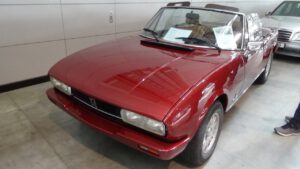
Visually, the 1971 Jaguar E-Type V12 Coupé differs noticeably from the earlier Series 1 fixed-head models. The larger grille opening, introduced to improve cooling for the twelve-cylinder engine, dominates the front view. Flared wheel arches and a wider track give the car a broader and more planted stance.
Unlike the early short-wheelbase coupé, the Series 3 Coupé was produced exclusively in 2+2 configuration. The extended wheelbase subtly alters the side profile, stretching the cabin area rearward and raising the roofline slightly for improved rear passenger accommodation. The result is a less compact but more spacious silhouette.
The open headlamps—introduced with the previous generation—remain a defining feature. Chrome bumpers, revised lighting elements, and a more substantial overall presence distinguish the V12 Coupé from its predecessors. Inside, the cabin reflects early-1970s expectations of refinement. Improved seats, upgraded ventilation, rocker switches replacing earlier toggles, and standard power steering all emphasize usability. The interior moves further toward luxury grand touring while retaining the E-Type’s driver-focused instrument layout.
Historical Significance:
The Jaguar E-Type had originally been conceived as a lightweight, racing-inspired sports car. By 1971, however, international safety and emissions regulations—particularly in the United States—had reshaped the sports car market. Jaguar’s response was decisive: rather than allowing performance to decline, it introduced an entirely new V12 engine.
This engine also powered the Jaguar XJ12 shortly after, marking Jaguar’s commitment to twelve-cylinder refinement across its range. The E-Type V12 Coupé thus represents both a technical culmination and a strategic repositioning. It ensured that the E-Type remained competitive in terms of power and smoothness at a time when many rivals were detuned.
The 1971 model year marks the beginning of the final phase of E-Type production, which would continue until 1974. The Coupé version, with its 2+2 layout and emphasis on comfort, illustrates how the E-Type evolved to meet changing buyer expectations in its last years.
Quirks and Pop Culture:
The Jaguar E-Type had long enjoyed cultural prominence. Early acclaim—including the often-quoted praise from Enzo Ferrari—continued to shape its reputation well into the 1970s. The V12 Coupé, however, occupies a distinct place within enthusiast circles.
Some purists favor the earlier Series 1 cars for their lighter weight and closer alignment with the 1961 original concept. Others appreciate the Series 3 Coupé for its turbine-like smoothness and relaxed high-speed cruising ability. The V12’s subdued mechanical character contrasts with the sharper edge of the earlier inline-six cars, reflecting broader changes in sports car philosophy at the start of the 1970s.
The 2+2 configuration also gives the V12 Coupé a practical dimension absent from the original fixed-head version, making it more suitable for long-distance touring with occasional rear passengers.
Display and preservation:
The vehicle was exhibited at the Oldtimer-Meeting Baden-Baden in 2021. This event, held annually in the spa town’s Kurpark and along the Kaiserallee, is one of Germany’s most picturesque classic car gatherings. In 2021, the 44th edition featured 300 vintage vehicles from 80 different brands, including rare models. The event embraced a 1970s theme, showcasing over 40 vehicles from that era. An innovative highlight was the “automobile fashion show,” where models presented current fashion trends while riding in open-top classic cars through the park. The event concluded with the traditional Concours d’élégance, awarding 120 prizes across 15 categories.
Conclusion:
The 1971 Jaguar E-Type V12 Coupé stands as a decisive reinterpretation of an automotive icon. Its 5.3-litre V12 engine, extended wheelbase, ventilated brakes, and standard power steering transformed the E-Type into a refined grand tourer without abandoning its performance credentials. While visually and mechanically distinct from the early Series 1 models, the V12 Coupé ensured that the E-Type concluded its production life with technical authority and continued relevance in a changing automotive landscape.