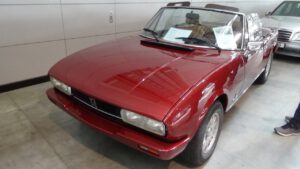
1969 Citroen DS 21 Chapron Cabriolet Serie 2 – Exterior and Interior – Classic Expo Salzburg 2021
The Citroën DS 21 Chapron Cabriolet occupies a unique position in automotive history due to its collaboration between Citroën and the French coachbuilding company Chapron.
Technical Details:
The Citroën DS 21 Chapron Cabriolet got a modern short-stroke power unit, notable for its strong performance reserves. The four-cylinder inline engine is water-cooled and features an overhead-valve valvetrain driven by a chain. With a displacement of 2,175 cc and bore and stroke measuring 90 x 85.5 mm, the engine delivers 100 PS at 5,500 rpm, while later developments increased output even further. Power is sent to the front wheels, continuing Citroën’s commitment to front-wheel drive in the luxury segment. Fuel delivery is handled by a register carburetor, paired with either a hydraulic or mechanical four-speed transmission, with reverse. Braking is managed by disc brakes at the front and drum brakes at the rear, a configuration typical of the DS range.
The Citroën DS 21 Chapron Cabriolet achieves a top speed of approximately 170 km/h and carries a curb weight between 1,325 and 1,345 kilograms. Its long wheelbase of 3,125 mm underlines the car’s grand touring character, while the track widths of 1,500 mm at the front and 1,300 mm at the rear contribute to its distinctive stance. Measuring 4,858 mm in length, 1,790 mm in width, and 1,470 mm in height, the DS 21 Chapron Cabriolet remains a large and technically ambitious open car. Despite its bespoke body, owners experienced little more technical concern than drivers of the standard DS saloon, a testament to the robustness of the underlying engineering. Even winter usability was surprisingly good, thanks to the relatively dense and padded fabric roof, though rear tire changes remained notoriously difficult and were often left to dealer roadside services.
- Manufacturer: Citroën (coachbuilt by Chapron)
- Model Name: DS 21 Chapron Cabriolet Serie 2
- Year of Manufacturing: 1969
Design:
The design of the Citroën DS 21 Chapron Cabriolet Serie 2 transforms the already futuristic DS silhouette into an elegant open-air statement. The long, flowing body retains the unmistakable proportions of the DS, but the absence of a fixed roof enhances its sculptural purity. The cabriolet’s lines appear lighter and more graceful, emphasizing length and horizontal movement while preserving the car’s dignified presence. From September 1967 onward, the third front design with double headlights behind glass gave the model a cleaner, more unified face, reinforcing its avant-garde character.
As a four-seater convertible, the DS 21 Chapron Cabriolet balances luxury and practicality. The well-padded fabric roof fits tightly and blends harmoniously with the body when raised, contributing both to comfort and visual coherence. Inside, the cabin reflects the refined luxury expected of a DS, with generous space and an atmosphere that feels more like a mobile salon than a conventional sports convertible. The overall aesthetic evokes a sense of calm sophistication rather than aggression, making the car feel timeless, elegant, and unmistakably French.
Historical Significance:
The Citroën DS 21 Chapron Cabriolet occupies a unique position in automotive history due to its collaboration between Citroën and the French coachbuilding company Chapron. Henri Chapron fell in love with the Citroën DS as early as 1958 and immediately recognized its potential as a basis for something even more extraordinary. That same year, he presented a four-seat cabriolet version at the Paris Motor Show. The design impressed Citroën’s management so deeply that Chapron was commissioned to produce a standardized factory cabriolet, known as the Cabriolet Usine, which entered production in 1960 and was sold through Citroën’s official dealer network.
Alongside these factory-sanctioned models, Chapron continued to build his own bespoke DS cabriolets, which were more expensive and offered a high degree of individual customization. Throughout the 1960s, Chapron steadily expanded his portfolio of DS special models, making the Citroën DS 21 Chapron Cabriolet a symbol of the era’s blend of industrial innovation and artisanal craftsmanship. It stands as an example of how a mainstream manufacturer successfully collaborated with a coachbuilder to elevate a production car into an icon of luxury and design.
Quirks and Pop Culture:
In broader cultural terms, the DS itself has long been regarded as a symbol of French innovation and elegance, and the Chapron cabriolet version amplified this reputation. As a rare and prestigious derivative, it became an object of admiration rather than mass recognition, often associated with exclusivity, craftsmanship, and avant-garde thinking rather than popular media saturation.
Display and preservation:
The vehicle was exhibited at the Classic Expo Salzburg in 2021. As one of Austria’s premier classic car events, the show has established itself as a central meeting point for collectors, restorers, and enthusiasts from across Central Europe. The 2021 edition took place at Messezentrum Salzburg and featured more than 250 exhibitors, along with a strong turnout of over 20,000 visitors. Attendees could explore a broad range of offerings—from historical vehicles and motorcycles to automobilia, spare parts, and literature.
Conclusion:
The 1969 Citroën DS 21 Chapron Cabriolet Serie 2 represents a rare fusion of technical sophistication, distinctive design, and historical importance. Built on the advanced DS platform and refined by Chapron’s coachbuilding expertise, it offered reliable engineering, surprising practicality, and unmistakable elegance. Its flowing open-top design elevated the futuristic DS aesthetic, while its origins tell a story of creative collaboration between manufacturer and artisan. Today, the DS 21 Chapron Cabriolet stands as a lasting testament to a time when innovation, luxury, and individuality could coexist in a single, unforgettable automobile.