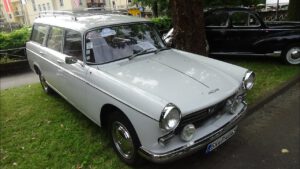
1968 Peugeot 404 Familiale – Oldtimer-Meeting Baden-Baden 2016
In the late 1960s, Peugeot quietly expanded the versatility of one of its most successful models. The Familiale version of the Peugeot 404 was not about performance or prestige, but about space, endurance, and long-distance practicality—qualities that made it a familiar sight across continents.
Technical Details
The 1968 Peugeot 404 Familiale was built on the proven mechanical foundation of the broader Peugeot 404 range. It featured a front-mounted inline four-cylinder engine, typically displacing 1.6 liters (1,618 cc), producing around 65 to 72 horsepower depending on configuration and carburetion. Fuel-injected variants existed within the Peugeot 404 lineup, though the Familiale was more commonly associated with carbureted engines prioritizing reliability over performance.
Power was delivered to the rear wheels via a four-speed manual transmission, with some versions offering a column-mounted gear shift. The drivetrain followed a conventional front-engine, rear-wheel-drive layout, contributing to balanced handling and durability on varied road conditions. Suspension consisted of independent front wheels with coil springs and a rigid rear axle with coil springs, a setup tuned for comfort and load-carrying capability.
Braking was handled by disc brakes at the front and drum brakes at the rear, a relatively advanced configuration for a family-oriented estate car of the time. The chassis and suspension were engineered to تحمل higher loads, reflecting the vehicle’s role as a long-distance transporter for families or commercial use.
- Manufacturer: Peugeot
- Model name: Peugeot 404 Familiale
- Year of manufacturing: 1968
Design
The design of the Peugeot 404 Familiale reflects a clear shift from the elegant restraint of the sedan toward a more functional, elongated form. Developed in collaboration with Italian design house Pininfarina, the Peugeot 404 retained its clean lines and balanced proportions even in estate configuration.
The Familiale featured an extended roofline and a nearly vertical rear section to maximize interior space. Large side windows emphasized visibility and created a bright cabin environment, while the long wheelbase contributed to a stable and composed stance. The front end remained consistent with the standard 404, including its simple grille, round headlights, and restrained chrome detailing.
Inside, practicality dominated. The Familiale was configured to accommodate up to seven or eight passengers through additional foldable rear seating rows. The interior layout prioritized flexibility, allowing seats to be folded or removed to increase cargo capacity. Materials were durable rather than luxurious, aligning with the car’s utilitarian purpose.
Historical Significance
By the late 1960s, Peugeot had established itself as a manufacturer of robust, export-oriented vehicles. The Peugeot 404 played a central role in this strategy, particularly in markets across Africa and South America, where durability and ease of maintenance were critical.
The Familiale variant extended this philosophy. It responded to growing demand for multi-purpose vehicles capable of transporting large families or serving as taxis and utility vehicles. In many regions, the Peugeot 404 Familiale became synonymous with reliability under demanding conditions, from unpaved roads to extreme climates.
Production of the Peugeot 404 began in 1960 and continued into the mid-1970s in Europe, with even longer production runs in international markets. The Familiale contributed to the model’s global success, reinforcing Peugeot’s reputation for engineering vehicles suited to real-world use rather than purely European driving conditions.
Quirks and Pop Culture
The Peugeot 404 Familiale developed a reputation less through media appearances and more through everyday presence. In many African countries, it became a common taxi or bush vehicle, often modified to carry more passengers than originally intended. Its ability to handle heavy loads and rough terrain made it a practical solution in regions with limited infrastructure.
A notable quirk was its seating configuration. The rear-facing third-row seats, typical of estate cars of the era, created a distinctive passenger experience and allowed the car to function almost like a small people carrier before that category formally existed.
The Peugeot 404 in general also gained recognition through endurance events. Variants of the model participated in long-distance rallies such as the East African Safari Rally, reinforcing its image as a durable and dependable machine.
Display and preservation
This car was filmed at the 40th International Oldtimer-Meeting Baden-Baden. Held from 8 to 10 July 2016, the show transformed the Kurpark into an elegant open-air museum of automotive history. Featuring 376 classic cars spanning nine decades, the event combined concours-level presentation with a uniquely atmospheric setting. Highlights included a special exhibition by Erdmann & Rossi and a tribute to 40 Years of the Golf GTI. As evening fell, nostalgic garden parties with jazz music, fashion shows, and illuminated displays created a refined backdrop, emphasizing both preservation and the living culture of classic motoring.
Conclusion
The 1968 Peugeot 404 Familiale represents a pragmatic extension of a highly successful platform. Technically straightforward yet robust, it combined a reliable drivetrain with a chassis designed for load and longevity. Its design balanced Pininfarina elegance with functional space, while its historical role highlighted Peugeot’s global ambitions. More than a stylistic statement, the Familiale became a working vehicle—one that earned its reputation through everyday use across diverse environments.