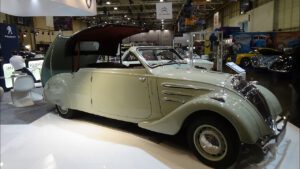
1968 Mini Cabrio – Exterior and Interior – Retro Classics Stuttgart 2022
In 1968, an open-top Mini was not a standard factory product but a specialist creation. Compact, front-wheel-driven and originally conceived as an economical city car, the Mini became the basis for exclusive cabriolet conversions. The result combined British small-car engineering with bespoke craftsmanship.
Technical Details
The 1968 Mini Cabrio was based on the standard Mini platform engineered by Alec Issigonis and produced by the British Motor Corporation (BMC). Its defining technical feature was the transverse-mounted inline four-cylinder engine driving the front wheels — an advanced layout introduced in 1959 that maximized interior space within minimal exterior dimensions.
By 1968, engine options typically included the 848 cc, 998 cc, or 1,275 cc A-Series engines, depending on base model and market. Power outputs ranged approximately from 34 horsepower (848 cc) to around 76 horsepower in higher-performance Cooper S variants. The four-speed manual gearbox was integrated into the engine sump, sharing lubrication — a distinctive Mini engineering solution.
Suspension consisted of independent rubber cone suspension units front and rear, replacing conventional coil springs. This design contributed to the Mini’s compact packaging and responsive handling. Disc brakes were fitted on performance-oriented versions such as the Cooper S, while standard models retained drum brakes.
Convertible conversions required structural reinforcement, as the Mini’s original monocoque relied heavily on roof rigidity. Coachbuilders added strengthened sills and additional bracing to compensate for the removed roof structure, ensuring torsional stability.
- Manufacturer: British Motor Corporation
- Model Name: Mini Cabrio (coachbuilt conversion)
- Year of Manufacturing: 1968 (conversion year; original Mini platform introduced 1959)
Design
The 1968 Mini Cabrio retained the instantly recognizable compact proportions of the classic Mini: short overhangs, upright windshield, and minimal body length. The removal of the fixed steel roof transformed the car’s profile, emphasizing its small footprint and open-air character.
Unlike later factory-built Mini Convertibles, 1960s cabriolets were typically produced by independent coachbuilders such as Radford, Crayford, or other specialist firms. Designs varied: some retained full door frames with a folding fabric top, while others adopted more radical cut-down door designs and simplified soft-top mechanisms.
The interior reflected the base Mini’s functional simplicity, often upgraded by the coachbuilder. Higher-end conversions could include improved upholstery, wood trim, and enhanced instrumentation. Despite its small size, the Mini Cabrio offered seating for four, though rear passenger space remained limited.
Historical Significance
The Mini itself became one of the most influential small cars of the 20th century. Its transverse engine and front-wheel-drive layout set a template that would later dominate compact car design worldwide. By 1968, the Mini had already achieved motorsport success, including multiple victories in the Monte Carlo Rally with Cooper S variants.
Open-top versions, however, were never a mainstream factory offering during the 1960s. The Mini Cabrio therefore represents a niche chapter in Mini history — one shaped by coachbuilders responding to customer demand for individuality and leisure-oriented motoring. These conversions aligned with the broader cultural atmosphere of the late 1960s, when small, stylish cars became part of youth and urban culture in Britain and beyond.
Because production numbers were limited and conversions varied by builder, each 1968 Mini Cabrio tends to have unique details, making them particularly interesting within classic car circles.
Quirks and Pop Culture
The Mini’s cultural presence in the 1960s extended far beyond technical innovation. It became associated with British popular culture, fashion, and music. Although the most famous Mini film appearance remains the 1969 movie The Italian Job (featuring hardtop Minis), convertible variants contributed to the model’s image as playful and urban.
Coachbuilt Mini convertibles were sometimes commissioned by celebrities and affluent buyers seeking exclusivity. The combination of small dimensions and open-top driving gave the car a distinctive character: light, agile, and unconventional compared with larger British convertibles of the era.
Display and preservation:
The vehicle was exhibited at the Retro Classics Stuttgart in 2022. This car show is one of the major events on the classic car calendar in Germany. In 2022, it took place across five exhibition halls. Visitors can enjoy special showcases, hunt for rare parts and books, and buy cars—both private sellers and dealers offer a wide range of classic and youngtimer vehicles. In 2022, there was a noticeable increase in low-mileage youngtimers and classic cars.
Conclusion
The 1968 Mini Cabrio represents a specialized interpretation of one of Britain’s most influential automobiles. Built on the innovative front-wheel-drive Mini platform from British Motor Corporation, it combined compact engineering with bespoke open-top conversion. Structurally reinforced and often individually finished, these cabriolets remain rare examples of 1960s coachbuilding creativity. As part of the broader Mini legacy, the 1968 Mini Cabrio reflects both technical ingenuity and the cultural optimism of its time.