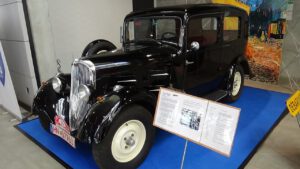
1968 Alfa Romeo Giulia TI – Oldtimer-Meeting Baden-Baden 2022
At a time when family sedans were expected to be obedient and unremarkable, the Alfa Romeo Giulia TI quietly challenged that assumption. Introduced in 1962, it looked pragmatic but behaved with an ease and confidence more typical of sports cars. Its real achievement was not speed alone, but how effortlessly it blended everyday usability with advanced thinking.
Technical Details:
Beneath the Alfa Romeo Giulia TI’s upright bodywork lay an engineering package that was far more sophisticated than many contemporaries in the mid-size sedan segment. Power came from a 1,570 cc four-cylinder engine with dual overhead camshafts, producing 92 horsepower at 6,200 rpm. This twin-cam layout, still unusual in family cars at the time, reflected Alfa Romeo’s habit of transferring competition-derived solutions directly into production models. Fuel delivery was handled by a single downdraft twin-choke carburetor, prioritizing smooth response and reliability over outright aggression. The engine was paired with a five-speed manual gearbox, initially operated via a column-mounted shifter, a configuration chosen to enhance cabin space and comfort. The Alfa Romeo Giulia TI’s suspension setup contributed significantly to its relaxed driving character, allowing the car to be driven quickly without feeling tense or demanding. Early examples relied on Alfin drum brakes, while from September 1963 onward disc brakes were adopted, bringing the braking system in line with the car’s performance potential. With a curb weight of around 1,000 kilograms and a top speed of roughly 165 km/h, the Alfa Romeo Giulia TI demonstrated how balanced engineering could outperform raw numbers.
- Manufacturer: Alfa Romeo
- Model name: Alfa Romeo Giulia TI
- Year of manufacturing: 1962–1967
Design:
The design of the Alfa Romeo Giulia TI was shaped less by tradition than by data. Alfa Romeo openly stated that wind tunnel testing guided the car’s form, an approach that was still rare for production sedans in the early 1960s. The result was a body that appeared almost austere, yet achieved a drag coefficient of approximately 0.34, lower than several sleeker-looking Alfa models. Rounded edges, carefully managed surfaces, and the distinctive Kamm-style rear were all functional responses to aerodynamic study. The exterior avoided ornamentation, giving the car a purposeful and honest appearance. Inside, the emphasis remained on practicality, but with thoughtful details. The dashboard presented clear instrumentation, and the front seats featured fully reclining backrests, a feature that aligned with the Alfa Romeo Giulia TI’s touring ambitions. Early cars promoted a six-seat configuration enabled by the column shift and front bench arrangement, though most drivers found the car ideally suited to four occupants and long-distance comfort rather than maximum capacity.
Historical Significance:
The Alfa Romeo Giulia TI arrived at a moment when Alfa Romeo was redefining its role in the market. Rather than separating sporting models from everyday transport, the company chose to merge these identities. The Alfa Romeo Giulia TI became the foundation of this philosophy, proving that advanced aerodynamics, a sophisticated engine, and a practical four-door layout could coexist in a single car. Its development also highlighted how closely Alfa Romeo’s production and competition departments worked together. Certain suspension elements appeared in contemporary Zagato racing cars, blurring the line between road car and racer. The later Alfa Romeo Giulia TI Super further emphasized this connection, offering increased power, twin carburetors, revised gearing, and a top speed approaching 190 km/h, all within the familiar sedan format. Over time, the Giulia platform expanded into numerous variants, including smaller displacement models and later Super versions, confirming the adaptability and longevity of the original concept.
Quirks and Pop Culture:
The Alfa Romeo Giulia TI’s reputation today is shaped as much by its contradictions as by its specifications. Its square profile earned it a reputation as an unlikely aerodynamic success, often cited as an early example of wind tunnel–influenced series production. The “TI” designation, standing for Turismo Internazionale, hinted at ambitions that went well beyond commuting. Period advertising even suggested the car could seat six, a claim made possible by the column-mounted shifter, though real-world use favored comfort over novelty. The Alfa Romeo Giulia TI also became a familiar presence in European cinema during the late 1960s, appearing in films such as Roma come Chicago, Niente rose per OSS 117, and Banditi a Milano. These appearances reinforced its image as a believable, fast-moving car of everyday life rather than an unattainable exotic.
Display and preservation:
The vehicle was exhibited at the Oldtimer-Meeting Baden-Baden in 2022. Set in the elegant spa gardens of Baden-Baden, this open-air event is one of Germany’s most atmospheric classic car gatherings. The 2022 edition marked the 46th year of the meeting and featured over 350 carefully selected vintage vehicles from across Europe. With its picturesque backdrop and festive ambiance, the event draws thousands of visitors who stroll among historic automobiles, enjoy live music, and take in themed displays. In 2022, American classics and convertibles were especially well represented, reflecting the event’s continued celebration of both international and domestic automotive heritage.
Conclusion:
Seen through a different lens, the Alfa Romeo Giulia TI was less about headline performance and more about intelligent integration. Its aerodynamic body, advanced twin-cam engine, and adaptable interior created a sedan that felt unusually complete for its time. By combining engineering rigor with daily practicality, the Alfa Romeo Giulia TI set a template that Alfa Romeo would revisit for years, leaving behind a car that still resonates with drivers who value substance over spectacle.