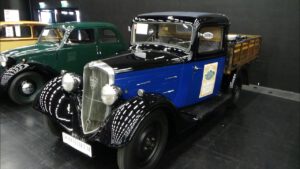
1968 Alfa Romeo Giulia TI – Oldtimer-Meeting Baden-Baden 2021
The Alfa Romeo Giulia TI arrived in 1962 looking like a sensible four-door sedan, yet it hid ideas that would shape Alfa Romeo’s future for more than a decade. Its boxy silhouette turned out to be unusually aerodynamic, and its family-friendly layout concealed genuine performance potential. Spend a little time with the Alfa Romeo Giulia TI and it becomes clear why it earned such a lasting reputation.
Technical Details:
When the Alfa Romeo Giulia TI was introduced, its technical strengths were not immediately obvious. Under the hood sat a 1,570 cc inline four-cylinder engine with dual overhead camshafts, a configuration that already reflected Alfa Romeo’s close relationship between road cars and racing technology. Producing 92 horsepower at 6,200 rpm, the engine was fed by a single downdraft twin-choke carburetor and delivered power smoothly and willingly. A five-speed manual gearbox came as standard, initially with a column-mounted shifter, underlining the car’s dual role as both family sedan and long-distance tourer. The chassis featured independent front suspension and a well-balanced rear axle, giving the Alfa Romeo Giulia TI a notably relaxed yet precise driving character. Early cars used Alfin drum brakes, but from September 1963 disc brakes were fitted, improving stopping power and consistency. Despite its practical four-door body and a curb weight of around 1,000 kilograms, the Alfa Romeo Giulia TI reached a top speed of approximately 165 km/h, demonstrating how effectively its mechanical package worked as a whole.
- Manufacturer: Alfa Romeo
- Model name: Alfa Romeo Giulia TI
- Year of manufacturing: 1962–1967
Design:
Alfa Romeo famously claimed that the wind itself had influenced the design of the Alfa Romeo Giulia TI, and this was more than marketing rhetoric. Extensive wind tunnel testing resulted in softly rounded surfaces and the distinctive Kamm-style rear end, which reduced aerodynamic drag despite the car’s upright proportions. With a drag coefficient of about 0.34, the Alfa Romeo Giulia TI was more aerodynamically efficient than some lower and sportier-looking Alfa models of the time. The exterior design balanced practicality and restraint, with large glass areas, simple body lines, and minimal ornamentation. Inside, the cabin emphasized functionality. The dashboard was clear and uncluttered, while the front seats featured reclining backrests that could fold fully flat, a novelty that reflected the car’s touring ambitions. Early models even promoted a six-seater concept thanks to the column shifter and front bench-style layout, though in practice the Alfa Romeo Giulia TI was most comfortable as a four-seater.
Historical Significance:
The Alfa Romeo Giulia TI introduced a concept that Alfa Romeo would refine repeatedly: compact dimensions combined with advanced engineering and real performance. Its aerodynamic development was groundbreaking for a production sedan and influenced not only later Giulia variants but also Alfa Romeo’s broader design philosophy. Elements of its suspension and chassis layout appeared in contemporary Zagato competition cars, illustrating how closely series production and motorsport development were linked at the company. The TI Super variant, produced between 1963 and 1964, pushed this idea further with 112 horsepower, twin carburetors, higher gearing, and a top speed close to 190 km/h. Homologated for touring car racing and built in limited numbers, the TI Super reinforced the Giulia’s sporting credibility. Over time, the Giulia range expanded to include smaller 1300 versions, later Super models, and even a diesel-powered Berlina in 1976, demonstrating the flexibility of the original platform.
Quirks and Pop Culture:
Among enthusiasts, the Alfa Romeo Giulia TI is often cited as an early example of wind tunnel–shaped production cars, earning a reputation as “boxy but slippery.” The twin-cam engine gave the sedan a character more commonly associated with sports cars, and the TI badge, standing for Turismo Internazionale, hinted at its ambitions. Early marketing’s six-seater claim has become a favorite piece of trivia, while the rapid evolution from drum to disc brakes shows how quickly Alfa Romeo refined the model. The Alfa Romeo Giulia TI also became a familiar sight in European cinema of the late 1960s, appearing in films such as Il medico della mutua, Banditi a Milano, and Le gendarme se marie. These roles reinforced its image as a believable, everyday performance car rather than an exotic showpiece.
Display and preservation:
The vehicle was exhibited at the Oldtimer-Meeting Baden-Baden in 2021. This event, held annually in the spa town’s Kurpark and along the Kaiserallee, is one of Germany’s most picturesque classic car gatherings. In 2021, the 44th edition featured 300 vintage vehicles from 80 different brands, including rare models. The event embraced a 1970s theme, showcasing over 40 vehicles from that era. An innovative highlight was the “automobile fashion show,” where models presented current fashion trends while riding in open-top classic cars through the park. The event concluded with the traditional Concours d’élégance, awarding 120 prizes across 15 categories.
Conclusion:
The Alfa Romeo Giulia TI combined thoughtful aerodynamics, advanced engine design, and everyday usability in a way that was quietly influential. Its technical layout bridged family transport and motorsport thinking, while its design proved that efficiency did not require dramatic styling. Decades later, the Alfa Romeo Giulia TI remains a reference point for enthusiasts who value engineering depth, understated design, and the idea that a practical sedan can still be genuinely engaging to drive.