1967 Renault R8 Gordini – Exterior and Interior – Retro Classics Stuttgart 2017
A compact family sedan transformed into a competition icon, the Renault R8 Gordini became closely associated with accessible motorsport in France. By 1967, it had evolved into a more powerful and refined version, attracting both amateur racers and enthusiastic road drivers. Its reputation rested less on luxury or size than on agility, tuning potential, and a distinctive character.
Technical Details
The 1967 Renault R8 Gordini was based on the standard Renault 8 platform but extensively reworked by Amédée Gordini for higher performance. It featured a rear-mounted inline four-cylinder engine with a displacement of 1,255 cc, replacing the earlier 1,108 cc unit used in previous versions. Equipped with a crossflow cylinder head and twin Weber carburetors, the engine produced approximately 88 PS, a significant increase for a car of its size and era.
Power was transmitted to the rear wheels through a close-ratio four-speed manual gearbox, optimized for spirited driving. The rear-engine, rear-wheel-drive layout contributed to strong traction, particularly under acceleration, though it also required careful handling at the limit. The chassis featured independent suspension on all four wheels, with revised geometry and stiffer settings compared to the standard Renault 8. Disc brakes were fitted on all four wheels, a notable feature in this class at the time and an important factor in the car’s competition credentials.
The Renault R8 Gordini was capable of reaching top speeds of around 170 km/h, placing it among the more performance-oriented small cars of the late 1960s. Its technical package emphasized responsiveness and balance rather than outright power, making it particularly suited to rallying and circuit racing.
- Manufacturer: Renault
- Model name: Renault R8 Gordini
- Year of manufacturing: 1964–1970 (1,255 cc version introduced in 1966)
Design
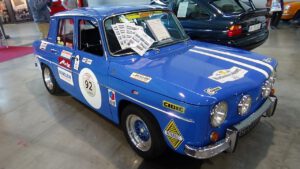
Visually, the Renault R8 Gordini remained close to the standard Renault 8, retaining its compact, boxy four-door sedan shape. The design was upright and functional, with clean lines and minimal ornamentation. Its performance identity was communicated through subtle but recognizable details rather than structural changes.
The most distinctive exterior feature was the paint scheme: a blue body color with two white racing stripes running longitudinally across the car. This livery became closely associated with the Gordini name and served as a visual marker of its sporting intent. Additional elements such as wider wheels and specific badging further distinguished it from standard versions.
Inside, the cabin remained relatively simple but included sport-oriented instrumentation. Additional gauges, such as a tachometer, were fitted to provide the driver with more detailed engine information. The interior balanced everyday usability with a focus on driving, reflecting the car’s dual role as both a road vehicle and a competition platform.
Historical Significance
The Renault R8 Gordini occupies an important place in the history of European motorsport, particularly in France. Developed in collaboration with Amédée Gordini, a well-known engineer and tuner, the model was designed to make competitive driving more accessible. Renault actively supported this goal by organizing the “Coupe Gordini,” a one-make racing series that allowed relatively inexperienced drivers to compete on equal terms.
The 1,255 cc version introduced in 1966, and continued into 1967, marked a significant step forward in performance. It strengthened the car’s competitiveness in rallying and circuit racing, where it achieved numerous successes in national and international events. The Renault R8 Gordini also contributed to Renault’s broader motorsport identity, laying groundwork for later performance models and racing programs.
Production numbers remained relatively limited compared to standard Renault models, reinforcing its status as a specialized vehicle. However, its influence extended far beyond its production volume, shaping perceptions of Renault as a brand capable of combining everyday practicality with sporting performance.
Quirks and Pop Culture
The Renault R8 Gordini became a cultural phenomenon in France during the 1960s. Its association with the Coupe Gordini racing series meant that many drivers gained their first competitive experience behind its wheel. This accessibility gave the car a unique status as both a training ground for future professionals and a symbol of grassroots motorsport.
Its distinctive blue-and-white color scheme made it instantly recognizable, and it became a familiar sight at race circuits and rally stages. The car’s lively handling characteristics, influenced by its rear-engine layout, also contributed to its reputation. Drivers often noted its tendency toward oversteer when pushed hard, a trait that became part of its appeal among enthusiasts.
Beyond motorsport, the Renault R8 Gordini appeared in period media and remains a frequent reference in discussions of classic French performance cars. Its identity is closely tied to a specific era of racing culture, where relatively simple machines could deliver engaging driving experiences.
Display and preservation
This car was exhibited at the 17th edition of Retro Classics Stuttgart in 2017. Spanning around 130,000 square meters, with 1,600 exhibitors and over 3,000 vehicles, the event attracted some 90,000 visitors. Yet beyond sheer size, a noticeable shift defined the exhibition: pre-war automobiles, once dominant, had dwindled to just a small fraction, making way for younger classics and emerging collectibles. Italian automotive culture was very present in Hall C2. Rare pieces from renowned collections, alongside iconic Maserati models and lesser-seen marques, emphasized careful curation and historical depth. Beyond cars, motorcycles and even tractors were presented with equal attention. With many vehicles offered for sale, the event also reinforced its role as a living marketplace where automotive heritage continues to change hands and remain in active circulation.
Conclusion
The 1967 Renault R8 Gordini represents a focused application of engineering to create an accessible performance car. With its rear-mounted 1.3-liter engine, four-wheel disc brakes, and competition-oriented tuning, it offered capabilities that exceeded its modest dimensions. Its design remained understated but distinctive, while its historical role in the Coupe Gordini and broader motorsport activities ensured lasting significance. As both a road car and a racing tool, the Renault R8 Gordini stands as a clear example of how technical refinement and targeted development can transform an ordinary platform into a lasting icon.