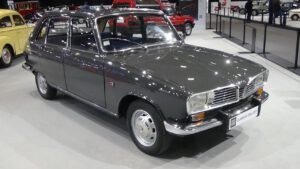
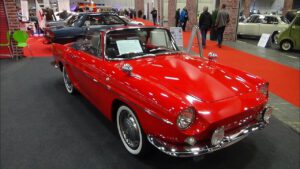
1966 Ford Mustang Coupe – Exterior and Interior – Oldtimer-Meeting Baden-Baden 2021
Most 1966 Mustangs were not convertibles or fastbacks—they were coupes. Parked in ordinary driveways and used for commuting as often as for cruising, the hardtop version defined what the Mustang meant in everyday terms. Its influence came from volume and visibility rather than spectacle.
Technical Details:
The 1966 Ford Mustang Coupe shared its mechanical architecture with the broader Mustang range, built on a unit-body platform derived from the Ford Falcon. Engine options were central to the model’s appeal. Buyers could choose between an inline six-cylinder engine (200 cubic inches / 3.3 liters) producing approximately 120 horsepower, or several versions of the 289 cubic inch (4.7-liter) small-block V8, with outputs ranging from around 200 to 225 horsepower, depending on carburetion and tuning.
Power was delivered to the rear wheels via a three-speed manual transmission, an optional four-speed manual, or a three-speed automatic (C4 Cruise-O-Matic). This drivetrain flexibility allowed the Coupe to serve as either economical daily transport or an entry-level performance car.
The suspension setup consisted of independent front suspension with coil springs and upper and lower control arms, while the rear employed a live axle with semi-elliptic leaf springs. Braking was by hydraulic drum brakes, with front disc brakes available as an option. Steering was recirculating ball, and power assistance was widely specified.
Performance varied significantly depending on engine choice. A V8-equipped Coupe could achieve 0–60 mph in roughly eight seconds under favorable conditions, while the six-cylinder version emphasized smoothness and efficiency over acceleration.
- Manufacturer: Ford
- Model Name: Mustang Coupe (Hardtop)
- Year of Manufacturing: 1966
Design:
The Coupe—often referred to as the hardtop—was the most widely produced Mustang body style in 1966. Its fixed roofline gave the car a more compact and structurally cohesive appearance compared with the convertible, while remaining lighter and less complex.
The proportions were deliberate: long hood, short rear deck, modest overall footprint. The upright C-pillar and clean roofline provided a balanced profile that worked equally well in understated or performance-oriented trim. Exterior detailing in 1966 included a revised grille texture and subtle ornamentation changes compared with earlier models.
Unlike larger American coupes of the era, the Mustang Coupe avoided excessive length or chrome. Its simplicity made it adaptable—equally suited to conservative finishes or sporty packages. Wheel choices, stripe kits, and optional trim allowed owners to shape the car’s personality without altering its essential design.
Inside, the Mustang Coupe featured a straightforward dashboard layout with round gauges and minimal decoration. The cabin was compact but functional, offering rear seating that, while limited in space, broadened the car’s usability. Upholstery options ranged from basic vinyl to upgraded trims, reinforcing the Mustang’s flexibility across price points.
Historical Significance:
The 1966 Mustang Coupe represents the normalization of the pony car concept. While early Mustang publicity emphasized novelty, by 1966 the model had become an established segment leader. The Coupe, as the most common body style, was central to that stability.
It demonstrated that a performance-inspired design could function as everyday transportation. Unlike later muscle cars that prioritized engine size and spectacle, the Mustang Coupe balanced cost, style, and mechanical simplicity.
Sales figures in 1966 remained strong, confirming that the Mustang was not a short-lived trend. Competitors responded with their own interpretations, but the Mustang’s early consolidation ensured its position as the segment benchmark.
Quirks and Pop Culture:
While fastback Mustangs often dominate cinematic and racing imagery, the Coupe was the car most owners actually drove. It appeared in suburban driveways, college parking lots, and commuter traffic—less dramatic, but more representative of its era.
Its accessibility contributed to its lasting presence in enthusiast culture. Because it was produced in high numbers, restoration parts remain widely available, making the Coupe one of the most approachable entry points into classic American cars.
A notable quirk is how adaptable the body proved for modification. From mild visual upgrades to extensive performance builds, the 1966 Coupe has served as a foundation for countless interpretations, reinforcing its role as a flexible platform rather than a fixed identity.
Display and preservation:
The vehicle was exhibited at the Oldtimer-Meeting Baden-Baden in 2021. This event, held annually in the spa town’s Kurpark and along the Kaiserallee, is one of Germany’s most picturesque classic car gatherings. In 2021, the 44th edition featured 300 vintage vehicles from 80 different brands, including rare models. The event embraced a 1970s theme, showcasing over 40 vehicles from that era. An innovative highlight was the “automobile fashion show,” where models presented current fashion trends while riding in open-top classic cars through the park. The event concluded with the traditional Concours d’élégance, awarding 120 prizes across 15 categories.
Conclusion:
The 1966 Ford Mustang Coupe succeeded through equilibrium. It combined recognizable styling, multiple drivetrain options, and attainable pricing in a format that felt both modern and practical. Unlike more extreme variants, the Coupe’s strength lay in its ordinariness—it was the Mustang most people could realistically own. Today, it stands as a reminder that influence often belongs not to the rarest version, but to the one that becomes part of everyday life.