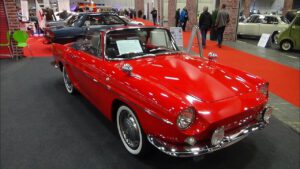
1966 Ford Mustang Convertible Type C – Exterior and Interior – Salon Automobile Lyon 2022
Open roof, long hood, and no requirement to justify either. The 1966 Mustang Convertible Type C appealed less through specifications than through immediacy, offering an uncomplicated version of personal mobility at a time when choice itself was becoming the selling point. Its success lay in how naturally it fit into everyday life rather than standing apart from it.
Technical Details:
The 1966 Ford Mustang Convertible Type C shared its mechanical foundation with the broader Mustang range, emphasizing proven components and wide availability. Engine options varied across markets and trim levels, ranging from inline six-cylinder units to small-block V8s, allowing buyers to tailor performance to their needs rather than committing to a single specification.
Power was delivered to the rear wheels through a choice of three-speed manual, four-speed manual, or three-speed automatic transmissions. This flexibility reinforced the Mustang’s positioning as a personal car adaptable to different driving styles and levels of experience.
The chassis was a unit-body structure derived from the Ford Falcon, balancing cost efficiency with adequate rigidity. Suspension consisted of independent front suspension with coil springs and control arms, while the rear employed a live axle with semi-elliptic leaf springs. This configuration favored comfort and predictability over sharp handling responses.
Braking was by hydraulic drum brakes on all four wheels, with front disc brakes available as an option. Steering was recirculating ball, with power assistance commonly specified on convertibles to reduce effort during low-speed maneuvering. Overall, the technical package prioritized ease of use and serviceability rather than outright performance.
- Manufacturer: Ford
- Model Name: Mustang Convertible (Body Type C)
- Year of Manufacturing: 1966
Design:
The design of the 1966 Ford Mustang Convertible emphasized clarity and proportion rather than dramatic revision. Compared with earlier models, the 1966 version introduced subtle refinements rather than visible transformation, reflecting the car’s established identity.
With the roof lowered, the Mustang Convertible presented a clean, uninterrupted beltline and a long hood that visually anchored the car despite its compact dimensions. The convertible top folded neatly behind the rear seats, preserving the car’s proportions and usability. Chrome detailing remained restrained, outlining key elements without overwhelming the design.
At the front, the Mustang retained its signature grille with the central running horse emblem, flanked by round headlights. Body surfaces were smooth and lightly sculpted, allowing the car to read as modern without appearing aggressive.
Inside, the convertible’s cabin balanced simplicity and comfort. The dashboard layout featured clear instrumentation and straightforward controls, while seating materials ranged from vinyl to higher-grade finishes depending on specification. With the top raised, the interior remained relatively well insulated for a convertible of the era, reinforcing the car’s everyday usability.
Historical Significance:
The 1966 model year marked a consolidation phase for the Mustang. Production volumes were high, competition had emerged, and Ford’s challenge was no longer to introduce a new idea, but to sustain it. The Convertible Type C played an important role in that effort.
Convertibles accounted for a significant share of Mustang sales, appealing to buyers who valued style and experience over raw performance. The Type C body code reflected Ford’s internal classification system, but it also underscores how standardized the Mustang had become—offered in multiple bodies, engines, and trim levels without losing coherence.
In a broader sense, the 1966 Mustang Convertible reflects the normalization of personal cars in American culture. It was no longer exceptional to own a stylish, open-top vehicle; the Mustang made that experience accessible at scale.
Quirks and Pop Culture:
While hardtop and fastback Mustangs often dominate performance narratives, the convertible developed a different cultural identity. It became associated with leisure, coastal driving, and casual style rather than competition or speed.
In film and television, Mustang convertibles frequently appeared as lifestyle vehicles—driven in everyday settings rather than dramatic chases. This presence reinforced the model’s versatility and broad appeal.
One notable quirk of the 1966 convertible is its balance between openness and structure. Reinforcement added to compensate for the lack of a fixed roof increased weight slightly, but also improved ride comfort and solidity, making the car feel more substantial than some contemporary open-top rivals.
Display and preservation:
This vehicle was presented at the Salon Automobile de Lyon 2022, held from 7 to 11 April 2022, which welcomed more than 65,000 visitors. This edition placed a strong emphasis on ecological transition, notably through the dedicated “Place Zéro Émission” area highlighting electric and hydrogen technologies. At the entrance, 25 fully electric or hybrid models underscored manufacturers’ commitments to new energies, while a 10,000 m² “second-hand” hall showcased 350 vehicles. The show offered a lively, hands-on experience: visitors could approach the cars freely, sit inside them, talk with brand representatives, and even take part in test drives organized outside the exhibition halls. Numerous animations complemented the displays, including exceptional car exhibitions, virtual reality eSport simulators, and heritage-focused showcases such as the 50th anniversary exhibition of the Renault 5 as well as a comprehensive retrospective tracing the eight generations of the Porsche 911.
Conclusion:
The 1966 Ford Mustang Convertible Type C represents the Mustang at its most settled. Neither experimental nor extreme, it delivered open-top motoring within a familiar, reliable framework. Its success lay in refinement rather than reinvention, offering buyers a relaxed and adaptable interpretation of the Mustang idea. Today, it stands as a reminder that cultural impact is often sustained not through constant change, but through careful continuity.