1965 Renault 16 – Geneva International Motor Show 2024
A family car that quietly rewrote expectations: when the Renault 16 appeared in 1965, it combined practicality and engineering in a way few competitors had attempted. Its unusual hatchback layout and front-wheel-drive architecture signaled a shift in how European cars would be designed. What looked unconventional at launch would soon become a standard formula.
Technical Details
The 1965 Renault 16 was engineered around a front-engine, front-wheel-drive layout, a configuration that Renault had already explored but refined significantly here. It was powered by an inline four-cylinder petrol engine with a displacement of 1,470 cc, producing around 55 PS in early versions. The engine was mounted longitudinally behind the front axle line, an unusual arrangement that helped optimize weight distribution and interior space. Power was transmitted to the front wheels via a four-speed manual gearbox.
The chassis featured independent suspension on all four wheels, contributing to a ride quality that was widely noted for comfort and stability. Torsion bars were used both at the front and rear, allowing for a relatively compact suspension design. Braking was handled by disc brakes at the front and drum brakes at the rear, aligning with mid-1960s European engineering standards. The Renault 16 was not designed as a high-performance vehicle but as a technically progressive family car, prioritizing space efficiency, comfort, and everyday usability.
- Manufacturer: Renault
- Model name: Renault 16
- Year of manufacturing: 1965–1980
Design
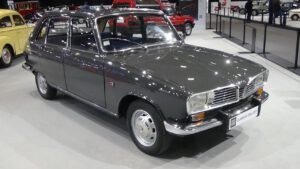
The Renault 16 stood apart visually from most mid-1960s sedans. Its five-door hatchback body combined the proportions of a saloon with the practicality of an estate, creating a new category that was not yet widely recognized. The roofline extended smoothly toward the rear, ending in a large tailgate that allowed access to a versatile cargo area.
The design emphasized function over ornamentation. Clean body surfaces, relatively large glass areas, and a high roof contributed to a sense of openness and practicality. Inside, the cabin was configured with flexibility in mind. The rear seats could be adjusted or folded in multiple ways, enabling different seating and cargo arrangements. This modular interior concept was unusual at the time and reinforced the car’s role as a practical, adaptable vehicle for everyday use.
Historical Significance
The Renault 16 emerged during a period when European car manufacturers were rethinking how to package space and functionality in mid-size vehicles. Introduced in 1965, it represented a departure from the conventional three-box sedan layout that dominated the market. By combining a hatchback body with front-wheel drive and a flexible interior, Renault created a car that addressed changing expectations of mobility and practicality.
The model’s impact was recognized early. In 1966, the Renault 16 was awarded the European Car of the Year title, reflecting its innovative approach. It demonstrated that a family car could offer both comfort and versatility without increasing size or complexity. Over its long production run until 1980, the Renault 16 influenced a generation of vehicles that adopted similar layouts, particularly in Europe, where hatchbacks would become a dominant format.
Quirks and Pop Culture
One of the Renault 16’s most distinctive features was its asymmetrical wheelbase: the left and right wheelbases differed slightly due to the torsion bar suspension layout. This technical detail had no noticeable effect on driving but remains a frequently cited curiosity among enthusiasts.
The car also became associated with a more modern, practical lifestyle in late 1960s Europe. It appealed to professionals and families who valued versatility over traditional prestige. While it did not become a major film or television icon, its presence on European roads helped normalize the hatchback concept, which later models would build upon.
Display and preservation
This car was displayed at the 2024 Geneva International Motor Show. Marking its 100-year anniversary, the spotlight on heritage proved more compelling than the scaled-down main exhibition. While the modern displays felt restrained, the carefully curated “Classic Gallery” stood out as a celebration of automotive preservation at its finest. The exhibition brought together icons spanning decades—from the Ferrari F40 and Porsche 959 to the humble Renault 16 and VW Beetle.
The displays highlighted not only the aesthetic and technical evolution of the automobile but also the importance of preserving these machines as cultural artifacts, allowing visitors to experience automotive history in a tangible, vivid way.
Conclusion
The 1965 Renault 16 introduced a combination of ideas that would shape the future of family cars. Its front-wheel-drive layout, flexible interior, and hatchback design created a template that many manufacturers would follow. Technically thoughtful rather than radical, and visually functional rather than decorative, it marked a turning point in automotive design. Today, the Renault 16 is best understood as an early and influential example of the modern hatchback concept, bridging the gap between traditional sedans and the versatile vehicles that followed.