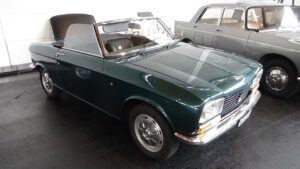
1965 Glas Goggomobil TS 250 Coupe – Exterior and Interior – Oldtimer-Meeting Baden-Baden 2022
By 1965, most European buyers were already moving toward larger small cars, yet the Glas Goggomobil TS 250 Coupé still represented an entry point into private mobility. Compact, economical, and mechanically simple, it stood at the end of Germany’s microcar boom. The TS 250 shows how far the Goggomobil concept could be refined within strict limits of size and displacement.
Technical Details
The Glas Goggomobil TS 250 Coupé was produced by Hans Glas GmbH in Dingolfing and formed part of the broader Goggomobil TS series introduced in the late 1950s as a sportier derivative of the T saloon. The “250” designation refers to its rear-mounted, air-cooled two-cylinder two-stroke engine with a displacement of 247 cc. Output figures are generally cited at approximately 15 PS, depending on specification and year.
The engine was positioned longitudinally at the rear and drove the rear wheels via a four-speed manual transmission. As with other Goggomobil models, the body was a steel monocoque construction. Suspension was independent, using coil springs and swing axles at the rear, while braking was provided by hydraulic drum brakes on all four wheels.
With a kerb weight in the region of 400 kilograms, the TS 250 Coupé achieved a top speed of roughly 85–90 km/h. Fuel consumption remained low, and the two-stroke engine required a petrol-oil mixture. Although performance was modest, the lightweight construction and compact dimensions made the car agile in urban environments. The technical package prioritized affordability and ease of maintenance over refinement.
- Manufacturer: Hans Glas GmbH
- Model Name: Glas Goggomobil TS 250 Coupé
- Year of Manufacturing: 1965
Design
The TS Coupé differed visually from the standard Goggomobil T saloon through its lower roofline and more dynamic silhouette. While still unmistakably compact, the coupé body introduced a sloping rear section and a more pronounced two-door sports profile. The proportions remained short and upright by modern standards, yet the TS conveyed a stronger sporting identity within the microcar class.
The front end featured simple round headlamps and modest chrome detailing, while the rear housed the compact engine compartment beneath a small access lid. Large windows provided good visibility, and the steel body panels were shaped to maximize interior space within minimal external dimensions.
Inside, the cockpit was straightforward. A centrally positioned speedometer and minimal switchgear defined the dashboard layout. Seating was compact but practical for short journeys. The TS designation did not transform the Goggomobil into a high-performance vehicle; instead, it offered a slightly more stylish and youthful alternative to the saloon without altering the underlying mechanical concept.
Historical Significance
The Goggomobil range was introduced in 1955 and quickly became one of the most commercially successful German microcar families of the postwar period. The TS Coupé, launched in 1957, broadened the lineup by appealing to buyers who wanted a sportier appearance without sacrificing economy.
By 1965, however, the European car market had changed significantly. Rising incomes and the availability of larger, more powerful small cars reduced demand for very small-displacement vehicles. The TS 250 Coupé therefore represents the late phase of the Goggomobil era. Production of Goggomobil variants continued until the late 1960s, but the segment was increasingly under pressure.
In 1966, Hans Glas GmbH was taken over by BMW, marking the end of Glas as an independent manufacturer. The TS 250 Coupé thus stands as one of the final expressions of Glas’ original microcar philosophy before the company’s integration into a larger automotive group.
Quirks and Pop Culture
The Goggomobil name became deeply embedded in German popular culture during the Wirtschaftswunder years. The compact dimensions and distinctive two-stroke engine sound contributed to a recognizable identity. Owners often recall the characteristic exhaust note and the routine of mixing oil with petrol as part of everyday driving.
The TS Coupé, with its slightly sportier body, attracted younger drivers and has since become a favorite among microcar collectors. Its modest power output and compact cabin are now seen less as limitations and more as defining traits of a specific historical period in European mobility. Surviving examples frequently appear at classic car gatherings, where their size and distinctive profile draw attention.
Display and preservation:
The vehicle was exhibited at the Oldtimer-Meeting Baden-Baden in 2022. Set in the elegant spa gardens of Baden-Baden, this open-air event is one of Germany’s most atmospheric classic car gatherings. The 2022 edition marked the 46th year of the meeting and featured over 350 carefully selected vintage vehicles from across Europe. With its picturesque backdrop and festive ambiance, the event draws thousands of visitors who stroll among historic automobiles, enjoy live music, and take in themed displays. In 2022, American classics and convertibles were especially well represented, reflecting the event’s continued celebration of both international and domestic automotive heritage.
Conclusion
The 1965 Glas Goggomobil TS 250 Coupé represents a refined but fundamentally simple microcar concept. Powered by a 247 cc two-cylinder two-stroke engine and built around a lightweight steel monocoque, it offered economical and accessible transportation in a compact, slightly sportier package. Historically, it marks the closing chapter of Germany’s microcar boom and the final years of Glas as an independent manufacturer. Today, the TS 250 Coupé remains a concise reminder of how small-displacement cars shaped everyday mobility in postwar Europe.