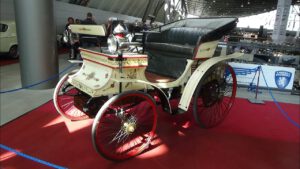
1965 Glas 1300 GT Cabriolet – Exterior and Interior – Oldtimer-Meeting Baden-Baden 2022
Italian design and Bavarian engineering rarely met as directly as they did in the 1965 Glas 1300 GT Cabriolet. Styled by Pietro Frua and powered by a modern overhead-cam four-cylinder engine, this compact open grand tourer marked Glas’ move into a more ambitious market segment. It was both a stylistic statement and a technical declaration from a company better known for microcars only a decade earlier.
Technical Details
The 1965 Glas 1300 GT Cabriolet was produced by Hans Glas GmbH and represented a significant step up from the firm’s earlier small-displacement models. Power came from a front-mounted inline four-cylinder engine with a displacement of 1,290 cc. This engine featured a single overhead camshaft driven by a toothed belt—an advanced solution at the time and one of Glas’ notable engineering contributions. Output for the 1300 GT was typically rated at approximately 75 PS at around 5,500 rpm.
Power was transmitted to the rear wheels through a four-speed manual gearbox, maintaining the classic front-engine, rear-wheel-drive layout expected of a compact grand tourer. The steel monocoque body structure provided rigidity, while suspension consisted of independent front suspension and a live rear axle with coil springs. Braking was handled by hydraulic drum brakes in early versions, with front disc brakes introduced during the model’s development.
With a kerb weight of roughly 900–950 kilograms, the Glas 1300 GT Cabriolet achieved a top speed in the region of 160 km/h, placing it competitively within the 1.3-litre sports car class of the mid-1960s. The combination of overhead-cam technology, relatively low weight, and balanced chassis tuning gave the car responsive handling and respectable performance for its displacement.
- Manufacturer: Hans Glas GmbH
- Model Name: Glas 1300 GT Cabriolet
- Year of Manufacturing: 1965
Design
The Glas 1300 GT Cabriolet was styled by Italian designer Pietro Frua, and its proportions reflect clear Mediterranean influence. The body is compact yet elegantly balanced, with a long, gently sloping bonnet and a clean, straight beltline. The front end features twin round headlamps integrated into a simple grille arrangement, while the rear is defined by subtle curvature rather than aggressive ornamentation.
The cabriolet version removed the fixed roof of the coupé while maintaining visual coherence. A folding soft top allowed open-air driving without significantly altering the car’s proportions. Chrome accents were used sparingly, highlighting window frames and bumpers without overwhelming the design. The overall impression is restrained and harmonious rather than flamboyant.
Inside, the cabin was driver-oriented, with a clearly arranged instrument cluster featuring round gauges set into a clean dashboard. Seating was supportive but compact, reflecting the car’s modest dimensions. The combination of Italian styling and German build quality gave the 1300 GT Cabriolet an identity distinct from purely domestic competitors.
Historical Significance
The Glas 1300 GT marked a turning point for Hans Glas GmbH. Having achieved success with the Goggomobil microcar range, the company sought to move upmarket in the early 1960s. The introduction of the 1300 GT in 1963 signaled this strategic shift toward higher-performance and more sophisticated vehicles.
The use of a toothed-belt-driven overhead camshaft was particularly noteworthy, as it anticipated later widespread adoption of belt-driven cam systems. The collaboration with Pietro Frua underscored Glas’ ambition to compete in the growing European compact GT segment.
However, despite technical competence and elegant styling, Glas faced increasing financial pressure from larger manufacturers. In 1966, the company was taken over by BMW. Production of Glas models continued briefly under BMW stewardship before being phased out. The 1300 GT Cabriolet thus represents one of the final independent Glas efforts to establish a premium sporting identity.
Quirks and Pop Culture
Among enthusiasts, the Glas 1300 GT is often referred to as the “Glaserati,” a nickname more commonly associated with the later 2600 V8 but reflecting the Italian styling flair across the GT range. The cabriolet variant is considerably rarer than the coupé, making surviving examples particularly sought after.
The toothed-belt camshaft drive remains a frequent point of discussion in classic car circles, as it was ahead of its time and contributed to Glas’ reputation for technical innovation. Today, the 1300 GT Cabriolet appears regularly at European classic car events, appreciated for its combination of modest size, elegant proportions, and historical context.
Display and preservation:
The vehicle was exhibited at the Oldtimer-Meeting Baden-Baden in 2022. Set in the elegant spa gardens of Baden-Baden, this open-air event is one of Germany’s most atmospheric classic car gatherings. The 2022 edition marked the 46th year of the meeting and featured over 350 carefully selected vintage vehicles from across Europe. With its picturesque backdrop and festive ambiance, the event draws thousands of visitors who stroll among historic automobiles, enjoy live music, and take in themed displays. In 2022, American classics and convertibles were especially well represented, reflecting the event’s continued celebration of both international and domestic automotive heritage.
Conclusion
The 1965 Glas 1300 GT Cabriolet stands as a compact grand tourer that bridged German engineering and Italian design. Its 1.3-litre overhead-cam engine, rear-wheel-drive layout, and balanced chassis delivered credible performance within a lightweight, stylish package. Historically, it reflects Glas’ ambition to move beyond microcars into the competitive GT market, just before the company’s acquisition by BMW. As a rare and technically interesting open sports car, the 1300 GT Cabriolet remains a distinctive chapter in mid-1960s European automotive development.