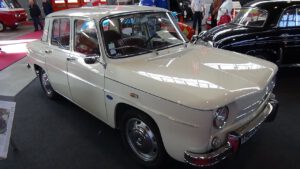
1965 Fiat 500 F – Exterior and Interior – Salon Automobile Lyon 2022
Walk through any Italian city in the mid-1960s and the Fiat 500 F would not be far away. It blended into daily routines so completely that its refinements often went unnoticed, even as they made ownership easier and safer. The model’s significance lies in how seamlessly it improved an already familiar design.
Technical Details:
The 1965 Fiat 500 F retained the 499 cc air-cooled inline two-cylinder engine, producing approximately 18 horsepower. The engine used an overhead valve configuration and was mounted at the rear, continuing the compact packaging philosophy introduced with the Nuova 500.
Cooling was managed by a fan-driven air system, eliminating the need for a conventional radiator and simplifying the car’s front-end layout. Fuel delivery was handled by a single carburetor, and power was transmitted to the rear wheels via a four-speed manual transmission, with synchromesh on the upper gears.
The 500 F employed a unitary (monocoque) body structure, maintaining structural rigidity within minimal dimensions. Independent front suspension with a transverse leaf spring and rear independent suspension with coil springs supported the lightweight chassis.
Braking was handled by hydraulic drum brakes on all four wheels. The Fiat 500 F achieved a top speed of approximately 95 km/h, sufficient for urban commuting and short intercity travel.
A key mechanical and structural update in the 500 F concerned its door configuration: unlike earlier versions, the F adopted front-hinged doors, replacing the “suicide” rear-hinged doors of prior models. This change improved safety perception and aligned the car with evolving automotive standards.
- Manufacturer: Fiat
- Model Name: Fiat 500 F
- Year of Manufacturing: 1965
Design:
The Fiat 500 F retained the familiar rounded proportions of the Nuova 500 series. Short overhangs, minimal grille detailing, and small circular headlamps defined the front end.
The extended folding fabric roof remained a central design element, allowing an open-air experience while preserving structural integrity through fixed pillars.
The most visible structural refinement was the introduction of front-hinged doors, which subtly altered the car’s side profile while maintaining its overall character. Chrome accents were limited and understated, consistent with the model’s utilitarian focus.
Inside, the dashboard featured a centrally mounted instrument cluster with speedometer and integrated warning lights. Seating remained compact but practical, accommodating four passengers for short journeys. The simplicity of the interior reflected the car’s focus on efficient urban mobility.
Historical Significance:
The Fiat 500 F represented the maturation of the Nuova 500 concept. By the mid-1960s, the model had proven its viability in the growing Italian market, and refinements such as front-hinged doors improved practicality and safety perception.
The 500 F became one of the most widely produced variants of the classic Fiat 500 lineage. It maintained the car’s affordability while addressing incremental improvements rather than pursuing major redesign.
In the broader context of European automotive development, the 500 F exemplified how small cars evolved through steady technical refinement rather than radical reinvention.
Quirks and Pop Culture:
The Fiat 500 F became emblematic of mid-1960s Italian urban life. Its compact footprint made it ideally suited to dense city centers and limited parking space.
One notable distinction among enthusiasts is the door configuration change, which marks a clear visual and historical difference between early and later 500 variants.
The model continues to appear in period photography and film as a representation of everyday mobility rather than luxury or performance.
Display and preservation:
This vehicle was presented at the Salon Automobile de Lyon 2022, held from 7 to 11 April 2022, which welcomed more than 65,000 visitors. This edition placed a strong emphasis on ecological transition, notably through the dedicated “Place Zéro Émission” area highlighting electric and hydrogen technologies. At the entrance, 25 fully electric or hybrid models underscored manufacturers’ commitments to new energies, while a 10,000 m² “second-hand” hall showcased 350 vehicles. The show offered a lively, hands-on experience: visitors could approach the cars freely, sit inside them, talk with brand representatives, and even take part in test drives organized outside the exhibition halls. Numerous animations complemented the displays, including exceptional car exhibitions, virtual reality eSport simulators, and heritage-focused showcases such as the 50th anniversary exhibition of the Renault 5 as well as a comprehensive retrospective tracing the eight generations of the Porsche 911.
Conclusion:
The 1965 Fiat 500 F illustrates the value of incremental engineering improvement. Retaining the 499 cc rear-mounted engine and minimalist architecture, it refined usability and structural details without altering the car’s essential identity. As one of the most recognizable variants of the classic Fiat 500, the F reinforced the model’s role as a cornerstone of Italian small-car design.