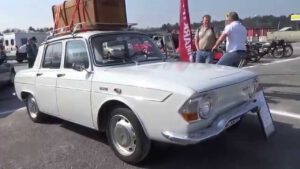
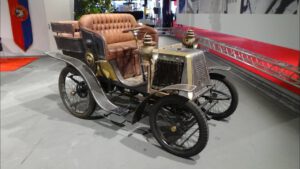
1965-1967 – Renault 10 Major – Exterior and Interior – Auto Show Veterama Hockenheim 2015
A compact sedan with a surprisingly mature presence, the Renault 10 Major illustrates how refinement can be introduced into an existing concept without radical redesign. Developed from the Renault 8, it offered improved comfort, better proportions, and a more balanced driving experience. By the mid-1960s, it represented Renault’s effort to elevate small family cars into a more sophisticated segment.
Technical Details
The Renault 10 Major, produced between 1965 and 1967, retained the rear-engine, rear-wheel-drive layout of its predecessor, the Renault 8. It was powered by a rear-mounted inline four-cylinder engine with a displacement of 1,108 cc. Output is generally cited at around 46 to 50 horsepower, depending on specific tuning and market variations. This engine provided modest but adequate performance, particularly suited to everyday driving conditions.
Power was delivered through a four-speed manual gearbox, a notable improvement over earlier three-speed configurations, allowing for better flexibility and cruising capability. The drivetrain layout ensured good traction, though it also required careful handling due to rear weight bias.
The car featured four-wheel independent suspension, with coil springs and telescopic dampers, contributing to a relatively comfortable ride for its class. Braking was handled by four-wheel disc brakes—an advanced feature at the time for a compact sedan—offering improved stopping performance and consistency compared to drum systems.
The monocoque body construction provided structural rigidity while keeping overall weight low. Combined with the rear-engine configuration, this allowed for efficient use of interior space and a compact external footprint.
- Manufacturer: Renault
- Model name: Renault 10 Major
- Year of manufacturing: 1965–1967
Design
The Renault 10 Major builds on the design language of the Renault 8 but introduces subtle yet effective changes that alter the car’s visual balance. Most notably, the front and rear overhangs were extended, giving the car a more elongated and formal appearance. This adjustment created a silhouette closer to that of larger sedans, enhancing its perceived maturity.
The front end is characterized by a rectangular grille with integrated headlights, moving away from the more compact look of the Renault 8. Chrome accents are used sparingly but effectively, adding a sense of refinement without excess. The rear maintains a clean and simple form, with the engine housed beneath a slightly raised deck.
The side profile is defined by straight lines and a clear three-box structure, emphasizing practicality and order. Inside, the cabin reflects the car’s positioning as a more comfortable alternative within the compact segment. Improved seating, clearer instrumentation, and better sound insulation distinguish it from its predecessor, making longer journeys more agreeable.
Historical Significance
The Renault 10 Major was introduced in 1965 as a development of the Renault 8, rather than a completely new model. It reflects Renault’s strategy of evolving existing platforms to meet changing market expectations, particularly the growing demand for comfort and refinement in small cars.
By the mid-1960s, European buyers increasingly expected compact vehicles to offer not just affordability, but also improved ride quality and interior space. The Renault 10 Major addressed these expectations by extending the body and enhancing comfort features, while retaining the proven mechanical layout of the Renault 8.
The “Major” designation signified a higher level of trim and equipment, positioning the car slightly above the base versions. This approach allowed Renault to appeal to a broader customer base without significantly increasing production complexity.
Production of the Renault 10 continued into the early 1970s, but the 1965–1967 period marks its introduction and early development phase. The model also represents one of the last generations of Renault’s rear-engine sedans before the company transitioned to front-engine, front-wheel-drive layouts with models such as the Renault 12.
Quirks and Pop Culture
One of the defining quirks of the Renault 10 Major is its rear-engine layout combined with relatively advanced braking technology. The use of four-wheel disc brakes in a compact sedan was unusual at the time and contributed to the car’s reputation for competent road manners.
The extended body overhangs, while improving aesthetics and luggage capacity, also subtly altered weight distribution and handling characteristics compared to the Renault 8. This gave the Renault 10 Major a slightly different driving feel, often described as more stable at speed.
Although the Renault 10 Major did not achieve strong visibility in global pop culture, it was a common sight on European roads during the late 1960s and early 1970s. It represents a category of vehicles that quietly supported the expansion of personal mobility during a period of economic growth.
Display and preservation
We filmed this car at the Veterama Hockenheim 2015, held from March 20 to 22 at the legendary Hockenheimring. The circuit hosted Europe’s largest marketplace for classic car enthusiasts. Known as a “screwdrivers’ paradise,” the event ranged from rare treasures to forgotten relics, with vast areas filled with parts, tools, literature, and complete vehicles. Special highlights included a historic wall of death show and anniversary displays such as 40 years of the BMW 3 Series.
Conclusion
The 1965–1967 Renault 10 Major demonstrates how incremental development can significantly enhance a vehicle’s appeal. By combining a proven rear-engine platform with improved comfort, extended proportions, and advanced braking technology, Renault created a compact sedan that felt more substantial than its size suggested. It stands as a transitional model, bridging earlier rear-engine designs and the more modern front-wheel-drive cars that would follow.