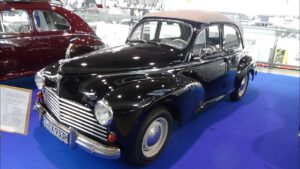
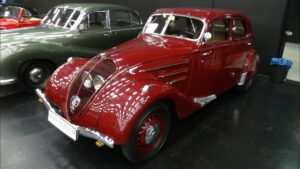
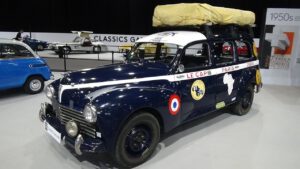
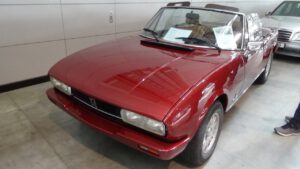
1964 Jaguar E-Type 4.2 – Exterior and Interior – Retro Classics Stuttgart 2022
When Jaguar replaced the 3.8-liter engine with a 4.2-liter unit, the Jaguar E-Type gained torque, drivability, and refinement without altering its iconic silhouette. The evolution was mechanical, not visual.
Technical Details:
The 1964 Jaguar E-Type 4.2 Series 1 was powered by a 4.2-liter dual overhead camshaft (DOHC) inline six-cylinder engine, replacing the earlier 3.8-liter unit. Output remained officially rated at approximately 265 horsepower, but torque increased significantly, improving mid-range response and everyday usability.
Fuel delivery continued through triple SU carburetors, and power was transmitted to the rear wheels via a four-speed manual transmission. Unlike the earlier 3.8-liter cars, the 4.2 featured a fully synchronized gearbox, improving shift quality and ease of operation.
The car retained its advanced structure: a monocoque center section with a tubular front subframe. Independent front suspension with torsion bars was paired with a fully independent rear suspension system featuring inboard disc brakes.
Four-wheel disc brakes remained standard. The 4.2-liter E-Type achieved a top speed similar to the 3.8—approximately 150 mph (240 km/h)—but delivered smoother acceleration due to the increased displacement and torque.
Cooling and electrical systems were also refined, enhancing reliability and everyday drivability.
- Manufacturer: Jaguar Cars
- Model Name: Jaguar E-Type 4.2 (Series 1)
- Year of Manufacturing: 1964
Design:
Visually, the 1964 E-Type 4.2 retained the defining characteristics of the Series 1 design. Covered headlamps, a long forward-hinged bonnet, and flowing body lines continued unchanged.
The model was available in both Open Two Seater (OTS) and Fixed Head Coupé (FHC) body styles. The aerodynamic profile and balanced proportions remained central to its identity.
Inside, however, subtle changes distinguished the 4.2-liter cars. The earlier aluminum center console was replaced with a black vinyl-covered console and revised seating, improving comfort and practicality. Seat designs were updated to provide better support and adjustability.
The overall aesthetic remained elegant and purposeful, but the cabin environment became more refined and user-friendly.
Historical Significance:
The introduction of the 4.2-liter engine in 1964 marked an important refinement in the E-Type’s development. While peak horsepower figures remained similar, the increased displacement delivered improved torque and flexibility—qualities that enhanced real-world driving.
The adoption of a fully synchronized gearbox addressed one of the primary criticisms of the earlier 3.8-liter cars. This update made the E-Type more accessible to a broader range of drivers without diminishing performance.
The 4.2 Series 1 cars preserved the original covered headlamp design and slim bumpers, maintaining the aesthetic purity of the early E-Type while benefiting from mechanical improvements.
Quirks and Pop Culture:
The 4.2-liter Series 1 E-Type occupies a unique position among enthusiasts. It combines the early visual purity of the 1961–1967 Series 1 body with improved drivability compared to the 3.8.
One notable distinction is the interior transformation—from aluminum console to padded vinyl trim—which reflects Jaguar’s effort to balance sporting intent with comfort.
The E-Type continued to appear prominently in film and media throughout the mid-1960s, reinforcing its cultural status as a symbol of modern performance and design.
Display and preservation:
The vehicle was exhibited at the Retro Classics Stuttgart in 2022. This car show is one of the major events on the classic car calendar in Germany. In 2022, it took place across five exhibition halls. Visitors can enjoy special showcases, hunt for rare parts and books, and buy cars—both private sellers and dealers offer a wide range of classic and youngtimer vehicles. In 2022, there was a noticeable increase in low-mileage youngtimers and classic cars.
Conclusion:
The 1964 Jaguar E-Type 4.2 represents refinement without reinvention. By increasing displacement and introducing a fully synchronized gearbox, Jaguar enhanced usability while preserving the Series 1’s iconic form. With its 4.2-liter DOHC inline six, independent rear suspension, and four-wheel disc brakes, it maintained the E-Type’s position at the forefront of 1960s sports car engineering—combining performance, sophistication, and unmistakable design.