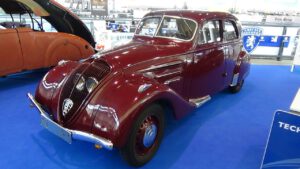
1964 Daimler Dart SP 250 – Exterior and Interior – Oldtimer-Meeting Baden-Baden 2022
A British sports car with a hemispherical-head V8 was an unusual proposition in 1964. The Daimler Dart SP 250 combined lightweight fiberglass construction with a compact 2.5-litre V8 engine at a time when most domestic rivals relied on inline four- or six-cylinder units. It remains one of the most distinctive departures from British sports car convention of the early 1960s.
Technical Details
The 1964 Daimler SP 250 was produced by Daimler Company, which had been acquired by Jaguar Cars in 1960. Originally introduced in 1959 as the “Dart,” the model was later renamed SP 250 to avoid trademark conflicts.
Power came from a 2,548 cc V8 engine featuring hemispherical combustion chambers. Designed by Edward Turner—known for his work in motorcycle engineering—the engine produced approximately 140 bhp (SAE gross). The V8 was relatively compact and lightweight, contributing to the car’s favorable power-to-weight ratio. Power was transmitted to the rear wheels through a four-speed manual gearbox.
The SP 250 used a separate ladder-type chassis with a fiberglass body mounted on top. Early versions were criticized for chassis flex, but by 1964 structural reinforcements had been introduced, improving rigidity and handling stability. Suspension consisted of independent front suspension with coil springs and a live rear axle located by semi-elliptic leaf springs. Four-wheel hydraulic disc brakes were fitted, reflecting the car’s performance orientation.
With a kerb weight of around 940 kilograms, the Daimler SP 250 achieved a top speed in the region of 190 km/h (approximately 120 mph), making it one of the faster British sports cars of its class at the time.
- Manufacturer: Daimler Company
- Model Name: Daimler Dart SP 250
- Year of Manufacturing: 1964
Design
The SP 250’s design was unconventional for its era. The fiberglass body allowed complex curves and detailing that would have been more difficult in steel. The front end featured a distinctive grille shape flanked by pronounced headlamp housings, while the sides incorporated sculpted contours and chrome trim elements.
The car’s proportions followed the classic roadster formula: long bonnet, compact cockpit, and short rear deck. However, the styling details—particularly the grille and tail treatment—divided opinion at the time. Compared with more restrained contemporaries, the SP 250 presented a bold visual statement.
Inside, the cabin combined sporting elements with traditional Daimler touches. The dashboard typically featured a wood veneer fascia with centrally arranged round instruments. Leather upholstery and chrome accents reinforced the car’s premium positioning within the British Motor Corporation’s portfolio after Jaguar’s acquisition.
Historical Significance
The Daimler SP 250 was introduced in 1959 as Daimler’s attempt to enter the sports car market, traditionally dominated by brands such as Jaguar, MG, and Austin-Healey. The use of a compact V8 engine set it apart from most competitors.
Following Jaguar’s acquisition of Daimler in 1960, the SP 250 continued in production, but development resources were limited. Structural improvements were made to address early criticisms of chassis rigidity, and by 1964 the model had reached its most refined specification.
Production ended in 1964, with approximately 2,600 units built in total. The SP 250 remains notable as Daimler’s only postwar production sports car and as one of the few British roadsters of its period to feature a V8 engine as standard.
Quirks and Pop Culture
The hemispherical-head V8 is often cited as the SP 250’s defining feature. Its compact size and distinctive exhaust note differentiated it from the inline engines common in rival models.
The model’s original name, “Dart,” was changed to SP 250 due to trademark concerns in export markets. The combination of fiberglass bodywork and luxury trim elements also contributed to its unusual positioning—part sports car, part premium roadster.
Today, the Daimler SP 250 is appreciated for its individuality and engineering distinctiveness. While once controversial in styling, it has gained recognition as a rare example of British V8 sports car experimentation in the early 1960s.
Display and preservation:
The vehicle was exhibited at the Oldtimer-Meeting Baden-Baden in 2022. Set in the elegant spa gardens of Baden-Baden, this open-air event is one of Germany’s most atmospheric classic car gatherings. The 2022 edition marked the 46th year of the meeting and featured over 350 carefully selected vintage vehicles from across Europe. With its picturesque backdrop and festive ambiance, the event draws thousands of visitors who stroll among historic automobiles, enjoy live music, and take in themed displays. In 2022, American classics and convertibles were especially well represented, reflecting the event’s continued celebration of both international and domestic automotive heritage.
Conclusion
The 1964 Daimler Dart SP 250 combined a 2.5-litre hemispherical-head V8 engine with lightweight fiberglass body construction and four-wheel disc brakes. Producing approximately 140 bhp and capable of around 120 mph, it offered performance that matched its unconventional engineering. As Daimler’s sole postwar sports car and one of the few British V8 roadsters of its era, the SP 250 occupies a distinctive position in 1960s automotive history.