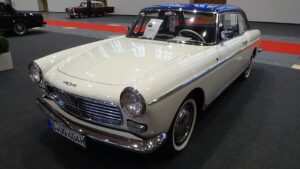
1963 Porsche 356 B 1600 Coupe – Exterior and Interior – Auto Zürich Classic Car Show 2022
In autumn 1959, a familiar silhouette arrived with subtle but consequential changes. Higher bumpers, repositioned headlights, and a refined 1.6-liter boxer engine quietly reshaped how Porsche met new regulations without abandoning its core ideas. The result was the Porsche 356 B 1600, a car that looked evolutionary yet marked a clear step into the 1960s.
Technical Details:
The Porsche 356 B 1600 was powered by an air-cooled four-cylinder boxer engine with a displacement of 1,582 cc. With two valves per cylinder and twin Zenith 32 NDIX downdraft carburetors, the so-called “Damen” variant delivered 60 PS (44 kW) and a peak torque of 110 Nm. Power was sent through a four-speed manual gearbox to the rear wheels, a configuration already central to Porsche’s engineering identity. Drum brakes were fitted all around, with duplex drums at the front and simplex units at the rear, reflecting the period’s balance between performance and reliability. The car reached a top speed of around 155 km/h and accelerated from 0 to 100 km/h in approximately 16.5 seconds. Weighing about 900 kg in standard form, slightly more after the 1962 model year revisions, the 356 B 1600 relied on light construction rather than outright power. The chassis dimensions remained compact, with a 2,100 mm wheelbase, supporting agile handling that appealed to both everyday drivers and enthusiastic amateurs.
- Manufacturer: Porsche
- Model Name: Porsche 356 B 1600
- Year of Manufacturing: 1960–1963 (Roadster: 1960–1962)
Design:
Visually, the 356 B introduced changes that were immediately noticeable to those familiar with earlier A-series cars. Export regulations prompted Porsche to raise the bumpers, which in turn led to headlights being positioned higher on the front fenders. These headlights were more upright and featured asymmetric dipped beams, giving the front a subtly altered expression. Coupé versions could be identified by standard pop-out side windows, while Cabriolet and Roadster variants maintained a lighter, more open appearance. The Hardtop Coupé, built on a Cabriolet body, stood out with its welded roof and an unusual rear section that hinted at a notchback profile. Inside, Porsche focused on ergonomics rather than spectacle. Updated seats, a deep-dish steering wheel, and incremental refinements to controls reflected a growing attention to driving position and comfort. The overall design remained restrained, but it carried a sense of maturity that suited the new decade.
Historical Significance:
The 356 B was unveiled at the 1959 International Motor Show in Frankfurt as part of Porsche’s T5 technical program. Rather than pursuing a clean-sheet redesign, Porsche chose targeted updates, influenced by tightening export rules and limited budgets due to expanding motorsport activities. Bodies for Coupé and Cabriolet models were produced by Reutter in Stuttgart, while the Roadster added a fresh option to the range. Some long-time enthusiasts felt the raised lights and bumpers softened the original character of the 356, yet sales figures told a different story. The B-series outsold its predecessor, demonstrating that careful evolution could satisfy regulators, customers, and engineers alike. By the 1962 model year, further updates such as a larger rear window and revised engine lid ventilation showed how Porsche continuously refined the car while keeping its mechanical foundations intact.
Quirks and Pop Culture:
The 356 B era introduced several details that later became talking points among enthusiasts. Later B models moved the fuel filler to an external flap on the front fender, eliminating the need to open the front trunk to refuel. Cabin changes, including deeper seats and steering wheel revisions, highlighted Porsche’s early obsession with driver fit. The Hardtop Coupé remains a niche curiosity, a body style remembered mostly by collectors and historians. Beyond design quirks, the 356 family carried strong motorsport associations, often cited for class successes in endurance racing such as Le Mans and events like the Mille Miglia. The model’s cultural profile was boosted by famous owners, including Steve McQueen, James Dean, and Sean Connery, all frequently linked with Porsche 356s in period accounts and later lore.
Display and preservation:
The vehicle was exhibited at the Auto Zürich Classic Car Show in 2021. As part of the broader Auto Zürich Car Show, the Classic section has grown into a key attraction for lovers of historic vehicles in Switzerland. In 2021, the event took place at Messe Zürich and featured a dedicated hall showcasing a curated selection of vintage automobiles, spanning from pre-war icons to youngtimers. The atmosphere combined elegance with accessibility, allowing visitors to admire rare collector cars alongside enthusiast vehicles. Special displays highlighted Swiss automotive heritage and featured club presentations and dealer exhibits.
Conclusion:
The Porsche 356 B 1600 illustrates how measured change can extend a successful concept. With its refined 1.6-liter engine, updated bodywork, and subtle interior improvements, it bridged early postwar Porsche design and the more regulated automotive world of the 1960s. Neither radical nor static, the 356 B 1600 maintained the brand’s technical philosophy while adapting to new demands, securing its place as an important chapter in Porsche history and a lasting reference point for enthusiasts today.