1963 Peugeot 404 – Klassikwelt Bodensee 2017
Introduced at a moment when European car design was moving toward clarity and restraint, the Peugeot 404 stood out through its balance rather than boldness. The 1963 model year captures the car in its early phase, before later updates, when its combination of durability, modern styling, and technical consistency established its long-term success.
Technical Details
The 1963 Peugeot 404 was powered by a front-mounted inline four-cylinder engine with a displacement of 1,618 cc. In its standard carbureted form, the engine produced approximately 65 horsepower, while fuel-injected versions—equipped with the Kugelfischer mechanical injection system—reached around 85 horsepower. This made the injected Peugeot 404 one of the more technically advanced mid-size sedans of its class in the early 1960s.
Power was delivered to the rear wheels via a four-speed manual transmission, often operated through a column-mounted gear lever, a common feature at the time. An automatic transmission was also available in certain markets. The chassis used independent front suspension combined with a rigid rear axle, tuned for stability and durability rather than sporty dynamics.
Braking was handled by drum brakes on all four wheels in early versions, consistent with the standards of the period. The overall engineering emphasized robustness and ease of maintenance, qualities that would later define the model’s global reputation. The Peugeot 404’s mechanical layout proved particularly well suited to difficult road conditions, contributing to its widespread use in export markets.
- Manufacturer: Peugeot
- Model name: Peugeot 404
- Year of manufacturing: 1963
Design
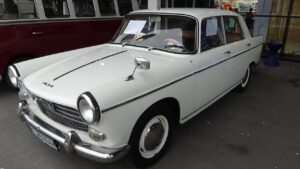
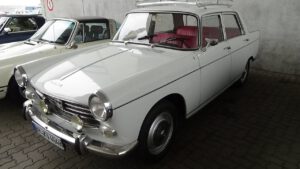
The design of the Peugeot 404 was developed in collaboration with Pininfarina, resulting in a clean and disciplined aesthetic. The 1963 version retains the original design language introduced at the model’s launch, characterized by straight lines, balanced proportions, and minimal decorative elements.
The front features a rectangular grille flanked by vertically oriented headlights, giving the car a composed and formal appearance. The body sides are flat and uncluttered, while the overall silhouette remains upright, prioritizing interior space and visibility. Chrome accents are used sparingly, reinforcing the car’s understated character.
Inside, the cabin reflects a functional approach. The dashboard layout is simple and easy to read, with controls arranged logically. Materials are durable rather than luxurious, aligning with the car’s role as a practical family vehicle. In contrast, the coupé and cabriolet versions—also designed by Pininfarina—introduced a more refined interpretation of the same design principles, with a lower roofline and more expressive detailing.
Historical Significance
By 1963, the Peugeot 404 had already begun to establish itself as a key model in the brand’s lineup, following its introduction in 1960 as the successor to the Peugeot 403. It represented a continuation of Peugeot’s strategy of producing solid, mid-sized cars with strong export potential.
The early 1960s were a period of rapid expansion for the European automotive market, and the Peugeot 404’s combination of reliability and modern styling allowed it to compete effectively. Over time, production would reach approximately 2.8 million units, with the model remaining in production in Europe until 1975 and even longer in some international markets.
The availability of mechanical fuel injection in a mid-range sedan was a notable feature, highlighting Peugeot’s engagement with emerging technologies. At the same time, the later introduction of diesel variants would further strengthen the model’s reputation, particularly in markets where durability and fuel efficiency were critical.
Quirks and Pop Culture
The Peugeot 404 became widely known for its durability, particularly outside Europe. In many African countries, it gained a reputation as a nearly indestructible taxi, capable of operating for years under demanding conditions. This image became a defining part of its identity.
The model also participated in long-distance rally events, where its robust construction and predictable handling proved advantageous. These appearances reinforced its reputation as a dependable rather than high-performance vehicle.
Another interesting aspect is the contrast within the model range: while the sedan was practical and restrained, the coupé and cabriolet versions added a layer of elegance, showing the flexibility of the underlying design.
Display and preservation
This car was filmed at the Klassikwelt Bodensee 2017. The show demonstrated how dynamic classic vehicle preservation can be when brought to life beyond static displays. Attracting nearly 39,000 visitors from 17 countries, the event combined exhibitions across ten halls with live demonstrations on land, water, and in the air. Historic aircraft, racing cars, and motorcycles were not only displayed but actively showcased, reinforcing their mechanical vitality. Special exhibitions and club presentations added depth, while around 600 privately owned classics integrated visitors into the display itself. This immersive format highlighted preservation as an experience—where history is not only protected, but continuously lived and shared.
Conclusion
The 1963 Peugeot 404 represents the model at an early and formative stage, combining straightforward engineering with a clean, modern design. Its reliable mechanical layout, advanced options such as fuel injection, and carefully balanced styling contributed to its long-lasting success. As both a family car and a global workhorse, the Peugeot 404 became one of Peugeot’s defining models, and the 1963 version illustrates the foundations of that achievement.