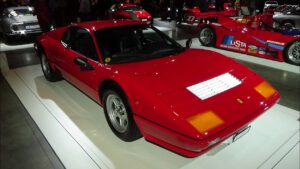
1963 Ferrari 250 GTE – Exterior and Interior – Classic Expo Salzburg 2021
In 1963, Ferrari was no longer building cars exclusively for racing drivers and two-seat purists. The Ferrari 250 GTE 2+2 combined a Colombo V12 with genuine rear seating, becoming the company’s first series-produced four-seat model. It marked a decisive expansion of Ferrari’s grand touring ambitions.
Technical Details:
The 1963 Ferrari 250 GTE 2+2 was powered by a front-mounted 2,953 cc V12 engine from the long-running Colombo family. The engine featured a 60-degree layout, single overhead camshaft per bank, and three Weber 36 DCL carburetors in standard configuration. Output was rated at approximately 240 PS (around 177 kW) at 7,000 rpm, depending on market specification.
Power was transmitted to the rear wheels through a four-speed manual gearbox, often equipped with electric overdrive in later examples. The drivetrain followed Ferrari’s established front-engine, rear-wheel-drive configuration. The chassis was based on a tubular steel frame derived from the 250 GT platform, with independent front suspension using wishbones and coil springs, and a live rear axle with semi-elliptic leaf springs. Disc brakes were fitted on all four wheels, reflecting Ferrari’s shift toward improved braking performance in the early 1960s.
With a top speed of approximately 230 km/h, the 250 GTE delivered strong grand touring performance despite its additional size and weight compared with two-seat 250 variants.
- Manufacturer: Ferrari
- Model Name: Ferrari 250 GTE 2+2
- Year of Manufacturing: 1960–1963
Design:
The Ferrari 250 GTE 2+2 was styled by Pininfarina and built by Carrozzeria Pininfarina. Unlike earlier Ferrari 250 GT coupés, which prioritized compact proportions, the GTE’s wheelbase was extended to accommodate a genuine rear bench seat. The result was a more balanced 2+2 configuration without resorting to exaggerated rooflines.
The front end featured a restrained grille and dual headlamps set into clean fender contours. Chrome detailing was subtle, reinforcing the car’s role as an elegant touring machine rather than a competition model. The side profile displayed a smooth shoulder line and a relatively upright greenhouse to maximize interior space.
Inside, the 250 GTE offered a more spacious and refined environment than previous Ferrari road cars. The rear seats were usable for short to medium journeys, making it practical for family touring. The dashboard incorporated classic round instrumentation in front of the driver, complemented by high-quality leather upholstery and wood trim elements typical of early-1960s Italian luxury cars.
Historical Significance:
Introduced in 1960, the Ferrari 250 GTE 2+2 was a turning point in Ferrari’s production strategy. It was the first Ferrari to be built in significant numbers, with more than 950 examples produced between 1960 and 1963. This made it the company’s best-selling model up to that time.
The 250 GTE played a crucial financial role. Its commercial success provided Ferrari with stable revenue during a period when racing activities demanded significant resources. The model broadened Ferrari’s customer base beyond dedicated sports car enthusiasts, attracting buyers seeking a fast yet comfortable grand tourer with additional seating.
By 1963, production of the 250 GTE was nearing its end, soon to be replaced by the 330 America and later the 330 GT 2+2. The GTE thus represents the first mature expression of Ferrari’s four-seat grand touring formula.
Quirks and Pop Culture:
The Ferrari 250 GTE has sometimes been overshadowed by more competition-focused 250 variants such as the 250 GT SWB or the 250 GTO. However, its role as Ferrari’s first high-volume production model makes it historically significant.
During the 1960s, some 250 GTEs were used by Italian police forces, including the Polizia Stradale, highlighting the car’s performance capabilities even in official service. In collector culture, the 250 GTE has often been regarded as a more accessible entry point into the 250 series, though increasing recognition of its historical importance has strengthened its standing.
The model also illustrates Ferrari’s shift from a primarily race-oriented manufacturer to a broader producer of refined grand tourers.
Display and preservation:
The vehicle was exhibited at the Classic Expo Salzburg in 2021. As one of Austria’s premier classic car events, the show has established itself as a central meeting point for collectors, restorers, and enthusiasts from across Central Europe. The 2021 edition took place at Messezentrum Salzburg and featured more than 250 exhibitors, along with a strong turnout of over 20,000 visitors. Attendees could explore a broad range of offerings—from historical vehicles and motorcycles to automobilia, spare parts, and literature.
Conclusion:
The 1963 Ferrari 250 GTE 2+2 stands as a milestone in Ferrari’s evolution. Technically defined by its 3.0-liter Colombo V12, tubular chassis, four-wheel disc brakes, and rear-wheel-drive layout, it delivered authentic Ferrari performance in a practical four-seat format. Its Pininfarina-designed body combined elegance with improved interior space, while its commercial success provided financial stability for the company. As Ferrari’s first series-produced 2+2 model, the 250 GTE remains a foundational chapter in the brand’s grand touring history.