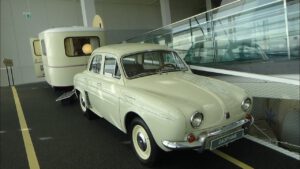
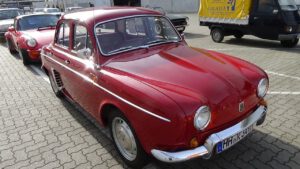
1962 Renault Dauphine – Hadi Columbus T 295 – Hymer Museum Bad Waldsee 2021
In 1962, two very different approaches to mobility could be found on European roads: the compact Renault Dauphine and the far rarer Hadi Columbus T 295 caravan. One represented mass-produced urban transport, the other a niche solution for leisure travel. Together, they illustrate how mobility in the early 1960s was expanding beyond necessity toward flexibility and recreation.
Technical Details
The 1962 Renault Dauphine retained its characteristic rear-engine, rear-wheel-drive layout. It was powered by a water-cooled inline four-cylinder engine with a displacement of 845 cc, producing around 30 to 32 horsepower. This modest output was sufficient for its intended role as an economical passenger car, with a top speed of approximately 110–115 km/h. The engine was paired with a three-speed manual transmission, with later versions offering four forward gears. Independent suspension on all four wheels, using coil springs, contributed to a relatively compliant ride, particularly on uneven European roads.
The Hadi Columbus T 295, by contrast, was not a self-propelled vehicle but a lightweight travel caravan designed to be towed by small cars such as the Dauphine. Its construction emphasized low weight and aerodynamic efficiency, critical factors given the limited towing capacity of compact vehicles. The caravan featured a simple chassis with a single axle and lightweight body panels, often made from a combination of wood framing and metal skin. Braking systems were typically minimal or absent, relying on the towing vehicle for deceleration.
The technical relationship between the two is key: the Dauphine’s modest engine output required trailers like the Columbus T 295 to be as light and efficient as possible. This pairing reflects a broader engineering compromise of the era, where leisure travel had to adapt to the limitations of small-displacement cars.
- Manufacturer: Renault / Hadi
- Model name: Renault Dauphine / Hadi Columbus T 295
- Year of manufacturing: 1962
Design
The Renault Dauphine’s design followed the principles of late-1950s European small cars, with a rounded ponton body and integrated fenders. Its compact proportions, smooth surfaces, and restrained detailing gave it a modern but approachable appearance. The rear-engine configuration allowed for a short front overhang and a front luggage compartment, while cooling vents at the rear subtly indicated the engine placement. Inside, the cabin was simple and functional, with an emphasis on space efficiency and visibility.
The Hadi Columbus T 295 adopted a distinctly different design language, shaped by the requirements of towing and temporary habitation. Its form was compact and streamlined, with softly curved edges to reduce drag. Large side windows provided light to the interior, while the overall height was kept relatively low to maintain stability behind small cars.
Inside, the caravan was arranged with efficiency in mind. Seating areas could be converted into sleeping spaces, and storage compartments were integrated wherever possible. Materials were lightweight but practical, reflecting the need to balance comfort with towing limitations. Visually, the caravan complemented cars like the Dauphine, forming a cohesive combination that emphasized mobility and independence.
Historical Significance
By 1962, the Renault Dauphine had become one of the most widely produced French cars, with millions of units built since its introduction in 1956. It played a central role in Renault’s expansion into international markets and represented accessible mobility for a broad customer base. Its engineering, derived from the earlier 4CV, reflected continuity in Renault’s approach to small-car design.
At the same time, Western Europe was experiencing rising prosperity, which led to increased interest in leisure travel. Caravans like the Hadi Columbus T 295 emerged as part of this shift, enabling families to travel independently without relying on hotels or fixed accommodations. These lightweight trailers were specifically designed to be compatible with smaller vehicles, making recreational travel accessible to a wider audience.
The pairing of a Dauphine with a compact caravan illustrates a transitional moment: mobility was no longer limited to commuting or basic transport but extended into tourism and personal freedom. This combination reflects broader social changes in post-war Europe, where increasing car ownership began to reshape patterns of travel and leisure.
Quirks and Pop Culture
The Renault Dauphine’s reputation varied across markets, but in Europe it became a familiar and often fondly remembered vehicle. Its rear-engine layout gave it distinctive handling characteristics, including good traction but also a tendency toward oversteer under certain conditions. These traits became part of its identity among drivers.
Caravans like the Hadi Columbus T 295 contributed to a new visual culture of travel. Period photographs and advertisements often depict small family cars towing compact trailers through alpine roads or coastal landscapes, symbolizing a growing sense of mobility and independence. The modest scale of both car and caravan stands in contrast to later decades, when larger vehicles would dominate recreational travel.
The idea that a relatively small car such as the Dauphine could tow a caravan at all is itself a notable feature, highlighting both the ambitions and limitations of the time. It reflects a period when efficiency and ingenuity were essential to achieving new forms of mobility.
Display and preservation
We filmed the car and caravan in 2021 at the Hymer Museum in Bad Waldsee. The museum presents the history of mobile travel through a refreshingly personal perspective. Across more than 6,000 square meters, over 80 historic caravans, motorhomes, and leisure vehicles guide visitors along iconic dream routes—from the Alps to North America. Many exhibits remain in original condition or have been carefully restored, preserving their authentic character. Supported by an extensive collection of around 250 vehicles and archival material, the museum emphasizes both technical development and cultural context. Its interactive approach ensures that the spirit of travel, innovation, and preservation remains vivid and accessible to every visitor.
Conclusion
The 1962 Renault Dauphine and the Hadi Columbus T 295 represent two complementary aspects of early 1960s mobility. The Dauphine provided affordable, mass-produced transportation, while the Columbus caravan extended its capabilities into leisure and travel. Technically, the pairing required careful balance between power, weight, and practicality.
Together, they illustrate how automotive design was adapting to changing social expectations. As car ownership increased, so too did the desire for flexibility and independence, leading to solutions that combined everyday transport with recreational use. This combination captures a moment when mobility was expanding in both function and meaning, shaping how people moved and traveled in post-war Europe.