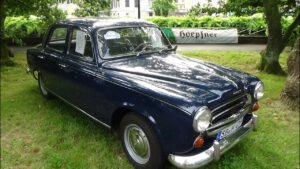
1962 Peugeot 403 B – Oldtimer-Meeting Baden-Baden 2016
By the early 1960s, the Peugeot 403 had become a well-established and widely trusted model, known for its durability and understated design. The 1962 Peugeot 403 B represents one of the later iterations of this successful series, incorporating incremental improvements while maintaining the core qualities that had defined the model since its introduction. It reflects Peugeot’s consistent approach of refining proven engineering rather than pursuing rapid redesign.
Technical Details
The 1962 Peugeot 403 B was powered by a front-mounted inline four-cylinder engine with a displacement of 1,468 cc. The engine featured an overhead valve configuration and produced approximately 65 horsepower in its later versions, offering a balanced combination of efficiency and performance for everyday use. Power was transmitted to the rear wheels via a four-speed manual gearbox, with the fourth gear functioning as an overdrive, improving fuel efficiency and reducing engine wear during sustained driving.
The car followed a conventional front-engine, rear-wheel-drive layout. Its construction was based on a robust chassis with a unitary body structure, contributing to overall rigidity and durability. The suspension system consisted of independent front suspension with coil springs and a rear live axle supported by leaf springs, designed to provide a comfortable ride on a variety of road surfaces.
Braking was handled by drum brakes on all four wheels, which were typical for the period, although some later versions of the Peugeot 403 range introduced improvements in braking assistance. The overall technical design emphasized longevity, ease of servicing, and consistent performance under demanding conditions.
- Manufacturer: Peugeot
- Model name: Peugeot 403 B
- Year of manufacturing: 1962
Design
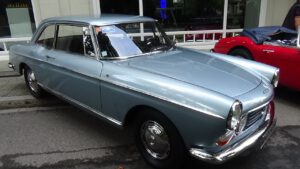
The Peugeot 403 was designed by Pininfarina, marking one of the early collaborations between Peugeot and the Italian coachbuilder. The design of the Peugeot 403 B reflects a transition toward more modern, balanced proportions while retaining a degree of traditional formality.
The front end is characterized by a wide grille with horizontal elements, flanked by integrated headlamps that sit within the front fenders. The body lines are clean and restrained, with a clear separation between functional elements and decorative details. Compared to earlier Peugeot models, the 403 appears more structured and less rounded, reflecting evolving design trends of the late 1950s and early 1960s.
The proportions are practical, with a spacious cabin and a relatively upright stance that maximizes interior volume. Chrome accents are present but used sparingly, emphasizing key features without dominating the overall design. Inside, the cabin layout is straightforward, with clear instrumentation and durable materials suited to everyday use. The design prioritizes clarity and usability over visual complexity.
Historical Significance
The Peugeot 403 was introduced in 1955 as a successor to the 203 and quickly became one of the brand’s most important models. It was developed during a period of growth for Peugeot, as the company expanded its production capacity and strengthened its position in international markets.
By 1962, the Peugeot 403 had already achieved significant commercial success, with production exceeding one million units over its lifespan. The “B” designation reflects a later stage in the model’s development, incorporating refinements in engine performance and overall reliability.
The Peugeot 403 also played a key role in establishing Peugeot’s collaboration with Pininfarina, a partnership that would continue for decades and influence many subsequent models. Its reputation for durability made it particularly successful in export markets, including regions with challenging driving conditions. The model’s longevity and widespread adoption highlight its importance in Peugeot’s transition into a more modern automotive manufacturer.
Quirks and Pop Culture
The Peugeot 403 gained notable visibility through its association with the television series Columbo, where the main character, portrayed by Peter Falk, drove a worn but distinctive Peugeot 403 Cabriolet. Although this specific version differs from the Peugeot 403 B saloon, it contributed significantly to the model’s recognition in popular culture.
Beyond its media presence, the Peugeot 403 became known for its reliability and versatility. It was widely used as a family car, taxi, and commercial vehicle, reinforcing its image as a dependable and practical automobile. Its understated design and long production run made it a familiar sight across Europe and beyond.
The model’s ability to perform reliably under varied conditions contributed to its enduring reputation, and it remains a respected example of mid-20th-century automotive engineering within classic car communities.
Display and preservation
This car was filmed at the 40th International Oldtimer-Meeting Baden-Baden. Held from 8 to 10 July 2016, the show transformed the Kurpark into an elegant open-air museum of automotive history. Featuring 376 classic cars spanning nine decades, the event combined concours-level presentation with a uniquely atmospheric setting. Highlights included a special exhibition by Erdmann & Rossi and a tribute to 40 Years of the Golf GTI. As evening fell, nostalgic garden parties with jazz music, fashion shows, and illuminated displays created a refined backdrop, emphasizing both preservation and the living culture of classic motoring.
Conclusion
The 1962 Peugeot 403 B represents the mature phase of a model defined by consistency and reliability. Its straightforward engineering, durable construction, and restrained design allowed it to meet the needs of a broad range of users. Historically, it reflects Peugeot’s strategy of refining successful concepts while expanding its international presence. Today, the Peugeot 403 B stands as a clear example of how thoughtful engineering and gradual development can result in a lasting and widely appreciated automobile.