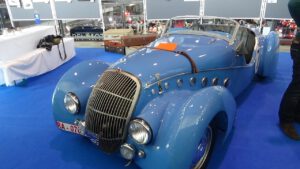
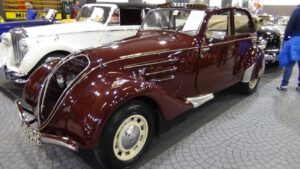
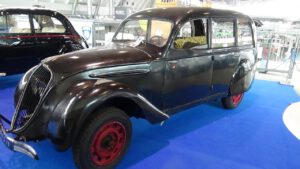
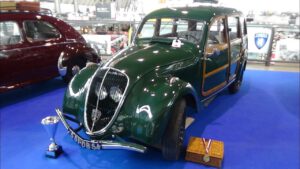
1962 Maserati 3500 GT Vignale Spider – Exterior and Interior – Auto Zürich Classic Car Show 2021
By 1962, the Maserati 3500 GT Vignale Spider had matured into one of Italy’s most refined open grand tourers. It combined a competition-derived six-cylinder engine with modern fuel injection and four-wheel disc brakes. At a time when Maserati was redefining its future, this Spider embodied both technical ambition and commercial necessity.
Technical Details:
The 1962 Maserati 3500 GT Vignale Spider was powered by a front-mounted inline six-cylinder engine with a displacement of 3,485 cc. Derived from Maserati’s 350S sports racing engine, this unit had been adapted for road use with revised cam profiles and improved durability. By 1962, many examples were delivered in GTI specification, equipped with Lucas mechanical fuel injection rather than the earlier triple Weber carburetors. Output in injected form was typically rated at around 235 horsepower, providing strong mid-range torque and a top speed of approximately 220 km/h.
Power was transmitted to the rear wheels via a five-speed manual gearbox supplied by ZF, replacing the earlier four-speed transmission found on initial production cars. The chassis consisted of a tubular steel frame, reflecting Maserati’s motorsport engineering background. Independent front suspension with coil springs and wishbones was paired with a live rear axle supported by semi-elliptic leaf springs. By this stage of production, four-wheel disc brakes were standard, significantly enhancing stopping performance compared to many contemporaries. The overall layout remained front-engine, rear-wheel drive, optimized for high-speed touring stability and balanced handling.
- Manufacturer: Maserati
- Model Name: Maserati 3500 GT Vignale Spider
- Year of Manufacturing: 1959–1964
Design:
The Spider version of the Maserati 3500 GT was bodied by Carrozzeria Vignale and introduced in 1959 as an open alternative to the Touring-designed coupé. By 1962, the design had evolved subtly, presenting a clean and restrained profile consistent with early 1960s Italian styling.
The front end featured Maserati’s signature oval grille with the Trident emblem centered prominently. Headlamps were smoothly integrated into the front fenders, while a straight, horizontal beltline defined the side view. Compared with the coupé, the Spider had a slightly shorter wheelbase, contributing to more compact proportions and a sportier visual stance. Chrome detailing was present but controlled, outlining bumpers and window frames without overwhelming the overall form.
Inside, the 3500 GT Vignale Spider emphasized clarity and driver orientation. The dashboard typically displayed a row of round gauges set within a simple, horizontal fascia. Materials such as leather upholstery and polished trim reinforced the car’s grand touring role. With the top folded, the open body enhanced the sense of space and connection to the road, aligning with the expectations of export markets, particularly the United States.
Historical Significance:
The Maserati 3500 GT was introduced in 1957 as the company’s first true series-production road car. Until then, Maserati had relied heavily on racing activities and limited road models. Financial pressures in the late 1950s made it clear that a sustainable future depended on commercially viable grand tourers. The 3500 GT provided that foundation.
The Spider variant, launched in 1959, was developed in response to strong demand for open high-performance cars, especially in North America. By 1962, the model line had been refined through the adoption of fuel injection (designated 3500 GTI) and improved braking systems. These updates positioned the 3500 GT among the technically advanced European grand tourers of its era.
Production of the Spider remained limited, with just over 240 examples built between 1959 and 1964. This relatively small number underscores its exclusivity compared with the coupé. The success of the 3500 GT family enabled Maserati to stabilize financially and paved the way for later models such as the Sebring and Mistral, which continued the front-engine grand touring tradition.
Quirks and Pop Culture:
The Maserati 3500 GT Vignale Spider became closely associated with the early 1960s international lifestyle. Its blend of racing-derived engineering and understated Italian styling appealed to affluent buyers seeking performance without excessive flamboyance. Unlike some later Maserati models, the 3500 GT did not rely on dramatic styling cues; its appeal lay in proportion and mechanical pedigree.
Collectors often distinguish sharply between the Touring-bodied coupé and the Vignale-bodied Spider, even though both share the same underlying mechanical architecture. The use of different coachbuilders for variants of the same model reflects the Italian tradition of combining standardized chassis engineering with individualized body design.
Display and preservation:
The vehicle was exhibited at the Auto Zürich Classic Car Show in 2021. As part of the broader Auto Zürich Car Show, the Classic section has grown into a key attraction for lovers of historic vehicles in Switzerland. In 2021, the event took place at Messe Zürich and featured a dedicated hall showcasing a curated selection of vintage automobiles, spanning from pre-war icons to youngtimers. The atmosphere combined elegance with accessibility, allowing visitors to admire rare collector cars alongside enthusiast vehicles. Special displays highlighted Swiss automotive heritage and featured club presentations and dealer exhibits.
Conclusion:
The 1962 Maserati 3500 GT Vignale Spider represents a mature phase of Maserati’s first successful series-production grand tourer. Its 3.5-liter inline-six engine—often equipped with Lucas fuel injection—tubular chassis, ZF five-speed gearbox, and four-wheel disc brakes illustrate a technically sophisticated approach rooted in competition experience. Designed by Carrozzeria Vignale, the open body added elegance and export appeal to an already accomplished platform. As a limited-production model built during a crucial transition in Maserati’s history, the 3500 GT Vignale Spider remains a significant and sought-after example of early 1960s Italian grand touring engineering.