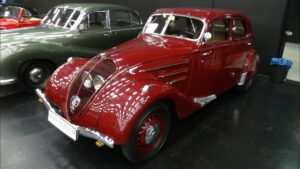
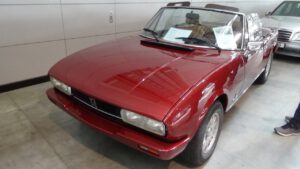
1962 Ford Taunus 12M – Oldtimer-Meeting Baden-Baden 2022
The Taunus nameplate had already become central to Ford-Werke’s passenger-car identity well before the Ford Taunus 12M appeared. First introduced before the Second World War and revived afterward, Taunus models formed the backbone of Ford’s West German production throughout the 1950s to the 1970s.
Technical Details:
The Ford Taunus 12M (P4) of 1962 represents a clear technical break from earlier Taunus generations. Most notably, it was the first front-wheel-drive production car built by Ford, marking a fundamental change in drivetrain philosophy for the company in Germany. Power came from a compact V4 engine, an unconventional choice at the time that was closely tied to the car’s overall packaging concept. The engine was mounted at the front and drove the front wheels, freeing up interior and luggage space compared to traditional rear-wheel-drive layouts.
Displacement ranged from 1,172 to 1,498 cubic centimeters, with power outputs spanning from 38 PS at 4,250 rpm to 55 PS at the same engine speed, depending on version. Top speed varied accordingly, from around 105 km/h up to approximately 130 km/h. The four-cylinder engine configuration was designed to be short in length, allowing the drivetrain to fit transversely while keeping the front overhang compact. The Taunus 12M (P4) used a steel monocoque body, continuing Ford Germany’s postwar move toward modern self-supporting chassis construction. Braking and suspension were engineered to suit everyday family use, prioritizing stability and durability over outright sportiness. The combination of front-wheel drive and V4 engine was a deliberate technical solution aimed at efficiency, space utilization, and predictable handling.
- Manufacturer: Ford (Ford-Werke, Germany)
- Model name: Taunus 12M (P4)
- Year of manufacturing: 1952-1958
Design:
Positioned as the smaller model within the Ford Taunus range, the Ford Taunus 12M (P4) was intended to sit below the larger Taunus and Ford Köln offerings, targeting buyers who wanted a practical family car without stepping into a higher price or size class. German historical sources describe the design as strongly influenced by Ford’s US-origin “Cardinal” project, later adapted for European conditions. This background explains the car’s functional proportions and emphasis on space efficiency. Offered as both a sedan and an estate, the Ford Taunus 12M provided generous interior room and an unusually large trunk for its class, a direct benefit of the front-wheel-drive layout and compact V4 engine. The steel body followed the ponton principle, integrating fenders into the main body volume and giving the car a clean, modern appearance for the early 1960s. Inside, the focus was on practicality and clarity rather than ornamentation, aligning with the expectations of buyers in the “untere Mittelklasse” segment. Overall, the design communicated rationality and usefulness, qualities that matched the car’s technical concept.
Historical Significance:
The Taunus nameplate had already become central to Ford-Werke’s passenger-car identity well before the Ford Taunus 12M appeared. First introduced before the Second World War and revived afterward, Taunus models formed the backbone of Ford’s West German production throughout the 1950s to the 1970s. Earlier milestones included the 1952 Ford Taunus 12M, Ford Germany’s first postwar new design and the first German automobile with a self-supporting ponton body, even though its styling originated in Dearborn rather than Cologne. The Ford Taunus 12M (P4) of 1962 marked another turning point. As a new-generation Taunus, it introduced front-wheel drive and the V4 engine to Ford’s German lineup, signaling a willingness to depart from conservative engineering solutions. Produced from 1962 to 1966, the Ford Taunus 12M achieved a total output of around 672,000 units, making it a solid-volume success in its segment and confirming that its unconventional layout could succeed in the European market.
Quirks and Pop Culture:
One of the most frequently cited episodes in the Ford Taunus 12M (P4) story is an endurance run carried out under FIA supervision beginning on 10 July 1963 at Miramas. Although this event occurred after the launch of the 1962 model-year car, it strongly shaped public perception of the P4. Over the course of the test, the car covered approximately 358,274 kilometers, surpassing the original 300,000-kilometer target and setting more than 100 records while averaging about 106.48 km/h. German club and reference material explicitly frame this run as a response to skepticism surrounding the durability and everyday suitability of the new V4 engine and front-wheel-drive layout. The fact that the car was essentially series-spec added to the credibility of the demonstration and helped cement the P4’s reputation for robustness.
Display and preservation:
The vehicle was exhibited at the Oldtimer-Meeting Baden-Baden in 2022. Set in the elegant spa gardens of Baden-Baden, this open-air event is one of Germany’s most atmospheric classic car gatherings. The 2022 edition marked the 46th year of the meeting and featured over 350 carefully selected vintage vehicles from across Europe. With its picturesque backdrop and festive ambiance, the event draws thousands of visitors who stroll among historic automobiles, enjoy live music, and take in themed displays. In 2022, American classics and convertibles were especially well represented, reflecting the event’s continued celebration of both international and domestic automotive heritage.
Conclusion:
The 1962 Ford Taunus 12M (P4) stands out as a decisive moment in Ford Germany’s postwar development. By introducing front-wheel drive and a compact V4 engine, it broke with established conventions and redefined how space, drivetrain layout, and practicality could be combined in a lower-middle-class car. Its design emphasized functionality, its engineering reflected a new conceptual approach, and its historical role extended the long-running importance of the Taunus nameplate. Supported by strong production numbers and reinforced by high-profile endurance testing, the Taunus 12M (P4) secured its place as one of the more technically significant German family cars of the early 1960s.