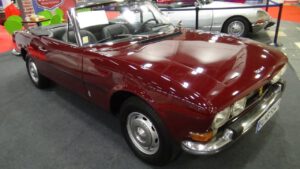
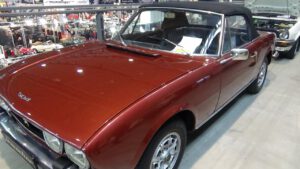
1962 Alfa Romeo Giulietta Sprint Zagato – Exterior and Interior – Classic Expo Salzburg 2021
The Giulietta Sprint Zagato emerged at a crucial moment for Alfa Romeo. After the success of the 1900, the Giulietta line was essential for the brand’s survival and growth, bringing advanced engineering to a broader but still aspirational audience. The Sprint Zagato itself was almost an accident. Its origins lie in a privately commissioned rebody of a crashed Giulietta Sprint Veloce, which Zagato reshaped according to its lightweight, aerodynamic philosophy.
Technical Details:
The 1962 Alfa Romeo Giulietta Sprint Zagato is based on the Giulietta platform but engineered with a clear motorsport focus. At its heart sits Alfa Romeo’s advanced 1.3-liter inline four-cylinder engine, a unit that was far ahead of its time when first introduced. The engine features an aluminum block and head, a crossflow layout, and two chain-driven overhead camshafts operating two valves per cylinder. Bore and stroke measure 74 by 75 millimeters, creating an almost square configuration that favors high-revving behavior. In Sprint Zagato specification, output rises to 100 PS at around 6,500 rpm, thanks to higher compression and competition-oriented tuning. Power is delivered through a four-speed manual gearbox to the rear wheels. Lightweight construction is central to the car’s performance: with a curb weight of roughly 854 kilograms and a height of just 1,250 millimeters, the power-to-weight ratio drops to approximately 8.5 kilograms per PS. Suspension follows proven Giulietta practice, with independent front suspension using MacPherson struts and a live rear axle with coil springs. Braking is by drums on all four wheels in standard SZ form, while later competition-focused variants received front disc brakes. With this setup, the Giulietta Sprint Zagato could reach a top speed close to 200 km/h, an exceptional figure for a 1300 cc GT car of the early 1960s.
- Manufacturer: Alfa Romeo
- Model Name: Alfa Romeo Giulietta Sprint Zagato
- Year of Manufacturing: 1954-1964
Design:
The design of the Giulietta Sprint Zagato departs sharply from the elegant Bertone-penned Sprint, replacing refinement with purpose. Zagato clothed the chassis in a hand-formed aluminum body, shaped to minimize weight and aerodynamic drag. The resulting form is compact, low, and unmistakably functional. The roofline flows smoothly into a rounded rear, earning the car its famous nickname “Brötchen,” or bread roll. Narrow pillars, thin aluminum panels, and often Plexiglas side and rear windows reinforce the competition intent. The front end is clean and minimal, with small headlights and a restrained interpretation of the Alfa Romeo grille. Wheels are pushed close to the corners, visually emphasizing the car’s short overhangs and athletic stance. Inside, the focus remains on driving: sparse trim, simple instruments, and lightweight seats dominate the cabin. Comfort takes a back seat to clarity and control, giving the interior the atmosphere of a road-legal race car rather than a grand touring coupé.
Historical Significance:
The Giulietta Sprint Zagato emerged at a crucial moment for Alfa Romeo. After the success of the 1900, the Giulietta line was essential for the brand’s survival and growth, bringing advanced engineering to a broader but still aspirational audience. The Sprint Zagato itself was almost an accident. Its origins lie in a privately commissioned rebody of a crashed Giulietta Sprint Veloce, which Zagato reshaped according to its lightweight, aerodynamic philosophy. The result proved so effective on the racetrack that Alfa Romeo adopted it into the official model range. Introduced in 1959 and still evolving by 1962, the SZ became one of the most successful 1300 cc GT racers of its era. Privateers campaigned it extensively, achieving class victories and strong finishes at events such as the Mille Miglia, Targa Florio, Nürburgring endurance races, Sebring, Le Mans, and Spa-Francorchamps. In total, Alfa Romeo produced nearly 180,000 Giuliettas across all variants, but Sprint Zagato production remained extremely limited, underlining its specialist role within the lineup.
Quirks and Pop Culture:
Built on Giulietta underpinnings but clothed in hand-formed aluminum, many Sprint Zagatos went full race-focused with Perspex windows and other weight-saving details, blurring the line between road car and competition machine. By 1962, the most discussed evolution was the “Coda Tronca” version, featuring an abruptly truncated rear end inspired by aerodynamic research. What appears at first glance as a styling oddity is pure function, and today it is often the SZ variant most frequently referenced by enthusiasts. Period racers embraced the car for its toughness and speed in the fiercely competitive 1300 cc GT class. Jeweler and racer Gianni Bulgari later recalled that in 1961 and 1962 there was hardly a race in Italy without several SZs battling at the front of their category. With production numbers often cited around 217 cars across 1960 to 1962, the Giulietta SZ remains rare. Its pop culture presence leans more toward collector and connoisseur circles than film or television appearances, reinforcing its reputation as an insider’s Alfa Romeo.
Display and preservation:
The vehicle was exhibited at the Classic Expo Salzburg in 2021. As one of Austria’s premier classic car events, the show has established itself as a central meeting point for collectors, restorers, and enthusiasts from across Central Europe. The 2021 edition took place at Messezentrum Salzburg and featured more than 250 exhibitors, along with a strong turnout of over 20,000 visitors. Attendees could explore a broad range of offerings—from historical vehicles and motorcycles to automobilia, spare parts, and literature.
Conclusion:
The 1962 Alfa Romeo Giulietta Sprint Zagato represents the most uncompromising expression of the Giulietta concept. Combining advanced lightweight engineering, a high-revving twin-cam engine, and a body shaped by racing logic rather than fashion, it stands apart from more refined coupés of its time. Its success on international circuits, low production numbers, and distinctive design have secured its place as one of the most focused and memorable Alfa Romeo sports cars of the early 1960s, valued today as much for its engineering integrity as for its racing heritage.