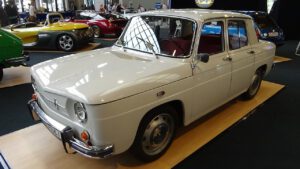
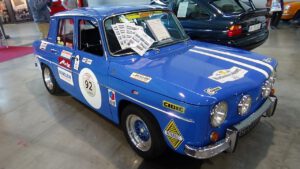
1962 – 1968 Renault R8 – Exterior and Interior – Klassikwelt Bodensee 2017
The Renault R8 arrived at a moment when small family cars were beginning to evolve beyond basic transportation. Produced from 1962 to 1968 in its original form, it combined familiar rear-engine engineering with a more modern body and improved comfort. It was also a car that quietly bridged two worlds: practical everyday use and, in certain versions, serious motorsport potential.
Technical Details
The Renault R8 retained a rear-engine, rear-wheel-drive layout, continuing the technical lineage of earlier Renault models such as the Dauphine. It was powered by a water-cooled inline four-cylinder engine mounted at the rear, with an initial displacement of 956 cc, producing around 44 horsepower in standard form. Later versions, including the R8 Major, featured a larger 1,108 cc engine with increased output.
The engine was paired with a four-speed manual transmission, a step forward from earlier three-speed setups. The gearbox was fully synchronized, improving drivability and ease of operation. One of the most notable technical upgrades compared to its predecessors was the introduction of four-wheel disc brakes, a relatively advanced feature for a compact car in the early 1960s.
Suspension followed an independent layout on all four wheels, using coil springs and maintaining Renault’s focus on ride comfort and road holding. The rear-engine configuration provided good traction, particularly in low-grip conditions, although it also influenced handling characteristics, especially at higher speeds.
- Manufacturer: Renault
- Model name: Renault R8
- Year of manufacturing: 1962–1968
Design
The Renault R8 marked a clear stylistic shift away from the rounded forms of the 1950s. Its body adopted a more angular, three-box design, with clean lines and a defined separation between front, passenger compartment, and rear. This gave the car a more modern and structured appearance compared to the Dauphine.
At the front, the R8 featured a simple rectangular grille flanked by round headlights, creating a balanced and functional look. The proportions were compact but upright, maximizing interior space within a relatively small footprint. The rear-engine layout allowed for a short front end, with the luggage compartment located at the front.
Inside, the cabin was more refined than earlier Renault small cars. The dashboard layout was clear and functional, with improved instrumentation and controls. Seating comfort was enhanced, and the overall interior design reflected a move toward greater usability and everyday practicality. Large windows contributed to good visibility and a sense of openness.
Historical Significance
The Renault R8 was introduced as the successor to the Dauphine, aiming to modernize Renault’s small-car offering while retaining a proven technical concept. By the early 1960s, however, the automotive industry was beginning to shift toward front-engine, front-wheel-drive layouts, a transition Renault itself would later embrace with models like the Renault 16.
Within this context, the R8 represents both continuity and evolution. It refined the rear-engine formula with better braking, improved suspension, and a more modern body, extending the life of this configuration for several more years.
The model also gained significant recognition through its performance-oriented variants, particularly the R8 Gordini. These versions demonstrated that the basic platform could be adapted for motorsport, achieving success in rallying and touring car competitions. This dual identity—practical family car and competitive performance machine—added depth to the R8’s legacy.
Production extended beyond 1968 in some markets, but the 1962–1968 period captures its core development and initial impact. In total, more than a million units were produced, confirming its role as a key model for Renault during the decade.
Quirks and Pop Culture
The Renault R8 is often remembered for its association with the Gordini name, which transformed the modest sedan into a recognizable performance car. Even standard versions benefited indirectly from this image, giving the model a broader appeal.
Its rear-engine layout remained a defining characteristic. While it offered advantages in traction and packaging, it also required drivers to adapt to its handling behavior. This trait became part of the car’s personality and is still discussed among enthusiasts today.
The R8 also appeared frequently in European everyday life during the 1960s, becoming a familiar presence on roads across France and beyond. Its straightforward design and widespread use made it representative of the era’s transition toward more modern, practical vehicles.
Display and preservation
This car was filmed at the Klassikwelt Bodensee 2017. The show demonstrated how dynamic classic vehicle preservation can be when brought to life beyond static displays. Attracting nearly 39,000 visitors from 17 countries, the event combined exhibitions across ten halls with live demonstrations on land, water, and in the air. Historic aircraft, racing cars, and motorcycles were not only displayed but actively showcased, reinforcing their mechanical vitality. Special exhibitions and club presentations added depth, while around 600 privately owned classics integrated visitors into the display itself. This immersive format highlighted preservation as an experience—where history is not only protected, but continuously lived and shared.
Conclusion
The Renault R8, produced between 1962 and 1968, represents a mature stage in the evolution of rear-engine small cars. Technically, it combined proven architecture with meaningful improvements such as four-wheel disc brakes and a fully synchronized gearbox. Its design moved toward a more modern, angular form, while the interior offered improved comfort and usability.
Historically, it stands at a crossroads between older engineering traditions and emerging new concepts in automotive design. Its success in both everyday use and motorsport highlights its versatility, making the Renault R8 an important and multifaceted model in Renault’s history.