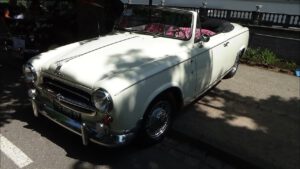
1959 Peugeot 403 B Cabrio – Exterior and Interior – Oldtimer Meeting Baden-Baden 2015
The 1959 Peugeot 403 B Cabriolet reflects a quieter kind of exclusivity. While the Peugeot 403 was widely seen as a dependable family car, its open-top variant remained rare, shaped by coachbuilding tradition rather than mass production. It is this contrast—between everyday reliability and limited-production elegance—that defines the model today.
Technical Details
The Peugeot 403 B Cabriolet was based on the robust mechanical foundation of the standard Peugeot 403 range. It featured a front-mounted inline four-cylinder engine with a displacement of 1,468 cc. In the later “B” specification, the engine benefited from incremental refinements, producing approximately 58 horsepower. Power was delivered to the rear wheels via a four-speed manual gearbox, a layout consistent with Peugeot’s engineering philosophy of durability and ease of maintenance. The car used a monocoque steel body structure, a modern solution for the time, combined with independent front suspension and a rigid rear axle supported by coil springs. Braking was handled by drum brakes on all four wheels, providing adequate stopping power for its performance level.
- Manufacturer: Peugeot
- Model name: Peugeot 403 B Cabriolet
- Year of manufacturing: 1959
Design
The design of the Peugeot 403 B Cabriolet was developed in collaboration with Pininfarina, whose influence is evident in its balanced proportions and restrained elegance. Compared to the sedan, the cabriolet featured a more refined silhouette, with a lower roofline and a clean, uninterrupted beltline that emphasized horizontal flow.
The front retained the characteristic Peugeot 403 grille and headlight arrangement, while subtle chrome accents added a sense of sophistication without excess. The rear was smoothly integrated, avoiding the heavy ornamentation seen in some contemporaries. The convertible top was neatly engineered to fold away, preserving the car’s clean lines when open. Inside, the cabin offered a simple but carefully finished environment, with clear instrumentation and materials chosen for durability rather than luxury, aligning with Peugeot’s understated approach.
Historical Significance
The Peugeot 403 marked an important phase in the company’s post-war development, representing a move toward modern, internationally styled vehicles. Introduced in 1955, the model was Peugeot’s first collaboration with Pininfarina and set a design direction that would influence the brand for decades.
Within this context, the cabriolet variant occupied a special position. Unlike the sedan, which was produced in large numbers, the cabriolet was built in relatively small quantities, making it one of the rarer expressions of the Peugeot 403 platform. By 1959, the “B” update reflected Peugeot’s strategy of gradual technical improvement rather than radical redesign, ensuring that the model remained competitive in a changing European market.
The Peugeot 403 also gained broader recognition as a reliable and versatile vehicle, exported widely and used in a variety of roles, from private transport to commercial service. The cabriolet, however, stood apart as a more lifestyle-oriented derivative, illustrating how Peugeot could adapt a practical base into a more expressive form.
Quirks and Pop Culture
The Peugeot 403 is perhaps best known for its association with the television series Columbo, where a well-worn Peugeot 403 Cabriolet became inseparable from the character of Lieutenant Columbo. Although the car used in the series was an earlier version, this connection significantly shaped the public image of the Peugeot 403 Cabriolet as a whole.
This cultural link contrasts with the car’s original positioning. What was once a relatively refined, limited-production convertible became, through its on-screen role, a symbol of understated persistence and everyday usability. Today, this dual identity—rare classic and familiar screen icon—adds to its appeal among collectors and enthusiasts.
Display and preservation
This car was displayed at the International Oldtimer-Meeting Baden-Baden 2015. Set against the elegant backdrop of the Kurpark, the show transformed the spa town into a refined celebration of automotive heritage. From July 10 to 12, around 360 classic vehicles were carefully presented in an open-air setting that emphasized both preservation and atmosphere. Honored guest Rolls-Royce marked its 111th anniversary with an exceptional display of 111 luxury automobiles, creating a living exhibition of craftsmanship and history. With approximately 20,000 visitors, the event blended elegance, authenticity, and a deep respect for classic motoring culture.
Conclusion
The 1959 Peugeot 403 B Cabriolet combines solid engineering with restrained design and a degree of exclusivity uncommon for the brand at the time. Its dependable mechanical base, shaped by Peugeot’s focus on longevity, is complemented by a Pininfarina-influenced body that avoids excess while maintaining elegance. Historically positioned between mass production and coachbuilt rarity, and reinforced by its lasting cultural presence, the Peugeot 403 Cabriolet remains a distinctive example of post-war European automotive design.