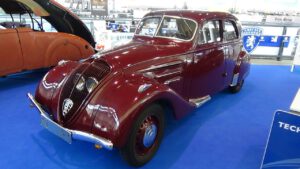
1959 Messerschmitt KR200 – Retro Classics Stuttgart 2022
Aircraft-inspired design met postwar austerity in the 1959 Messerschmitt KR200. With tandem seating beneath a transparent bubble canopy and a single-cylinder two-stroke engine at the rear, it looked more like a cockpit than a car. Yet for thousands of buyers, it provided practical and affordable mobility in a rapidly motorizing Germany.
Technical Details
The Messerschmitt KR200 was produced by Messerschmitt through its vehicle subsidiary, later known as Fahrzeug- und Maschinenbau GmbH Regensburg (FMR). The KR200 evolved from the earlier KR175 and was powered by a rear-mounted, air-cooled single-cylinder two-stroke engine supplied by Fichtel & Sachs. In the 1959 specification, displacement was 191 cc, producing approximately 9–10 PS depending on tuning.
The engine drove the single rear wheel via a four-speed manual transmission. The drivetrain layout was unconventional: two wheels at the front and one driven wheel at the rear. Steering was controlled through handlebars connected directly to the front wheels, reinforcing its aircraft-like character. Because of its lightweight construction—typically around 230 kilograms—the KR200 could achieve a top speed of approximately 85–90 km/h.
The body was constructed from steel and aluminum panels mounted on a tubular frame. Braking was handled by drum brakes. The compact dimensions and low mass allowed acceptable performance from minimal displacement, and fuel consumption remained very low. Like other two-stroke engines of the period, the KR200 required a petrol-oil mixture for lubrication.
- Manufacturer: Messerschmitt
- Model Name: Messerschmitt KR200
- Year of Manufacturing: 1959
Design
The design of the Messerschmitt KR200 was directly influenced by aircraft engineering. Its most distinctive feature is the transparent bubble canopy, hinged to open sideways or upward depending on version. Occupants sit in tandem—driver in front, passenger directly behind—similar to a fighter aircraft cockpit.
The narrow fuselage-like body tapers toward the rear, where the single driven wheel is located. At the front, two closely spaced wheels provide steering and stability. The canopy and compact body create a streamlined silhouette that reduces aerodynamic drag.
Inside, the layout is minimalist. The driver operates the vehicle using handlebars instead of a conventional steering wheel, and instrumentation is limited to essential gauges. The seating position is low, and entry requires lifting the canopy and stepping into the narrow cabin. The overall design prioritizes lightness and aerodynamic efficiency over comfort or practicality.
Historical Significance
The Messerschmitt KR200 emerged during the early 1950s, when Germany’s industrial recovery was constrained by restrictions on aircraft production. Fritz Fend, who had developed small invalid carriages after the war, collaborated with Messerschmitt to produce a lightweight microcar based on similar principles.
Introduced in 1955, the KR200 improved upon the earlier KR175 with greater displacement and better performance. By 1959, it represented one of the most recognizable microcars in Europe. It addressed the demand for affordable transportation at a time when conventional automobiles remained financially out of reach for many households.
As economic conditions improved in the late 1950s and early 1960s, demand for microcars declined in favor of larger small cars such as the Volkswagen Beetle and other compact saloons. Production of the KR200 ended in 1964. Nevertheless, the model became an icon of the microcar era and remains one of the most distinctive vehicles of postwar Europe.
Quirks and Pop Culture
The KR200’s aircraft-inspired appearance has ensured its lasting cultural visibility. Its bubble canopy and tandem seating arrangement have made it a frequent subject of automotive exhibitions and historical documentaries. The narrow track and three-wheel configuration also required drivers to adapt to different handling characteristics compared with four-wheeled cars.
One notable feature was its reversible engine rotation, which allowed the car to travel at similar speeds in reverse as in forward gear. This unusual solution compensated for the absence of a conventional reverse gear and remains one of the KR200’s most cited technical quirks.
Today, the Messerschmitt KR200 is a staple of microcar collections and museum displays. Its compact form and distinctive silhouette make it immediately recognizable, even to those unfamiliar with its technical background.
Display and preservation:
The vehicle was exhibited at the Retro Classics Stuttgart in 2022. This car show is one of the major events on the classic car calendar in Germany. In 2022, it took place across five exhibition halls. Visitors can enjoy special showcases, hunt for rare parts and books, and buy cars—both private sellers and dealers offer a wide range of classic and youngtimer vehicles. In 2022, there was a noticeable increase in low-mileage youngtimers and classic cars.
Conclusion
The 1959 Messerschmitt KR200 represents a highly unconventional approach to postwar mobility. Powered by a 191 cc single-cylinder two-stroke engine and configured with two front wheels and one driven rear wheel, it combined aircraft-inspired design with practical economy. Its bubble canopy, tandem seating, and lightweight construction distinguished it sharply from conventional automobiles. As a product of Germany’s recovery years and of Messerschmitt’s temporary shift from aviation to road vehicles, the KR200 remains a defining symbol of the European microcar era.