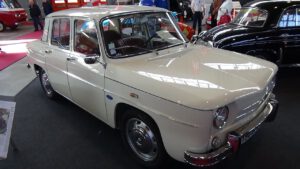
1959 Fiat 500 C Topolino – Exterior and Interior – Classic Expo Salzburg 2021
By 1959, the name “Fiat 500” already referred to a completely different car. Yet in certain markets and registrations, the older 500 C Topolino was still present on the road—carrying forward a prewar concept into a new automotive decade. Its continued visibility reflected longevity rather than contemporaneity.
Technical Details:
The Fiat 500 C Topolino, although originally introduced in the late 1940s, retained its established mechanical layout in its final production years. Power came from a 569 cc inline four-cylinder engine, delivering approximately 16.5 horsepower. The engine featured an overhead valve configuration and was water-cooled, emphasizing durability and efficient fuel consumption.
Fuel was supplied via a single carburetor, and power was transmitted to the rear wheels through a four-speed manual transmission. The drivetrain followed a conventional front-engine, rear-wheel-drive layout.
The Topolino utilized a separate chassis frame, consistent with its prewar engineering origins. Independent front suspension with transverse leaf spring and a rear live axle supported by leaf springs provided basic ride characteristics suitable for urban and rural roads.
Braking was by hydraulic drum brakes on all four wheels. Performance was modest, with top speeds generally around 90–95 km/h, depending on load and road conditions.
- Manufacturer: Fiat
- Model Name: Fiat 500 C Topolino
- Year of Manufacturing: 1959
Design:
The Fiat 500 C Topolino retained its compact, rounded proportions that had defined the model since its inception. Short overhangs, curved fenders, and an upright cabin gave the car a friendly and immediately recognizable silhouette.
The “C” version featured integrated headlamps and a simplified grille compared to earlier prewar variants. Chrome detailing was minimal and applied only where structurally or visually necessary.
A defining characteristic remained the folding canvas roof, extending from the windshield header toward the rear of the cabin. Unlike a fully removable top, this configuration preserved structural integrity while allowing partial open-air driving.
Inside, the cabin was simple and utilitarian. Instrumentation was limited to essential gauges, and the layout prioritized clarity. Seating accommodated two adults comfortably, with limited storage space behind.
By the late 1950s, the design was visibly rooted in an earlier era, yet it remained functional and mechanically honest.
Historical Significance:
The Fiat 500 C Topolino represents one of Fiat’s most enduring small-car designs. Introduced before the Second World War and evolved into the 500 C postwar variant, it played a central role in motorizing Italy.
Even as the Fiat 500 Nuova (introduced in 1957) began replacing it, the Topolino’s presence persisted in certain regions and secondary markets. Its mechanical simplicity and established reliability meant that it remained in active service long after production ceased.
The Topolino laid the conceptual groundwork for Fiat’s small-car philosophy: compact dimensions, efficient engines, and accessible pricing. The Nuova 500 would reinterpret that philosophy with modern engineering, but the Topolino defined its origins.
Quirks and Pop Culture:
The Topolino’s nickname—Italian for “little mouse”—captured its character. Its rounded shape and modest scale made it approachable rather than imposing.
In photographs from the late 1950s, Topolinos often appear alongside more modern cars, highlighting the rapid pace of automotive change during that period. Their continued operation underscores the durability of the design.
Today, restored examples are appreciated as symbols of pre- and immediate postwar Italian motoring. They are valued less for performance and more for historical continuity.
Display and preservation:
The vehicle was exhibited at the Classic Expo Salzburg in 2021. As one of Austria’s premier classic car events, the show has established itself as a central meeting point for collectors, restorers, and enthusiasts from across Central Europe. The 2021 edition took place at Messezentrum Salzburg and featured more than 250 exhibitors, along with a strong turnout of over 20,000 visitors. Attendees could explore a broad range of offerings—from historical vehicles and motorcycles to automobilia, spare parts, and literature.
Conclusion:
The 1959 presence of the Fiat 500 C Topolino marks the closing echo of a model that began in the 1930s. Technically modest yet historically significant, it bridged eras of Italian mobility. While overshadowed by its rear-engine successor, the Topolino remains foundational—demonstrating how compact engineering and careful design can achieve lasting relevance.