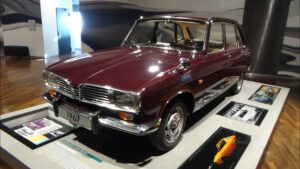
1959 Cadillac Coupe de Ville – Exterior and Interior – Motorworld Classics Bodensee 2022
Tailfins reached their apex in 1959. The Cadillac Coupe de Ville did not gradually evolve into an icon—it arrived fully formed, with vertical rear fins, twin bullet taillamps, and proportions that redefined the scale of American automotive design. It became a visual landmark of its era within months of its debut.
Technical Details:
The 1959 Cadillac Coupe de Ville was powered by Cadillac’s 390 cubic inch (6.4-liter) overhead valve V8, producing approximately 325 horsepower in standard configuration. The engine delivered substantial torque across a broad rev range, emphasizing smooth acceleration and effortless highway cruising.
Fuel delivery was via a four-barrel carburetor, and power was transmitted to the rear wheels through a four-speed Hydra-Matic automatic transmission, standard across the Coupe de Ville range. Manual transmissions were not offered, consistent with Cadillac’s luxury positioning.
The car utilized a body-on-frame construction, with independent front suspension using coil springs and a rear live axle supported by coil springs as well. Power steering and power-assisted brakes were standard equipment, ensuring manageable handling despite the car’s considerable length and weight.
Performance figures reflected the era’s priorities: acceleration was strong for a full-size luxury coupe, and sustained high-speed travel was stable and composed. The mechanical configuration favored isolation, quiet operation, and long-distance comfort.
- Manufacturer: Cadillac
- Model Name: Cadillac Coupe de Ville
- Year of Manufacturing: 1959
Design:
The 1959 Cadillac Coupe de Ville is widely recognized for its dramatic tailfins, which rose sharply from the rear quarter panels and framed dual bullet-style taillights. These fins were not incremental—they were architectural elements that defined the car’s identity.
At the front, a wide, intricate grille stretched nearly the full width of the body, flanked by quad headlamps integrated into sculpted fenders. Chrome detailing was extensive but structured, reinforcing horizontal lines and emphasizing width.
The Coupe de Ville’s proportions were expansive: long hood, extended rear deck, and low roofline. Compared with earlier Cadillacs, the 1959 model presented a sharper, more angular interpretation of late-1950s styling themes.
Inside, the cabin reflected Cadillac’s reputation for comfort and feature integration. Upholstery materials included premium fabrics and leather options, complemented by chrome accents and expansive dashboard surfaces. The instrument panel wrapped gently toward the driver, while broad bench seating accommodated multiple passengers comfortably.
The overall design balanced spectacle and coherence. While the fins dominated visual discussion, the car’s underlying proportions remained carefully managed.
Historical Significance:
The 1959 Cadillac Coupe de Ville occupies a central place in discussions of American automotive design. Introduced during a period of economic optimism and stylistic experimentation, it represented the peak expression of fin-era styling.
Sales volumes were strong, confirming that buyers responded positively to bold visual identity. The Coupe de Ville nameplate itself signified a trim level associated with comfort and prestige within Cadillac’s lineup, positioned below limited-production halo models but above base variants.
The 1959 redesign also influenced competitors, prompting other manufacturers to amplify rear-fin treatments and chrome detailing. However, none matched the scale and clarity of Cadillac’s execution that year.
By 1960 and beyond, Cadillac began moderating fin height, marking 1959 as a singular moment rather than the beginning of an ongoing escalation.
Quirks and Pop Culture:
The 1959 Coupe de Ville has become shorthand for late-1950s American style. It appears frequently in film, music videos, and visual art as a symbol of excess, optimism, and mid-century ambition.
Its tailfins are often cited as the most dramatic ever fitted to a production automobile. This reputation has ensured lasting visibility in classic car culture.
One notable characteristic is how well the design photographs from low angles, where the fins appear even more pronounced. This visual impact has reinforced the model’s iconic status in retrospective imagery.
Display and preservation:
The vehicle was exhibited at Motorworld Classics Bodensee in 2022. This event, held in Friedrichshafen, is a popular gathering for classic car enthusiasts in southern Germany, Austria, and Switzerland. The 2022 edition featured over 800 exhibitors spread across multiple halls and open-air spaces, offering a vibrant mix of vintage automobiles, motorcycles, boats, and aircraft. Visitors could explore restoration workshops, parts markets, and club presentations. A key highlight was the live vehicle auctions and dynamic driving demonstrations on the event grounds. The show reaffirmed its reputation as a hands-on celebration of classic mobility culture.
Conclusion:
The 1959 Cadillac Coupe de Ville represents a definitive statement in American automotive design. Mechanically refined and visually assertive, it balanced substantial V8 power with uncompromising styling ambition. While subsequent years would temper the extremes, the 1959 model remains a high-water mark of the fin era—instantly recognizable and historically significant.