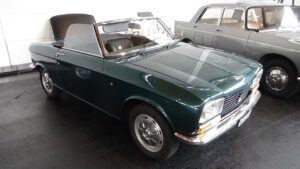
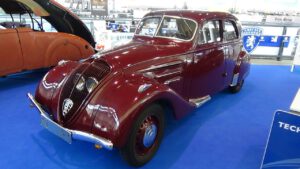
1959 AC Ace Roadster – Exterior and Interior – Retro Classics Stuttgart 2022
Before the Cobra name transformed AC’s international profile, there was the AC Ace. In 1959, this lightweight British roadster combined a tubular chassis with refined six-cylinder power and established the foundation for one of the most famous performance cars of the 1960s. The AC Ace Roadster represents a decisive chapter in postwar British sports car engineering.
Technical Details
The 1959 AC Ace Roadster was built around a lightweight tubular ladder-type chassis designed by John Tojeiro. The body was formed from hand-shaped aluminum panels mounted over this frame, contributing to a low kerb weight of roughly 750–800 kilograms, depending on specification. Suspension followed an advanced layout for its class: independent front suspension with transverse leaf spring and wishbones, and independent rear suspension using transverse leaf spring and trailing arms, a configuration that delivered balanced handling characteristics. Braking was provided by hydraulic drum brakes on all four wheels.
By 1959, most AC Ace models were powered by the 1,971 cc inline six-cylinder Bristol engine, itself derived from the prewar BMW 328 unit. In standard road trim, output was typically around 105–120 bhp, depending on carburetion and specification. The engine featured hemispherical combustion chambers and triple carburetors in many versions, allowing the Ace to reach top speeds in the region of 185–195 km/h (approximately 115–120 mph). Power was transmitted through a four-speed manual gearbox to the rear wheels. Earlier AC-engined variants had used AC’s own 2.0-litre straight-six, but by the late 1950s the Bristol-powered Ace had become the definitive specification for customers seeking performance. The combination of low mass, well-balanced chassis, and smooth six-cylinder power made the 1959 AC Ace Roadster competitive both on the road and in club-level motorsport.
- Manufacturer: AC Cars
- Model Name: AC Ace Roadster
- Year of Manufacturing: 1959
Design
The design of the AC Ace Roadster reflects mid-1950s British sports car aesthetics shaped by function rather than ornament. Its low bonnet line, gently curved front wings, and oval grille opening create a clean and purposeful face. The aluminum bodywork was crafted by hand, resulting in subtle variations between cars and a sense of individuality uncommon in larger-scale production vehicles.
The proportions are compact and well resolved: a long hood relative to the cockpit, minimal overhangs, and a short, tapering rear deck. The roadster configuration emphasizes openness, with a simple folding soft top and detachable side screens. Wire wheels were commonly fitted, reinforcing the Ace’s competition-oriented image. Inside, the cabin is restrained and driver-focused. A metal dashboard houses clearly arranged round instruments, while low-slung seating positions the driver close to the chassis. The emphasis is on lightness and mechanical clarity rather than luxury. The overall impression is of a car designed to be driven actively, with visual cues aligned closely to its engineering purpose.
Historical Significance
The AC Ace was introduced in 1953 and remained in production until 1963. Its origins lie in John Tojeiro’s sports racing chassis design, which AC Cars adapted for series production. The model quickly established itself as a capable and elegant British roadster, competing in a market that included contemporaries from MG, Triumph, and Jaguar. With Bristol power installed from 1956 onward, the Ace gained a more robust performance profile and became attractive to privateer racers.
The car achieved notable success in competition, including class victories at Le Mans and strong results in international sports car racing. By 1959, the Ace had matured into a well-developed platform with proven durability and handling. Its broader historical importance, however, extends beyond its own production run. In 1961, American racer and entrepreneur Carroll Shelby approached AC Cars with the idea of installing a V8 engine into the Ace chassis. This collaboration led directly to the development of the AC Cobra, fundamentally altering the company’s trajectory and leaving the Ace as the essential precursor to that transformation. The 1959 AC Ace Roadster therefore occupies a crucial position in the lineage that would define AC’s global reputation.
Quirks and Pop Culture
Unlike the later Cobra, the AC Ace did not achieve the same level of mass-media visibility, yet it developed a strong following among enthusiasts. Its Bristol engine connection linked it indirectly to BMW engineering heritage, a detail often noted by historians. The hand-built nature of the aluminum body means that no two Aces are entirely identical, a characteristic appreciated in the classic car community.
The Ace’s understated design and balanced performance also made it a favorite in historic racing circles. Surviving examples frequently appear in vintage motorsport events, where their combination of light weight and responsive handling remains competitive. Within British sports car culture, the Ace is often regarded as a connoisseur’s alternative to more widely recognized contemporaries, valued for engineering integrity rather than flamboyant styling.
Display and preservation:
The vehicle was exhibited at the Retro Classics Stuttgart in 2022. This car show is one of the major events on the classic car calendar in Germany. In 2022, it took place across five exhibition halls. Visitors can enjoy special showcases, hunt for rare parts and books, and buy cars—both private sellers and dealers offer a wide range of classic and youngtimer vehicles. In 2022, there was a noticeable increase in low-mileage youngtimers and classic cars.
Conclusion
The 1959 AC Ace Roadster stands as a technically refined and historically significant British sports car. Its tubular chassis, aluminum body, and Bristol six-cylinder engine created a lightweight, well-balanced machine capable of strong road and competition performance. In design, it combined clarity and proportion with hand-built craftsmanship. Historically, it provided the structural and conceptual foundation for the later AC Cobra, ensuring its lasting relevance. Today, the AC Ace Roadster remains a focused expression of postwar British engineering, positioned at the intersection of racing pedigree and understated elegance.