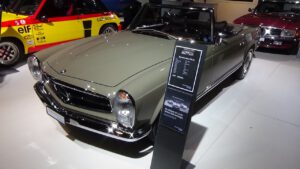
1958 Triumph TR3A – Exterior and Interior – Motorworld Classics Bodensee 2022
In 1958, the Triumph TR3A delivered direct, unfiltered sports car performance at an accessible price. With its rugged four-cylinder engine, optional disc brakes, and minimalist cockpit, it appealed strongly to export markets. The TR3A refined the earlier TR3 formula without softening its character.
Technical Details:
The 1958 Triumph TR3A was powered by a front-mounted inline four-cylinder engine with a displacement of 1,991 cc. This long-stroke unit produced approximately 100 horsepower in standard configuration, using twin SU carburetors. Power was transmitted to the rear wheels via a four-speed manual gearbox, with optional overdrive available on higher gears to improve long-distance cruising ability.
The TR3A retained a separate ladder-frame chassis rather than adopting monocoque construction. Independent front suspension with coil springs and a live rear axle supported by semi-elliptic leaf springs defined the car’s mechanical layout. One of its most notable technical features was the availability of front disc brakes, introduced on the earlier TR3 in 1956. At a time when many competitors still relied on drum brakes, this gave the TR3A a meaningful advantage in braking performance.
With a top speed of approximately 175 km/h (around 110 mph), the TR3A offered strong performance for its class. The combination of lightweight construction and robust engine torque made it particularly suitable for spirited driving and amateur competition use.
- Manufacturer: Triumph Motor Company
- Model Name: Triumph TR3A
- Year of Manufacturing: 1957–1962
Design:
Visually, the TR3A was an evolution of the earlier TR2 and TR3 models. It retained the upright, functional look typical of 1950s British roadsters but introduced several key refinements. The most obvious change compared to early TR3s was the full-width front grille, replacing the earlier narrow “small-mouth” design.
The body was constructed from steel panels mounted on the separate chassis, giving the car a purposeful, slightly angular appearance. Cutaway doors provided lower side access, enhancing the open-air driving experience. The folding soft top and removable side curtains emphasized the TR3A’s simplicity; weather protection was secondary to driving engagement.
Inside, the cockpit was straightforward and focused. A centrally mounted speedometer and tachometer dominated the dashboard, accompanied by smaller auxiliary gauges. The low seating position, large steering wheel, and minimal insulation reinforced the TR3A’s sporting intent rather than luxury aspirations.
Historical Significance:
The Triumph TR3A played a significant role in establishing Triumph as a serious competitor in the post-war sports car market. By the late 1950s, demand for affordable British roadsters was particularly strong in North America, and the TR3A became one of the brand’s most successful export models.
The “A” designation was not an official factory name at first but is now widely used to distinguish the revised version introduced in 1957. Improvements included exterior styling updates, strengthened chassis components, and incremental refinements in build quality.
Between 1957 and 1962, approximately 58,000 TR3A models were produced, making it one of Triumph’s most commercially successful early TR-series cars. The model also developed a strong presence in club racing and rally events, benefiting from its durable mechanicals and straightforward tuning potential.
Quirks and Pop Culture:
The Triumph TR3A gained a reputation for ruggedness and mechanical simplicity. Owners often praised its ability to be maintained and repaired with basic tools, a characteristic that contributed to its popularity among amateur enthusiasts.
Its direct steering and firm ride made it engaging but physically demanding compared to more refined grand tourers. The optional overdrive unit became a sought-after feature for drivers who used the car regularly on highways.
In classic car culture, the TR3A is often regarded as one of the last “traditional” British roadsters before later models introduced more comfort and modernized styling. Its exposed door handles, removable side curtains, and minimal weather sealing are part of its enduring charm.
Display and preservation:
The vehicle was exhibited at Motorworld Classics Bodensee in 2022. This event, held in Friedrichshafen, is a popular gathering for classic car enthusiasts in southern Germany, Austria, and Switzerland. The 2022 edition featured over 800 exhibitors spread across multiple halls and open-air spaces, offering a vibrant mix of vintage automobiles, motorcycles, boats, and aircraft. Visitors could explore restoration workshops, parts markets, and club presentations. A key highlight was the live vehicle auctions and dynamic driving demonstrations on the event grounds. The show reaffirmed its reputation as a hands-on celebration of classic mobility culture.
Conclusion:
The 1958 Triumph TR3A stands as a defining example of late-1950s British sports car engineering. With its 2.0-liter inline four-cylinder engine, separate chassis construction, front disc brakes, and straightforward interior, it offered performance and accessibility in equal measure. Produced in significant numbers and widely exported, the TR3A helped solidify Triumph’s reputation in the global sports car market. Today, it remains a respected and engaging classic that reflects a direct and uncompromising era of motoring.