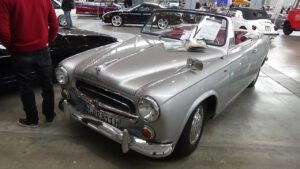
1958 Peugeot 403 Cabrio – Exterior and Interior – Retro Classics Stuttgart 2025
The open-top version of the Peugeot 403 was never a mass-market car, yet it became one of the most recognizable French cabriolets of the 1950s. Its restrained elegance, combined with Italian design input, set it apart from the more utilitarian sedan. Today, it is often remembered not only for its engineering but also for its subtle cultural presence.
Technical Details
The 1958 Peugeot 403 Cabriolet was based on the standard Peugeot 403 platform, introduced in 1955, and retained its robust, conventional engineering layout. It was powered by a front-mounted inline four-cylinder gasoline engine with a displacement of 1,468 cc. Output is typically cited at around 58 horsepower (SAE), delivered through a four-speed manual transmission driving the rear wheels. This configuration reflected Peugeot’s emphasis on durability and ease of maintenance rather than performance innovation.
The chassis relied on a unitary steel body construction, a modern solution for the time that improved rigidity compared to earlier body-on-frame designs. However, converting the closed sedan into a cabriolet required significant structural reinforcement, particularly in the sills and floor, to compensate for the loss of the fixed roof. Suspension consisted of independent front wheels with coil springs and a live rear axle supported by leaf springs, a setup designed for stability and comfort on varied road conditions. Hydraulic drum brakes were fitted on all four wheels, consistent with mid-1950s European standards. Top speed was generally reported at around 135 km/h, placing the car firmly in the touring category rather than the sporting segment.
- Manufacturer: Peugeot
- Model name: Peugeot 403 Cabriolet
- Year of manufacturing: 1956–1961 (example year: 1958)
Design
The design of the Peugeot 403 Cabriolet reflects a collaboration with the Italian design house Pininfarina, marking one of the earliest partnerships between a French manufacturer and an Italian stylist. While the sedan version of the Peugeot 403 already featured clean, modern lines, the cabriolet introduced a more refined and balanced silhouette.
The proportions were carefully adjusted for open-top driving. The absence of a fixed roof emphasized the horizontal lines of the body, while the gently sloping rear deck created a cohesive profile. Chrome detailing was used sparingly, outlining the grille and bumpers without overwhelming the overall composition. The front end retained the characteristic Peugeot grille, giving the car a recognizable identity despite its more exclusive body style.
Inside, the cabin was designed with understated elegance. Materials and finishes were modest but well executed, reflecting the car’s positioning as an upscale touring vehicle rather than a luxury product. The dashboard layout remained functional, with clear instrumentation and a straightforward control arrangement. With seating for four, the cabriolet maintained a degree of practicality unusual for open cars of the period.
Historical Significance
The Peugeot 403 range marked an important step for Peugeot in the post-war automotive landscape. It was the brand’s first model to surpass one million units in production, demonstrating its success as a reliable and widely accepted family car. Within this context, the cabriolet occupied a more specialized role.
Produced in relatively small numbers compared to the sedan, the Peugeot 403 Cabriolet was aimed at a more affluent clientele seeking open-air motoring without sacrificing everyday usability. Its design by Pininfarina also signaled Peugeot’s growing openness to international collaboration, a strategy that would continue in later decades and shape the brand’s visual identity.
The car’s engineering remained deliberately conservative, reflecting Peugeot’s focus on reliability and longevity. This approach contributed to the Peugeot 403’s strong reputation in export markets, particularly in Europe and Africa, where durability was a key selling point.
Quirks and Pop Culture
The Peugeot 403 Cabriolet gained lasting recognition through its association with the television series Columbo. Driven by the fictional detective Columbo, the car became an integral part of the character’s identity. Although the series began in the late 1960s, well after the car’s production period, this connection significantly boosted the model’s visibility among later generations.
Interestingly, the car chosen for the show was already somewhat outdated at the time, reinforcing the character’s understated and unpretentious personality. This cultural link has since become one of the defining aspects of the Peugeot 403 Cabriolet’s legacy, often overshadowing its technical qualities.
Another notable aspect is its rarity. Unlike the mass-produced sedan, the cabriolet required more complex manufacturing processes and was built in limited quantities, making surviving examples relatively scarce today.
Display and preservation
This car was filmed at the Retro Classics Stuttgart 2025. Across seven halls, thousands of historic vehicles illustrated more than a century of mobility, complemented by an expanded open-air classic parking area showcasing over 500 privately owned cars. Between 19th and 22nd February 2025, special exhibitions such as “Colors of Racing” and “JDM Tuning & Motorsport” highlighted both tradition and modern enthusiast culture. Live restoration workshops and a bustling parts market emphasized the craftsmanship and dedication required to maintain these machines, while auctions and active club participation ensured that preservation remains a living, evolving practice.
Conclusion
The 1958 Peugeot 403 Cabriolet combines solid engineering with refined design and a distinct cultural footprint. Technically, it followed a conservative but dependable formula, prioritizing durability and ease of use. Its design, shaped in collaboration with Pininfarina, gave it a balanced and elegant appearance that distinguished it from the standard sedan.
Historically, it represents Peugeot’s ability to extend a successful mass-market platform into a more exclusive segment. Its enduring association with Columbo further reinforces its place in automotive culture. Taken together, these elements make the Peugeot 403 Cabriolet a notable example of 1950s European open-top motoring—restrained, well-built, and quietly distinctive.