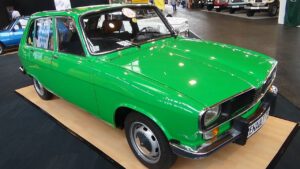
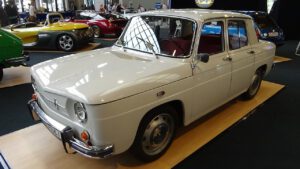
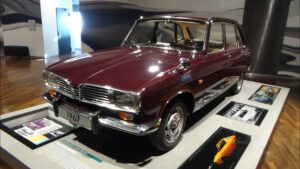
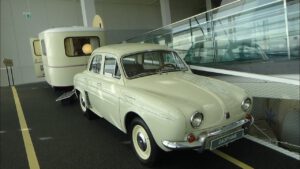
1957 Steyr-Fiat 1100 M – Exterior and Interior – Classic Expo Salzburg 2021
Austria’s roads were changing in the 1950s, and so were expectations of what a family car should deliver. The Steyr-Fiat 1100 M answered those expectations with modern construction and proven Italian engineering, assembled locally for a growing market. It stood at the intersection of domestic industry and international collaboration.
Technical Details:
The 1957 Steyr-Fiat 1100 M was based on the Italian Fiat 1100 (Tipo 103) platform, produced in Austria under license by Steyr-Daimler-Puch. It was powered by a 1,089 cc inline four-cylinder engine, featuring an overhead valve (OHV) configuration. Output in standard form was approximately 36–40 horsepower, depending on specification and market tuning.
Fuel delivery was handled by a single carburetor, and power was transmitted to the rear wheels through a four-speed manual gearbox, with synchromesh on the upper gears. The drivetrain followed a conventional front-engine, rear-wheel-drive layout, emphasizing serviceability and predictable handling characteristics.
The car employed a unitary (monocoque) body construction, contributing to structural rigidity and reduced weight compared with older body-on-frame designs. Independent front suspension with coil springs and wishbones provided improved ride quality, while the rear used a live axle supported by leaf springs. Braking was by hydraulic drum brakes on all four wheels, sufficient for the vehicle’s size and performance envelope.
Top speed was in the range of 120 km/h, aligning the 1100 M with contemporary small family sedans intended for urban and regional driving.
- Manufacturer: Steyr
- Model Name: Steyr-Fiat 1100 M
- Year of Manufacturing: 1957
Design:
The design of the Steyr-Fiat 1100 M reflected mid-1950s European compact-car sensibilities. The body featured clean, rounded forms without excessive ornamentation. Its proportions were balanced and upright, maximizing interior space within modest exterior dimensions.
The front fascia incorporated a restrained grille flanked by round headlamps, while chrome detailing was limited to essential accents. Large windows improved visibility and contributed to a light, practical cabin atmosphere.
Inside, the 1100 M emphasized clarity and durability. The dashboard layout was simple and functional, with clearly arranged gauges and straightforward controls. Seating accommodated four adults comfortably for short to medium journeys, reinforcing the car’s role as family transport.
Compared with prewar designs, the 1100 M felt distinctly modern: lower, more integrated, and structurally cohesive. Yet it avoided flamboyance, aligning with Austrian market expectations of reliability and efficiency.
Historical Significance:
The Steyr-Fiat 1100 M illustrates a significant industrial model of the postwar European automotive sector: licensed production. Rather than developing a fully independent small-car platform, Steyr-Daimler-Puch partnered with Fiat, adapting proven Italian engineering to Austrian manufacturing capabilities.
This arrangement allowed Steyr to offer a contemporary passenger car while supporting domestic employment and technical development. It also ensured that Austrian buyers had access to modern small-car technology without relying entirely on imports.
The 1100 series itself was commercially successful across Europe, and the Austrian-built variant contributed to local mobility during a period of economic growth. As road networks improved and private car ownership expanded, vehicles like the 1100 M played a crucial role in normalizing everyday automotive travel.
Quirks and Pop Culture:
The Steyr-Fiat 1100 M rarely appears in international popular culture, but it holds a quiet place in Austrian motoring history. Its dual identity—Italian design produced under Austrian manufacture—adds a layer of industrial nuance.
One notable aspect is how similar it appears to its Italian counterpart, yet subtle manufacturing details and badging distinguish it. This overlap occasionally leads to confusion among collectors, but also highlights the interconnected nature of European automotive production in the 1950s.
Today, surviving examples are appreciated for their authenticity and straightforward mechanical layout. Restoration is aided by parts compatibility with Fiat models of the era, reinforcing the practical foundation on which the car was built.
Display and preservation:
The vehicle was exhibited at the Classic Expo Salzburg in 2021. As one of Austria’s premier classic car events, the show has established itself as a central meeting point for collectors, restorers, and enthusiasts from across Central Europe. The 2021 edition took place at Messezentrum Salzburg and featured more than 250 exhibitors, along with a strong turnout of over 20,000 visitors. Attendees could explore a broad range of offerings—from historical vehicles and motorcycles to automobilia, spare parts, and literature.
Conclusion:
The 1957 Steyr-Fiat 1100 M represents a pragmatic approach to modernization. By combining Fiat engineering with Austrian production, Steyr-Daimler-Puch delivered a compact sedan suited to evolving mobility demands. Technically modest yet structurally modern, the 1100 M reflects a broader European shift toward accessible, efficient transportation. Its legacy lies not in innovation or spectacle, but in enabling ordinary drivers to participate in a new era of automotive independence.