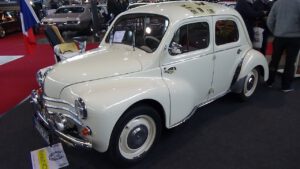
1957 Fiat 500N – Exterior and Interior – Retro Classics Stuttgart 2022
Rear engine. Two cylinders. 479 cubic centimeters. When the Fiat 500N was introduced in 1957, it represented a complete break from the Topolino formula it replaced. Smaller, lighter, and mechanically reimagined, the Nuova 500 was designed for a new phase of Italian mobility.
Technical Details:
The 1957 Fiat 500N (Nuova 500) was powered by a 479 cc air-cooled inline two-cylinder engine, mounted at the rear. Producing approximately 13 horsepower, the engine used an overhead valve configuration and was cooled by a fan-driven air system rather than liquid cooling. This simplified layout reduced weight and mechanical complexity.
Power was transmitted to the rear wheels through a four-speed manual gearbox, with synchromesh on the upper gears. The rear-engine, rear-wheel-drive configuration allowed for compact packaging and a flat front compartment that could be used for luggage.
The car employed a unitary (monocoque) body construction, marking a departure from the separate chassis of the Topolino. Independent front suspension with transverse leaf spring and rear independent suspension with coil springs contributed to basic ride compliance for a vehicle of its size.
Braking was handled by hydraulic drum brakes on all four wheels. With a top speed of approximately 85 km/h, the 500N was suited primarily to urban use and short regional travel.
- Manufacturer: Fiat
- Model Name: Fiat 500N (Nuova 500)
- Year of Manufacturing: 1957
Design:
The design of the 1957 Fiat 500N was radically compact. Shorter and narrower than the Topolino, it featured rounded contours and minimal overhangs. The front fascia was simple, with small circular headlamps and modest chrome accents.
One of the defining elements was its full-length folding fabric roof, extending from the windshield to the rear engine cover. This design reduced manufacturing complexity and added an open-air element without the need for a fully removable hardtop.
The rear placement of the engine allowed for a distinctive silhouette with a short front end and upright rear deck. Cooling vents were integrated into the rear bodywork to accommodate the air-cooled power unit.
Inside, the cabin was sparse but intelligently arranged. The dashboard consisted of a central instrument cluster with speedometer and basic indicators. Seating was compact but functional, and the rear bench was minimal. Despite its dimensions, the car was capable of carrying four passengers over short distances.
The design reflected a philosophy of minimalism—removing nonessential mass while preserving usability.
Historical Significance:
The 1957 Fiat 500N marked a strategic shift for Fiat. Unlike the Topolino, which evolved from prewar engineering, the Nuova 500 was conceived as a postwar urban microcar. It addressed rising demand for affordable personal transportation in densely populated cities.
Although initial sales were modest due to its limited power, the 500N laid the groundwork for subsequent, more powerful variants. Its rear-engine configuration and compact dimensions aligned with contemporary European microcar trends.
The Nuova 500 would go on to become one of the most recognizable small cars in automotive history, with production continuing in evolved forms for nearly two decades. The 1957 version represents the starting point of that lineage.
Quirks and Pop Culture:
The Fiat 500N quickly became associated with Italian urban life. Its size allowed it to navigate narrow streets and limited parking spaces with ease.
One notable quirk was its modest engine output. Early drivers sometimes found the initial 13 horsepower insufficient for hilly terrain, leading Fiat to introduce improved versions shortly after launch.
In popular culture, the Nuova 500 became emblematic of late-1950s and 1960s Italian optimism. Its rounded form and compact proportions made it visually distinctive and approachable.
Today, early 500N models are particularly valued for their historical significance as the first iteration of a design that would achieve global recognition.
Display and preservation:
The vehicle was exhibited at the Retro Classics Stuttgart in 2022. This car show is one of the major events on the classic car calendar in Germany. In 2022, it took place across five exhibition halls. Visitors can enjoy special showcases, hunt for rare parts and books, and buy cars—both private sellers and dealers offer a wide range of classic and youngtimer vehicles. In 2022, there was a noticeable increase in low-mileage youngtimers and classic cars.
Conclusion:
The 1957 Fiat 500N represented a fresh start for Fiat’s small-car strategy. With its rear-mounted two-cylinder engine, monocoque construction, and minimalist design, it redefined compact urban mobility. Though modest in power, it established a platform that would evolve into one of the most influential small cars of the 20th century.