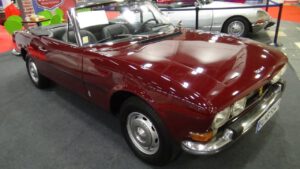
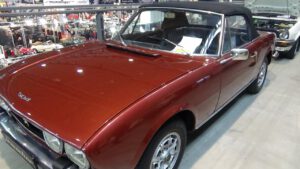
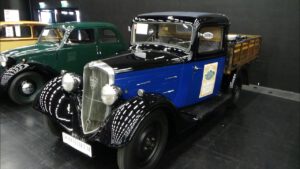
1957 Ferrari 500 TRC – Exterior and Interior – Auto Zürich Classic Car Show 2022
In 1957, Ferrari built a sports racing car that complied with new international regulations while retaining pure competition DNA. The Ferrari 500 TRC combined a four-cylinder racing engine with limited road equipment, making it eligible for both track use and road homologation. It became the final evolution of Ferrari’s four-cylinder Testa Rossa line.
Technical Details:
The 1957 Ferrari 500 TRC was powered by a front-mounted inline four-cylinder engine with a displacement of 1,985 cc. Designed by Aurelio Lampredi, this unit was part of Ferrari’s successful four-cylinder racing family. The engine featured dual overhead camshafts and two valves per cylinder. In TRC specification, output was approximately 180 horsepower at around 7,000 rpm, depending on tuning.
Fuel delivery was handled by Weber carburetors, typically twin-choke units, contributing to the engine’s high-revving character. Power was transmitted to the rear wheels via a four-speed manual gearbox. The drivetrain layout followed Ferrari’s established front-engine, rear-wheel-drive configuration for sports racing cars of the period.
The chassis was based on a tubular steel frame, designed for rigidity and low weight. Independent front suspension with wishbones and coil springs was combined with a live rear axle supported by semi-elliptic leaf springs. Hydraulic drum brakes were fitted at all four corners. The 500 TRC was capable of reaching top speeds in the region of 245 km/h, depending on gearing and aerodynamic setup.
- Manufacturer: Ferrari
- Model Name: Ferrari 500 TRC
- Year of Manufacturing: 1957
Design:
The Ferrari 500 TRC was bodied by Carrozzeria Scaglietti in aluminum. Its open two-seater configuration followed the barchetta format, emphasizing weight reduction and aerodynamic efficiency. The front featured a low, oval grille and faired-in headlights, while the long hood and short rear deck reflected classic mid-1950s sports racing proportions.
The “TR” designation stood for “Testa Rossa,” referring to the red-painted cam covers of the engine. The “C” suffix indicated “Corsa” but also signified compliance with Appendix C of the FIA regulations, which required certain road equipment for homologation in the Sports Car class. As a result, the 500 TRC was equipped with features such as a windshield of specified height and other elements necessary for competition eligibility.
The cockpit was minimalist and driver-focused, with exposed metal surfaces, simple instrumentation, and a large steering wheel. The design prioritized function and weight savings over comfort. Despite limited concessions to road legality, the overall aesthetic remained unmistakably that of a purpose-built racing machine.
Historical Significance:
The Ferrari 500 TRC occupies a specific place in Ferrari’s racing history. It was the final development of Ferrari’s four-cylinder sports racing cars, a line that had achieved significant success in the early to mid-1950s. The Lampredi-designed four-cylinder engines were known for their torque and simplicity, particularly in endurance racing.
By 1957, Ferrari was increasingly focusing on V12-powered sports racers, but the 500 TRC remained competitive in the 2.0-liter class. The introduction of new FIA regulations required sports cars to meet certain homologation standards, leading to the TRC’s revised specification compared with earlier 500 TR models.
Production was limited, with only 19 examples built. This low number reflects both its specialized racing purpose and Ferrari’s transition toward larger-displacement V12 competition cars. The 500 TRC represents the end of an era for Ferrari’s four-cylinder competition machines.
Quirks and Pop Culture:
Unlike later mid-engined Ferraris, the 500 TRC adhered to the front-engine layout typical of its time. Its four-cylinder configuration stands out in Ferrari history, as the brand is more commonly associated with V12 engines. Among collectors, the four-cylinder Ferraris are appreciated for their distinctive engine character and racing pedigree.
The red cam covers that gave rise to the “Testa Rossa” name became an enduring Ferrari signature, later associated with 12-cylinder sports racing cars and even road models decades afterward. The 500 TRC thus shares its name with some of the most celebrated Ferraris in motorsport history, despite its smaller displacement.
Today, surviving examples of the Ferrari 500 TRC are highly valued and frequently appear in historic racing events, including classic endurance competitions that celebrate 1950s sports cars.
Display and preservation:
The vehicle was exhibited at the Auto Zürich Classic Car Show in 2022. The 35th edition of Auto Zürich is Switzerland’s leading automotive trade fairs, traditionally hosting numerous world and Swiss premieres. Since 2019, Hall 6 has been exclusively dedicated to classic automobiles, providing a distinguished setting for historic vehicles, while the majority of the exhibition space remained focused on modern mobility solutions. The classic cars presented at Auto Zürich were of remarkably high quality. With approximately 60,000 visitors, Auto Zürich Classic was first introduced in 2019. In 2022, a special exhibition celebrated Ferrari’s 75th anniversary, showcasing more than a dozen Ferrari models.
Conclusion:
The 1957 Ferrari 500 TRC represents the final chapter of Ferrari’s four-cylinder sports racing development. Technically defined by its 2.0-liter Lampredi inline-four, tubular chassis, and lightweight Scaglietti body, it combined competition performance with compliance under new FIA regulations. Its design emphasized functional aerodynamics and driver focus, while its historical significance lies in bridging Ferrari’s early four-cylinder successes with its subsequent dominance in larger-displacement racing classes. Limited production and enduring motorsport relevance ensure the 500 TRC remains a key reference point in Ferrari’s mid-1950s competition history.