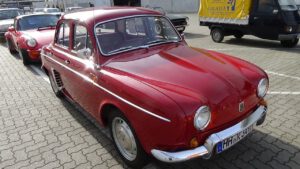
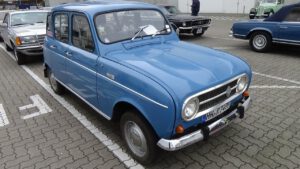
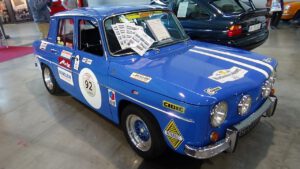
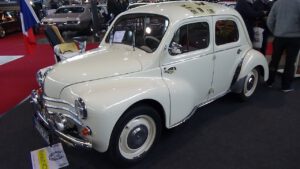
1957 Citroen 2 CV – Oldtimer-Meeting – Baden-Baden 2021
Few cars are surrounded by as many anecdotes as the Citroën 2 CV. Initially intended for rural use, the 2 CV unexpectedly found great success in cities, where its low running costs and surprising practicality were widely appreciated.
Technical Details:
By 1957, the Citroën 2 CV had already established itself as one of the most unconventional yet ingenious cars on European roads. It was powered by an air-cooled, front-mounted two-cylinder boxer engine driving the front wheels. Engine displacement varied during early production between 375 cc and 425 cc, later expanding up to 602 cc in subsequent evolutions. Output initially stood at just 9 horsepower at 3,500 rpm, enough to propel the earliest examples to about 65 km/h. Over the decades, power increased steadily, eventually reaching 29 horsepower at the end of the model’s production run, with a top speed of up to 115 km/h.
Technically, the 2 CV was defined by simplicity and resilience rather than outright performance. Independent suspension on all wheels, a box-section chassis, and a tall, lightweight steel body gave it an unmistakable driving character. It was famously difficult to tip over, although its extremely soft suspension caused the car to sway dramatically, earning comparisons to a boat in rough seas on ordinary country roads. Early versions even started by hand crank. While the Citroën 2 CV underwent numerous mechanical improvements over time—including repeated power increases and revised engines—it remained fundamentally unchanged in concept throughout its long career.
- Manufacturer: Citroën
- Model Name: Citroën 2 CV
- Year of Manufacturing: 1957
Design:
The design of the Citroën 2 CV followed function to an almost radical degree. Every visual element served a practical purpose, resulting in a shape that was initially met with skepticism and mockery. Its high body, narrow track, and simple steel panels reflected the vehicle’s utilitarian mission rather than aesthetic ambition. Early models featured a corrugated metal hood, which would later disappear in 1960 as production refinements progressed.
Available as a four-door cabrio-limousine and later as a three-door combi, the Citroën 2 CV offered remarkable interior space relative to its compact footprint. In 1971, the front bench seat was replaced by two individual seats, improving comfort while preserving the car’s minimalist spirit. Special versions added further character, including the Sahara variant, which famously used two engines—one driving the front axle and one the rear. Despite subtle updates over decades, the visual identity of the Citroën 2 CV remained instantly recognizable.
Historical Significance:
The Citroën 2 CV was the result of a long and difficult gestation period shaped by economic hardship and global conflict. After the brand’s larger models of the 1920s had pushed Citroën into financial trouble during the Great Depression, the company was taken over by Michelin in 1935. The new strategy centered on mobility for the broader population through the TPV project, short for Très Petite Voiture. The objective was clear: even the most modest rural households should be able to afford a Citroën.
The design brief famously stipulated that a farmer should be able to transport a basket of eggs across rough terrain without breaking a single one. Prototypes were built in 1939, but the Second World War halted development, and many early test vehicles were destroyed during the German occupation. The production model was finally unveiled in 1948, significantly refined from its earliest versions. Despite ridicule aimed at its extreme minimalism, demand quickly outpaced supply. Waiting times stretched up to six years, and by the time production ended in 1990, more than five million units had been sold worldwide.
Quirks and Pop Culture:
Few cars are surrounded by as many anecdotes as the Citroën 2 CV. Its development brief—to carry two farmers, their boots, a barrel of wine, and fragile eggs at 60 km/h over poor roads—has become legendary. Initially intended for rural use, the Citroën 2 CV unexpectedly found great success in cities, where its low running costs and surprising practicality were widely appreciated.
In France, affection for the car turned it into a cultural icon. Nicknamed the “Deudeuche,” it became part of the national heritage rather than merely a mode of transport. Beyond the standard sedan, more than 1.2 million van variants were sold, reinforcing its reputation as a hardworking, adaptable vehicle. Loved for its charm as much as its durability, the Citroën 2 CV transcended social classes and generations.
Display and preservation:
The vehicle was exhibited at the Oldtimer-Meeting Baden-Baden in 2021. This event, held annually in the spa town’s Kurpark and along the Kaiserallee, is one of Germany’s most picturesque classic car gatherings. In 2021, the 44th edition featured 300 vintage vehicles from 80 different brands, including rare models. The event embraced a 1970s theme, showcasing over 40 vehicles from that era. An innovative highlight was the “automobile fashion show,” where models presented current fashion trends while riding in open-top classic cars through the park. The event concluded with the traditional Concours d’élégance, awarding 120 prizes across 15 categories.
Conclusion:
The 1957 Citroën 2 CV stands as one of the purest expressions of functional automotive design ever produced. With modest power, revolutionary suspension, and unwavering practicality, it fulfilled its mission with remarkable consistency over more than four decades. Mocked at first yet cherished in the end, the Citroën 2 CV became far more than an economy car—it became a symbol of accessibility, resilience, and ingenious simplicity.