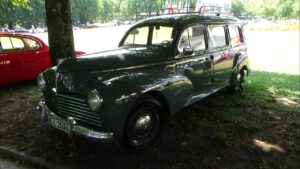
1956 Peugeot 203 Familiale – Oldtimer Meeting Baden-Baden 2015
The 1956 Peugeot 203 Familiale illustrates how post-war automotive design began to prioritize practicality without abandoning coherence in engineering. At a time when many European manufacturers were rebuilding, Peugeot focused on durability and versatility, and the Familiale version of the Peugeot 203 reflects that approach with particular clarity.
Technical Details
The Peugeot 203 Familiale was powered by a front-mounted inline four-cylinder engine with a displacement of 1,290 cc. This unit produced approximately 42 horsepower and was paired with a four-speed manual gearbox, with the fourth gear functioning as an overdrive in typical Peugeot fashion of the period. Power was transmitted to the rear wheels. The car featured a monocoque steel body, a relatively advanced construction method in the late 1940s that contributed to structural rigidity and reduced weight. The front suspension was independent, while the rear used a rigid axle with coil springs. Hydraulic drum brakes were fitted on all four wheels. Known for its reliability, the drivetrain was designed for long service intervals and consistent performance rather than outright speed.
- Manufacturer: Peugeot
- Model name: Peugeot 203 Familiale
- Year of manufacturing: 1956
Design
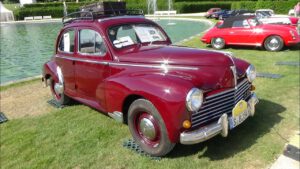
The design of the Peugeot 203 Familiale retained the rounded, flowing lines characteristic of the Peugeot 203 range but adapted them to a more utilitarian purpose. The extended roofline and elongated rear section allowed for increased interior space, distinguishing it clearly from the standard sedan. The front end featured Peugeot’s signature grille and integrated headlights, giving the car a cohesive and recognizable identity.
Large side windows enhanced visibility and contributed to a bright interior, while the overall proportions emphasized functionality. The rear section was carefully shaped to accommodate additional seating capacity, often allowing for up to seven occupants in a compact footprint. Inside, the layout was simple and practical, with durable materials and a focus on usability, reflecting the car’s role as a family-oriented vehicle.
Historical Significance
The Peugeot 203 was introduced in 1948 as the brand’s first entirely new model after the Second World War, and it played a central role in re-establishing Peugeot in the European market. Built on a modern monocoque platform, the Peugeot 203 marked a technological and strategic shift toward more integrated, mass-produced vehicles.
The Familiale variant expanded the model’s appeal by addressing the growing demand for multi-purpose vehicles in post-war Europe. As economies recovered and mobility needs evolved, cars like the Peugeot 203 Familiale offered a practical solution for larger families and commercial users alike. By the mid-1950s, Peugeot had refined the model through incremental updates, ensuring its competitiveness without major redesigns.
Production of the Peugeot 203 exceeded 600,000 units across all variants, underlining its commercial success and importance to Peugeot’s recovery and long-term positioning.
Quirks and Pop Culture
The Peugeot 203 developed a reputation for robustness that extended far beyond France. It was widely used in long-distance travel and even in endurance events, where its reliability often outweighed its modest performance. Owners frequently noted the car’s ability to cover large distances with minimal mechanical issues, a trait that became part of its identity.
While the Familiale version did not achieve the same level of pop culture recognition as some later Peugeot models, it remains closely associated with everyday life in post-war Europe. Its role as a practical, multi-seat vehicle made it a familiar presence on both urban streets and rural roads, embedding it in the social fabric of the time.
Display and preservation
This car was displayed at the International Oldtimer-Meeting Baden-Baden 2015. Set against the elegant backdrop of the Kurpark, the show transformed the spa town into a refined celebration of automotive heritage. From July 10 to 12, around 360 classic vehicles were carefully presented in an open-air setting that emphasized both preservation and atmosphere. Honored guest Rolls-Royce marked its 111th anniversary with an exceptional display of 111 luxury automobiles, creating a living exhibition of craftsmanship and history. With approximately 20,000 visitors, the event blended elegance, authenticity, and a deep respect for classic motoring culture.
Conclusion
The 1956 Peugeot 203 Familiale represents a balanced approach to post-war automotive design, combining reliable engineering with practical versatility. Its modest but durable engine, monocoque construction, and adaptable interior layout made it well suited to the evolving needs of families and businesses. As part of the broader Peugeot 203 range, it contributed significantly to Peugeot’s re-establishment as a major European manufacturer. Today, it stands as a clear example of how thoughtful design and engineering can address everyday mobility without unnecessary complexity.