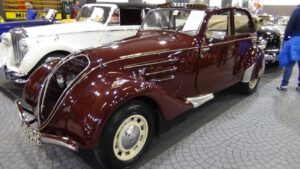
1956 Oldsmobile 88 – Exterior and Interior – Retro Classics Stuttgart 2022
By 1956, the Oldsmobile 88 had already built a reputation for combining V8 performance with mainstream accessibility. The 1956 model refined that formula with updated styling, higher output from the Rocket V8, and improved comfort features. It stood at the intersection of performance culture and mid-1950s American optimism.
Technical Details:
The 1956 Oldsmobile 88 was powered by Oldsmobile’s well-known Rocket V8 engine. For this model year, the engine displaced 324 cubic inches (5.3 liters). Depending on carburetion and specification, output ranged from approximately 230 horsepower in standard form to higher figures in performance-oriented versions equipped with four-barrel carburetors.
The engine featured overhead valves, a high-compression design typical of the era, and hydraulic valve lifters. Power was delivered to the rear wheels through either a three-speed manual transmission or Oldsmobile’s Hydra-Matic automatic transmission, a four-speed unit that had already become a defining feature of General Motors engineering.
The chassis followed a body-on-frame construction with independent front suspension and a live rear axle supported by coil springs. Power steering and power brakes were available options, reflecting the growing emphasis on driver comfort. With its V8 engine and robust drivetrain, the 1956 Oldsmobile 88 could achieve top speeds well above 170 km/h (over 100 mph), reinforcing its reputation as one of the quicker full-size American cars of the period.
- Manufacturer: Oldsmobile (Division of General Motors)
- Model Name: Oldsmobile 88
- Year of Manufacturing: 1956
Design:
The 1956 Oldsmobile 88 embodied the styling trends of mid-1950s America. Its exterior featured pronounced tailfins, a wide chrome grille, and sweeping side trim that emphasized length and motion. The body lines were broader and more sculpted than earlier postwar models, reflecting the influence of jet-age aesthetics.
The car was available in several body styles, including two-door and four-door sedans, hardtops (such as the Holiday Coupe), and convertibles. The Holiday hardtop, with its pillarless side profile, was particularly emblematic of the era’s emphasis on open, flowing design.
Chrome accents were used generously but integrated into cohesive patterns rather than applied indiscriminately. The rear design highlighted modest yet distinctive fins and vertically oriented tail lamps. Inside, the Oldsmobile 88 offered a spacious cabin with a wide bench seat configuration and a sweeping dashboard. Instrumentation was clearly arranged, and two-tone color schemes were common, reinforcing the car’s contemporary appeal.
Historical Significance:
The Oldsmobile 88 had gained prominence as early as 1949, when its combination of a lightweight body and Rocket V8 engine contributed to strong performance, including success in early stock car racing. By 1956, the 88 was firmly established as one of Oldsmobile’s core models, positioned between entry-level affordability and upper-tier luxury within General Motors’ hierarchy.
The 1956 model year marked a period of steady refinement rather than radical change. Increasing horsepower reflected the ongoing horsepower race among American manufacturers during the decade. The availability of automatic transmissions and power-assisted features demonstrated the rapid normalization of technological convenience in mainstream vehicles.
In the broader context of American automotive history, the Oldsmobile 88 represents the era when V8 power became standard in mid-priced cars. It helped define the performance-oriented family sedan long before the muscle car era formally emerged in the 1960s.
Quirks and Pop Culture:
The Oldsmobile 88 occupies a notable place in American pop culture. Earlier versions of the model were referenced in the 1950 rhythm-and-blues song “Rocket 88,” often cited as one of the first rock and roll recordings. While the 1956 model was not specifically referenced, the association between the “88” name and V8 performance remained strong.
Throughout the 1950s, Oldsmobile advertising emphasized the Rocket engine, turning it into a recognizable brand identity element. The combination of performance and accessibility appealed to buyers seeking more excitement than a standard family car provided.
Today, the 1956 Oldsmobile 88 is remembered as a representative example of mid-decade American design and engineering, combining chrome-accented styling with substantial V8 performance.
Display and preservation:
The vehicle was exhibited at the Retro Classics Stuttgart in 2022. This car show is one of the major events on the classic car calendar in Germany. In 2022, it took place across five exhibition halls. Visitors can enjoy special showcases, hunt for rare parts and books, and buy cars—both private sellers and dealers offer a wide range of classic and youngtimer vehicles. In 2022, there was a noticeable increase in low-mileage youngtimers and classic cars.
Conclusion:
The 1956 Oldsmobile 88 illustrates how American manufacturers balanced power, style, and comfort during the height of the 1950s automotive boom. Technically defined by its 324 cubic inch Rocket V8 and optional Hydra-Matic transmission, it delivered strong performance in a full-size package. Its design reflected jet-age influences, with tailfins, chrome detailing, and a spacious interior. Historically, the model stands as part of the evolution of the V8-powered American sedan, reinforcing Oldsmobile’s position as a performance-oriented division within General Motors.