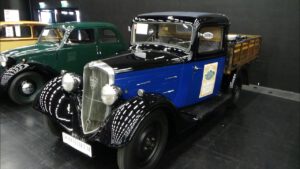
1956 – 1960 Lamborghini DL 30C – Exterior and Interior – Motorworld Classics Bodensee 2022
Long before Lamborghini became synonymous with mid-engined supercars, the company built machines designed for fields rather than highways. The Lamborghini DL 30 C, produced between 1956 and 1960, represents a decisive phase in Ferruccio Lamborghini’s rise as an industrial manufacturer. It was a robust agricultural tractor that helped finance one of Italy’s most famous automotive brands.
Technical Details:
The Lamborghini DL 30 C was a wheeled agricultural tractor developed by Lamborghini Trattori, the company founded by Ferruccio Lamborghini in 1948. The “DL” designation stood for “Diesel Lamborghini,” while “30” indicated the approximate horsepower class. The DL 30 C was equipped with a two-cylinder diesel engine of approximately 3.0 liters displacement, delivering around 30 PS. As was typical for agricultural machinery of the era, the engine emphasized torque and fuel efficiency rather than high rotational speed.
The tractor featured water cooling and direct injection, reflecting Lamborghini Trattori’s focus on reliable diesel technology. Power was transmitted through a manual gearbox offering multiple forward and reverse gears, enabling flexibility in different agricultural tasks. The DL 30 C employed rear-wheel drive with large-diameter rear wheels for traction and smaller front wheels for steering, in line with conventional mid-1950s tractor architecture.
The chassis was of robust ladder-frame construction, designed to withstand heavy field work. Mechanical drum brakes were fitted, and the rear power take-off (PTO) allowed the operation of implements such as ploughs, mowers, and harvest equipment. The DL 30 C was engineered for durability and ease of maintenance, key requirements for post-war Italian agriculture.
- Manufacturer: Lamborghini Trattori
- Model Name: Lamborghini DL 30C
- Year of Manufacturing: 1956–1960
Design:
The design of the Lamborghini DL 30 C was strictly functional, reflecting its agricultural purpose. The tractor featured a compact, upright layout with exposed mechanical components and a simple steel hood covering the engine. The front grille often displayed the Lamborghini name in bold lettering, long before the charging bull became associated with sports cars.
Large rear wheels dominated the visual profile, providing the necessary grip for ploughing and towing. The driver’s position was open, with a basic metal seat and minimal instrumentation—typically limited to essential gauges for engine monitoring. Controls were mechanically direct and clearly arranged, prioritizing operability over comfort.
Despite its utilitarian focus, the DL 30 C displayed a certain industrial clarity typical of 1950s machinery. Its proportions were balanced for stability, and its straightforward construction made it well suited to restoration decades later. The tractor’s visual identity clearly predates Lamborghini’s automotive design language but represents the brand’s earliest industrial aesthetic.
Historical Significance:
The Lamborghini DL 30 C belongs to a crucial chapter in Italian industrial history. After the Second World War, Ferruccio Lamborghini recognized the demand for agricultural mechanization in a rebuilding Italy. By converting surplus military equipment into tractors and later developing proprietary diesel engines, Lamborghini Trattori grew rapidly.
During the 1950s, the company expanded its product range and established a strong domestic presence. Models such as the DL 30 C contributed directly to this success. Revenue from tractor production enabled Ferruccio Lamborghini to diversify his business interests, eventually leading to the foundation of Automobili Lamborghini in 1963.
Thus, the DL 30 C can be viewed as part of the financial and industrial groundwork for Lamborghini’s later entry into high-performance sports cars. Without the commercial stability created by agricultural machinery, the development of models such as the 350 GT would likely not have been possible. The DL 30 C therefore occupies an indirect but meaningful place in Lamborghini’s broader corporate history.
Quirks and Pop Culture:
Unlike later Lamborghini automobiles, the DL 30 C is not associated with racing circuits or film appearances. Its cultural footprint lies primarily within agricultural heritage and classic machinery circles. Enthusiasts of historic tractors often emphasize the irony that one of the world’s most famous supercar manufacturers began with diesel-powered farm equipment.
Among collectors, early Lamborghini tractors are valued for their mechanical honesty and historical importance. The bold use of the Lamborghini name on utilitarian machinery creates a striking contrast when viewed alongside modern Lamborghini road cars. This juxtaposition frequently appears in exhibitions that showcase both tractors and sports cars to illustrate the brand’s evolution.
Display and preservation:
The vehicle was exhibited at Motorworld Classics Bodensee in 2022. This event, held in Friedrichshafen, is a popular gathering for classic car enthusiasts in southern Germany, Austria, and Switzerland. The 2022 edition featured over 800 exhibitors spread across multiple halls and open-air spaces, offering a vibrant mix of vintage automobiles, motorcycles, boats, and aircraft. Visitors could explore restoration workshops, parts markets, and club presentations. A key highlight was the live vehicle auctions and dynamic driving demonstrations on the event grounds. The show reaffirmed its reputation as a hands-on celebration of classic mobility culture.
Conclusion:
The 1956–1960 Lamborghini DL 30 C represents a foundational stage in the Lamborghini story. Technically straightforward yet robust, it combined a two-cylinder diesel engine, manual transmission, and durable chassis in a practical agricultural package. Its design reflected pure functionality, while its historical importance lies in the economic success that allowed Ferruccio Lamborghini to later enter the automotive sector. Though far removed from the supercars that would follow, the DL 30 C remains an essential part of Lamborghini’s industrial heritage.