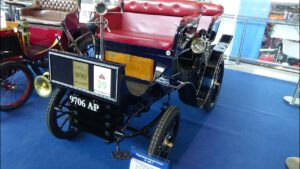
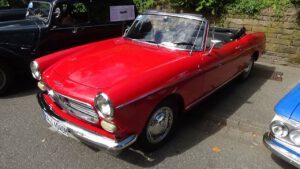
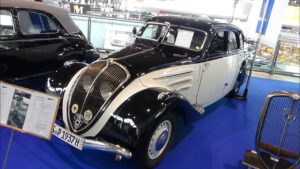
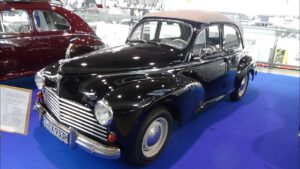
1955 Volkswagen Käfer Cabrio – Exterior and Interior – Retro Classics Stuttgart 2022
A defining cultural moment in the Volkswagen Käfer’s history occurred on 5 August 1955, when Volkswagen celebrated the production of its one-millionth vehicle. More than 100,000 guests gathered in Wolfsburg for an elaborate celebration that underscored the car’s growing global significance. The milestone vehicle was a specially equipped Export model, uniquely finished in gold paint—the first time such a color had been used by Volkswagen.
Technical Details:
By 1955, the Volkswagen Käfer had entered a phase of technical maturity shaped by the major overhaul introduced in 1953. Although the visual and mechanical changes in 1954 and 1955 were subtle, their cumulative effect was significant. Most importantly, both the limousine and the Cabrio benefited from the more powerful 30 PS engine introduced at the end of 1953. This engine delivered noticeably improved performance and greater elasticity across all gears. The Volkswagen Beetle Cabriolet could now be driven more briskly and effortlessly at lower engine speeds, a clear advantage in everyday use. Remarkably, this improvement in driving performance was achieved without any increase in fuel consumption.
The power increase of around 20 percent was the result of careful engineering rather than radical redesign. Volkswagen refined the gas channels, intake system, ignition, compression ratio, and carburetor settings, all without requiring premium fuel. Since 1953, all Volkswagen engines had been equipped with oil-bath air filters, a solution otherwise found mainly in expensive sports cars of the time. These filters ensured excellent air purification, resistance to flame backfires, and long engine life. Improved cooling and lubrication further enhanced reliability, allowing Volkswagen to dispense with traditional break-in regulations. From the first day, the Volkswagen Beetle could be driven within clearly defined and expanded speed ranges for each gear, up to top speed in fourth gear.
Safety and chassis improvements also defined this era. Softer, better-coordinated front and rear suspension settings increased wheel travel, supported by an increase in front axle torsion bars from six to eight. Visibility was improved through a windshield designed with clear-view zones to maintain driver vision even if damaged. Windshield wiper coverage was expanded by 12 percent, wiping frequency increased to 50 strokes per minute, and an automatic resting position was added. Additional safety measures included a rounded interior mirror to reduce injury risk and a securely strapped battery mounted beneath the rear seat.
- Manufacturer: Volkswagen
- Model name: Volkswagen Beetle Cabriolet (Volkswagen Käfer Cabrio)
- Year of manufacturing: 1955
Design:
In design terms, the 1955 Volkswagen Käfer retained its instantly recognizable silhouette while receiving carefully judged refinements. One of the most noticeable updates of the model year was the introduction of larger, higher-mounted single-chamber taillights. Twin exhaust outlets became a visual hallmark, with chrome or black finishes depending on the specific model variant. The rear seat was repositioned further back, subtly improving passenger comfort and contributing to increased luggage space.
Practicality was enhanced through a redesigned fuel tank, which expanded the front trunk capacity to 85 liters. Combined with the repositioned rear seat, rear luggage space grew to 130 liters. From August 1955, robust ram-protection bumpers—initially developed for the U.S. market—were also available in Germany, giving the Käfer a more substantial appearance.
Inside, the Volkswagen Käfer reflected Volkswagen’s focus on usability and restraint. Broader seats improved comfort, particularly in the Export models, which featured adjustable seatbacks. The curved gear lever improved ergonomics, while details such as sun visors, a passenger grab handle, rear arm straps, and newly upholstered seats enhanced everyday comfort. Aluminum trim elements along the hood, beltline, running boards, window surrounds, and horn grilles subtly elevated the exterior without compromising the car’s functional aesthetic.
Historical Significance:
By 1955, the Volkswagen Käfer had already become a cornerstone of postwar mobility. Its combination of simplicity, reliability, and low operating costs made it ideally suited to the economic realities of postwar Europe. The Volkswagen Käfer was no longer just a new car—it was a proven one. Continuous refinement rather than annual redesign ensured that customers trusted the product and valued dependability over fashion.
The Volkswagen Käfer’s development philosophy proved extraordinarily successful. Introduced into series production in 1948, it evolved steadily while remaining fundamentally unchanged. This approach laid the groundwork for the Beetle’s later status as the most successful car in automotive history. The 1955 model year stands as a clear example of Volkswagen’s confidence in its product and its belief in incremental progress.
Quirks and Pop Culture:
A defining cultural moment in the Volkswagen Käfer’s history occurred on 5 August 1955, when Volkswagen celebrated the production of its one-millionth vehicle. More than 100,000 guests gathered in Wolfsburg for an elaborate celebration that underscored the car’s growing global significance. The milestone vehicle was a specially equipped Export model, uniquely finished in gold paint—the first time such a color had been used by Volkswagen.
This ceremonial Volkswagen Käfer featured light-colored rubber components, an interior trimmed in red Jacquard-patterned brocade woven in France, and a type plate made of gold. Its chrome elements were adorned with cut glass crystals from Idar-Oberstein, creating an appearance of exclusivity unmatched in Volkswagen history. Presented to great applause, the car was later placed into the company’s collection for a future Volkswagen museum, symbolizing both industrial achievement and cultural pride.
Display and preservation:
The vehicle was exhibited at the Retro Classics Stuttgart in 2022. This car show is one of the major events on the classic car calendar in Germany. In 2022, it took place across five exhibition halls. Visitors can enjoy special showcases, hunt for rare parts and books, and buy cars—both private sellers and dealers offer a wide range of classic and youngtimer vehicles. In 2022, there was a noticeable increase in low-mileage youngtimers and classic cars.
Conclusion:
The 1955 Volkswagen Beetle Cabriolet (in German: Volkswagen Käfer Cabrio) represents a pivotal moment in the model’s evolution: technically mature, subtly refined, and culturally ascendant. Improved performance, thoughtful safety enhancements, and increased practicality were delivered without compromising the car’s core values. Combined with the symbolic milestone of the one-millionth Volkswagen, the 1955 Käfer stands as a testament to how careful engineering and consistency helped create one of the most enduring icons in automotive history.