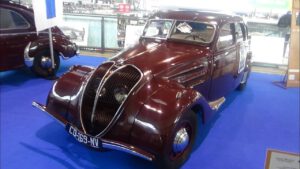
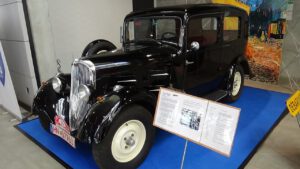
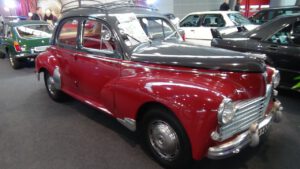
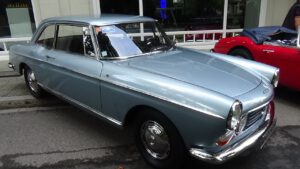
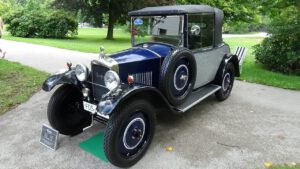
1955 Peugeot 203 C – Retro Classics Stuttgart 2019
The Peugeot 203 had already established itself as a dependable post-war car, but by 1955 the model had reached a mature and well-developed stage. The 203 C represented this phase clearly, combining incremental technical improvements with a design that had become familiar across European roads. It was not a radical car, yet it reflected Peugeot’s methodical approach to engineering and long-term product evolution.
Technical Details
The 1955 Peugeot 203 C was powered by a front-mounted inline four-cylinder engine with a displacement of 1,290 cc. This engine featured hemispherical combustion chambers, an advanced solution for a mass-produced car of its class, contributing to efficient fuel combustion and smooth operation. Output was approximately 45 horsepower, allowing for a top speed in the range of 115 km/h. Power was transmitted to the rear wheels via a four-speed manual gearbox, with the fourth gear acting as an overdrive, supporting more relaxed cruising at higher speeds.
The car used a unitary body construction, a relatively modern approach at the time, improving rigidity while reducing weight compared to traditional body-on-frame designs. Suspension consisted of independent front wheels with coil springs and a rear live axle supported by leaf springs. Braking was handled by drum brakes on all four wheels. The technical layout prioritized durability and ease of maintenance, characteristics that contributed to the model’s strong reputation in varied driving conditions.
- Manufacturer: Peugeot
- Model name: Peugeot 203 C
- Year of manufacturing: 1955
Design
The design of the Peugeot 203 C reflects the streamlined, ponton-influenced styling that became widespread in the early 1950s. Its body was smooth and rounded, with integrated fenders that created a cohesive, modern appearance compared to pre-war cars. The front end was defined by a prominent vertical grille, flanked by rounded headlights that blended into the bodywork. The overall shape was slightly bulbous, yet well balanced, giving the car a recognizable and approachable character.
Chrome detailing was used sparingly, primarily around the grille and bumpers, reinforcing a sense of understated quality rather than excess. The roofline was gently curved, contributing to aerodynamic efficiency while maintaining adequate interior space. Inside, the cabin was functional and clearly arranged, with a focus on practicality. Materials were durable, and the layout emphasized ease of use rather than decorative elements. The design as a whole aligned with Peugeot’s philosophy of producing reliable and accessible cars without unnecessary complexity.
Historical Significance
Introduced in 1948, the Peugeot 203 was the brand’s first entirely new model after the Second World War and played a crucial role in re-establishing the company’s position in the automotive market. By 1955, the model had been refined through continuous improvements, culminating in versions such as the 203 C. Production of the 203 exceeded 600,000 units, making it Peugeot’s first mass-produced success in the post-war era.
The 203 also marked several technical and strategic milestones for Peugeot. It was the company’s first car with a monocoque body and one of the early European models to adopt hemispherical combustion chambers in a production engine. These features demonstrated Peugeot’s focus on engineering efficiency rather than stylistic experimentation. The car’s reliability made it particularly successful not only in Europe but also in export markets, where durability under difficult conditions was essential.
Quirks and Pop Culture
The Peugeot 203 became closely associated with everyday life in post-war France, often seen as a family car or used for professional purposes. Its reputation for robustness meant it was widely employed as a taxi and for long-distance travel, particularly in regions with less developed infrastructure. This practical image shaped its cultural perception: the 203 was not glamorous, but dependable and widely trusted.
One notable aspect of the 203 is its long production run with relatively few visual changes, which can make it difficult to distinguish early and late models at a glance. Enthusiasts often focus on subtle details such as trim variations or interior updates to identify specific versions like the 203 C. This continuity reflects Peugeot’s strategy of refining an existing design rather than replacing it frequently.
Display and preservation
The vehicle was exhibited at Retro Classics Stuttgart in 2019. Spread across nine exhibition halls as well as the outdoor and entrance areas, the 19th edition welcomed more than 90,000 visitors and presented around 4,000 vehicles. Unlike earlier years, the organizers did not focus on a central special exhibition, placing even greater emphasis on the market itself. Around 1,700 of the cars on display were offered for private or trade sale, underlining the event’s strong reputation as a meeting point not only for enthusiasts, but also for collectors and buyers.
Conclusion
The 1955 Peugeot 203 C represents the mature phase of a model that was central to Peugeot’s post-war recovery. With its efficient four-cylinder engine, monocoque construction, and balanced design, it combined technical solidity with everyday usability. Its historical importance lies not in innovation alone, but in consistency: the 203 established Peugeot as a manufacturer capable of producing reliable, modern cars in large numbers. Today, it remains a clear example of how careful engineering and gradual development can create lasting impact.